
Decoding Emotions: The Articulatory Mechanics of Mandarin Speech in Smart Campus Environments
SPECIAL SECTION ON NOVEL LEARNING APPLICATIONS AND SERVICES FOR SMART CAMPUS
This study investigates the articulatory and acoustic characteristics of Mandarin disyllabic words under various emotional states (Anger, Happiness, Sadness, Neutral). By utilizing Electromagnetic Articulography (EMA), the authors collected synchronous physiological and acoustic data to analyze how emotional arousal influences the kinematics of the tongue and lips.
TL;DR
Researchers have moved beyond simple "sound" analysis to look at the "physics" of speech. By tracking the microscopic movements of the tongue and lips using electromagnetic sensors, this study reveals how emotions like anger and sadness fundamentally change the way we physically articulate Mandarin words. The findings suggest that adding physical motion data to acoustic features can significantly boost the accuracy of emotional AI.
The Missing Dimension: Why Acoustics Aren't Enough
For decades, emotional speech recognition has focused on Acoustical features: pitch (fundamental frequency), energy, and duration. However, these are merely the side effects of a physical process. The actual source of speech—the vocal tract and articulators—remains a "black box" in most AI models.
The challenge is particularly acute in Mandarin, a tonal language where emotional nuances are often buried within syllable transitions rather than just isolated vowels. Prior work has been limited by the difficulty of capturing natural speech movement without invasive X-rays or restrictive MRI environments.
Methodology: High-Precision Kinematic Tracking
To bridge this gap, the authors utilized Electromagnetic Articulography (EMA). By placing 24 tiny sensors on the tongue tip, body, root, and lip corners, they captured 3D movement data at 250Hz while subjects spoke common Mandarin phrases like "Mama" and "Nihao."
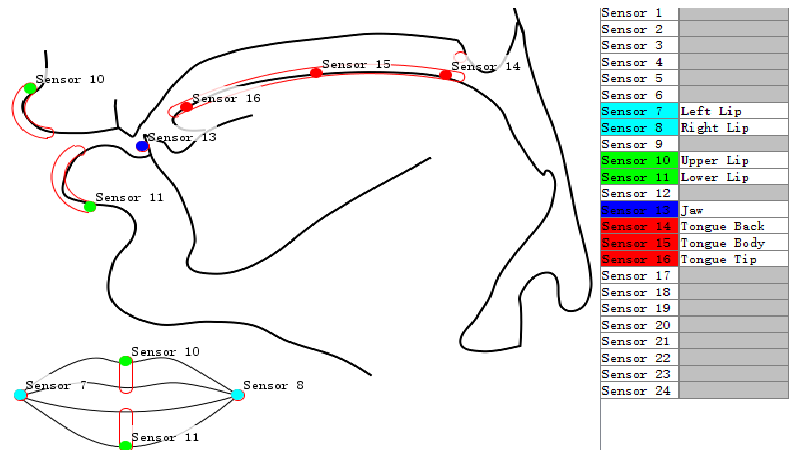 Figure 1: High-precision sensor placement used to track the physiological dynamics of emotional speech.
The ANOVA Deep Dive
The team applied one-way ANOVA (Analysis of Variance) to determine if the "emotional state" was a statistically significant factor in how fast or how far a person's tongue moved. They discovered a crucial distinction: Velocity matters more than Position. While the physical "target" position of a word might remain similar, the speed at which we reach that target changes drastically with our mood.
Key Insights: How Emotions Move Us
- The "Anger" Signature: Anger is the most "explosive" emotion. It produces the largest motion ranges for the tongue and lips. Interestingly, the tongue position for anger is the most forward-leaning, while the vertical motion velocity is at its peak.
- The "Sadness" Slump: In contrast, sadness results in the slowest articulation velocities and a "higher" overall tongue position, indicating a more constricted but less dynamic vocal tract.
- The Power of Fusion: By combining these physical "kinematic" features with traditional audio features, the researchers saw a marked improvement in machine classification.
 Figure 2: Visualizing the differences in tongue tip trajectories across different emotional states.
Experimental Results
The study proved that "disyllabic words" (two-syllable phrases) carry more emotional weight than single vowels. Specifically, the transitions between tones in Mandarin provide a rich landscape for sensing emotion.
| Feature Type | Neutral Accuracy | Anger Accuracy | Sadness Accuracy |
|---|---|---|---|
| Acoustic Only | 53.6% | 62.0% | 65.3% |
| Articulatory Only | 30.9% | 62.8% | 52.0% |
| Combined (Fusion) | 66.7% | 64.3% | 67.2% |
As shown in the table above (derived from the paper's findings), the Acoustic-Articulatory Fusion consistently outperforms individual modalities.
Critical Analysis & Future Outlook
While the study provides a robust framework for understanding the "how" of emotional speech, it faces a practical bottleneck: we cannot yet put EMA sensors on every student or user in a "Smart Campus."
The True Value: This research paves the way for Articulatory-Acoustic Inversion. If we can train AI to predict these physical tongue movements from just the audio signal, we can create a "virtual articulator." This would allow for much more natural Man-Machine interactions and highly sophisticated speech synthesis that doesn't just sound happy—it physically mimics the way a happy human speaks.
Conclusion
This work underscores that emotion is a full-body experience. By quantifying the secret dance of the tongue and lips, the researchers have provided the mathematical foundation for the next generation of empathetic AI.