
j-Path Edge Centrality: Rethinking Link Importance in Massive Social Networks
A novel measure of edge centrality in social networks
This paper introduces j-path edge centrality, a novel metric for evaluating the importance of links in social networks based on message propagation along simple random walks of bounded length . The authors propose the ERW-Kpath (and its weighted variant WERW-Kpath) algorithms, achieving a near-linear time complexity of , making it suitable for large-scale graphs where traditional betweenness centrality is computationally unfeasible.
Executive Summary
In the era of massive online social networks (OSNs), identifying which "pipes" carry the most influence is critical for everything from viral marketing to criminal forensics. This paper introduces j-path edge centrality, a measure that moves away from the rigid assumption that information only flows through shortest paths. By using simple random walks of limited length, the authors provide an algorithm that is not only sociologically more intuitive but also computationally superior, scaling linearly () to networks with millions of edges.
The Problem: The Shortest-Path Fallacy
Most traditional metrics, specifically Betweenness Centrality, rely on the shortest paths between nodes. This approach suffers from two fatal flaws:
- Computational Deadlock: Calculating shortest paths for every pair of nodes in a million-user network like YouTube is often impossible ( complexity).
- Unrealistic Dynamics: In real life, users don't have a "God's eye view" of the network. They pass information to immediate contacts, who then pass it to others. This process is inherently local and often proceeds along non-shortest paths.
Methodology: Simulating Information Flow
The authors propose a simulation-based approach. Instead of calculating all paths, they deploy "random walkers" across the graph.
Core Requirements
- Random Walks: Simulate decentralized message propagation.
- Simple Paths: A message shouldn't loop back over the same edge during a single transmission.
- Bounded Length (): Influence decays over distance; two nodes 100 hops apart rarely influence each other directly.
The Algorithm (WERW-Kpath)
The Weighted Edge Random Walk ( trials) follows these steps:
- Selection: Pick a starting node based on its normalized degree.
- Propagation: Perform a random walk up to steps.
- Reinforcement: Every time an edge is traversed, its centrality score is incremented by a bonus .
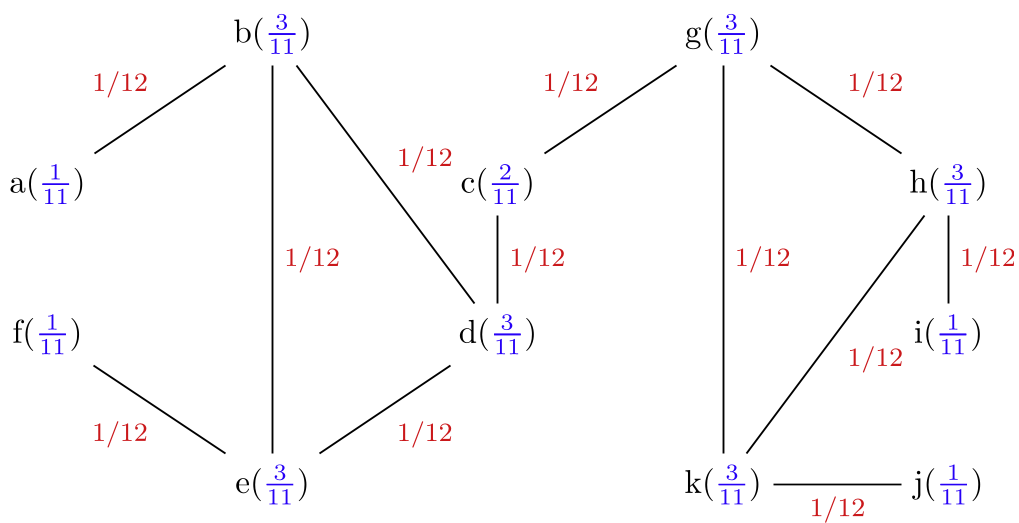 Figure 1: Conceptual illustration of the random walk process across nodes.
Experimental Insights & Results
The authors tested their method on six large datasets, including Facebook and Wikipedia.
Robustness and Scalability
Despite being a stochastic (randomized) algorithm, the results are remarkably stable. The Pearson correlation between independent runs consistently exceeds 0.7-0.9, meaning the "rank" of important edges remains the same regardless of random fluctuations.
Crucially, the execution time scales linearly. As shown in the performance charts, as the number of edges () increases, the time taken remains manageable, unlike traditional methods.
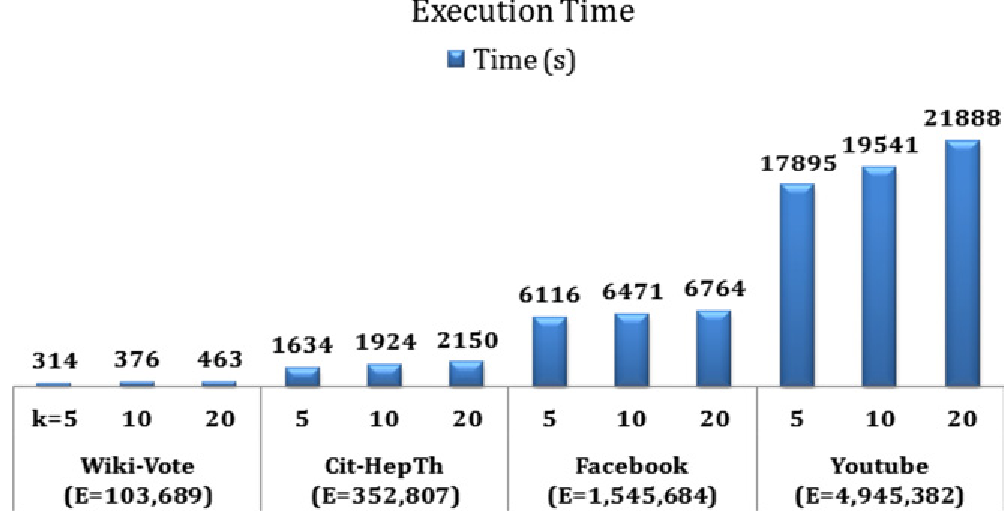 Figure 2: Execution time relative to network size, demonstrating linear scalability.
The Power Law of Influence
The results confirm that edge centrality follows a power-law distribution. A tiny fraction of edges hold immense "traffic" influence, while millions of others are rarely used. This "straight line" on a log-log plot (see Figure 3) is a hallmark of complex systems.
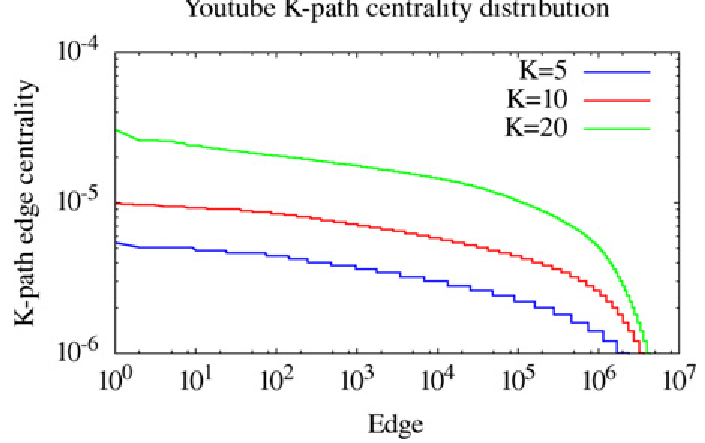 Figure 3: Power law distribution of edge centrality across different social datasets.
Future Applications in KB Systems
- Data Clustering: Identifying high-centrality edges helps in "edge removal" strategies for community detection (bridging the gap between groups).
- Semantic Web: In RDF graphs, this measure can quantify the "strength" of an association between two abstract concepts.
- Trust Networks: Propagating trust values via random walks can help filter malicious actors in decentralized platforms.
Critical Perspective: Limitations & Future Work
While the complexity is impressive, the choice of remains heuristic. The authors suggest as a sweet spot, but in "small-world" networks where the diameter is very low (e.g., 6 degrees of separation), a smaller might suffice, while more sparse graphs might require larger values. Future research could focus on adaptive selection based on local graph density.
Conclusion
j-Path Edge Centrality provides a scalable and sociologically grounded alternative to legacy graph metrics. By treating the network as a living propagation system rather than a static geometric object, it opens the door for real-time analysis of massive, ever-changing social landscapes.