
ELM-Weibo: High-Efficiency Spammer Detection via Extreme Learning Machines
A novel method for spammer detection in social networks
This paper introduces an Extreme Learning Machine (ELM) based supervised model for spammer detection on the Sina Weibo platform. By extracting key features related to message content and user behavior, the method achieves a True Positive Rate of 99% for spammers and 99.95% for legitimate users, outperforming traditional SVM and Bayesian approaches in both accuracy and computational efficiency.
TL;DR
Social networks are increasingly plagued by spammers spreading malware and phishing links. This paper proposes a high-performance detection model using Extreme Learning Machines (ELM) on the Sina Weibo dataset. By bypassing the tedious iterative training of traditional neural networks, the model achieves near-perfect accuracy (99%+) while being nearly 7-8 times faster than Support Vector Machines (SVM).
Problem & Motivation: The Bottleneck of Iterative Learning
Modern social platforms like Sina Weibo are massive, generating millions of posts daily. Conventional spammer detection methods, particularly those based on Support Vector Machines (SVM) or Back-Propagation (BP) neural networks, face two critical hurdles:
- Iterative Latency: These models require multiple passes over data and manual parameter tuning (e.g., C and gamma in SVM), which is time-consuming for large-scale datasets.
- Generalization Limits: Small shifts in spammer behavior often require retraining the entire model, which is computationally expensive on older architectures.
The authors recognized that for real-time detection, the community needs a model that learns in a single "gulp" rather than slow "bites."
Methodology: The Power of Random Neurons
The core of the proposed solution is the Extreme Learning Machine (ELM). Unlike traditional feedforward networks, ELM randomly initializes the weights between the input and hidden layers. The training then becomes a simple linear system problem: solving the weights for the output layer using the Moore-Penrose generalized inverse.
Feature Engineering
The model's success is rooted in four key behavioral insights:
- Low Originality: Spammers rarely create original content, often reposting to spread links.
- High URL Density: Over 90% of spammer messages contain URLs, often leading to phishing sites.
- Aggressive Following: Spammers follow many legitimate users hoping for a "follow back."
- Short Lifespan: Spammer accounts are often "young" due to frequent bans by platform moderators.
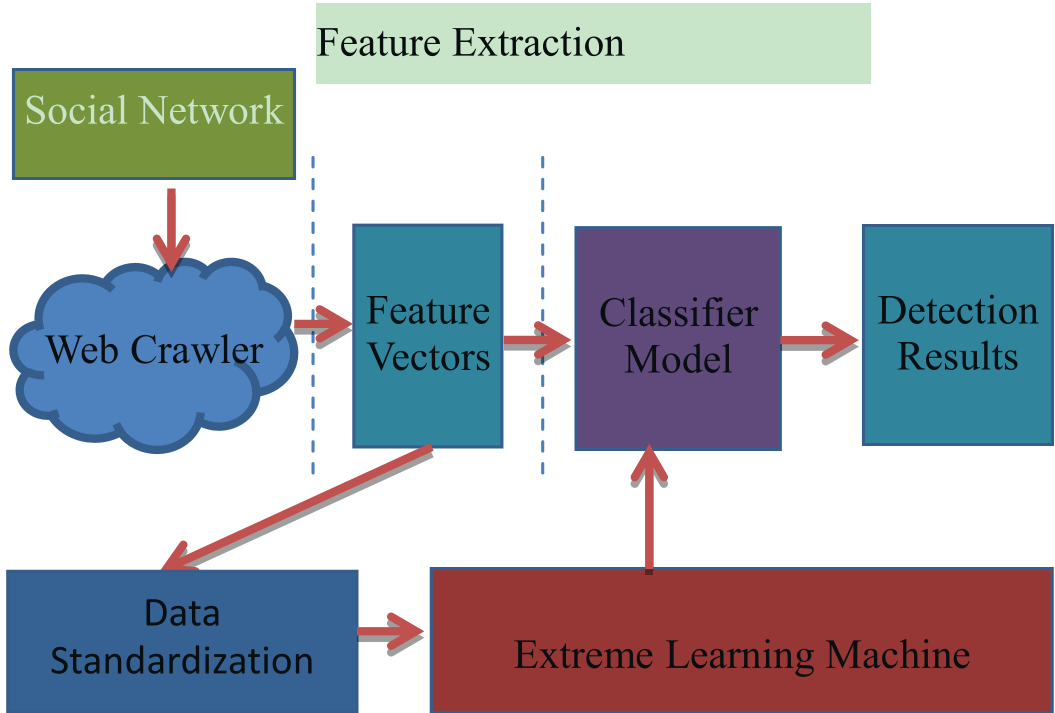 Fig 1. The Spammer Detection Pipeline from Data Collection to ELM Classification.
Experiments & Results: Speed Meets Accuracy
The researchers tested their ELM model against SVM, Decision Trees, and Naïve Bayes.
Performance Highlights
- Accuracy: ELM achieved a Precision of 0.999 for spammers and 0.994 for non-spammers, virtually eliminating false positives.
- Efficiency: In a direct head-to-head with SVM, the ELM model finished training in 0.4375 seconds, compared to 3.029 seconds for SVM.
| Classifier | Training time (s) | Testing time (s) |
|---|---|---|
| ELM | 0.4375 | 0.0625 |
| SVM | 3.029 | 0.499 |
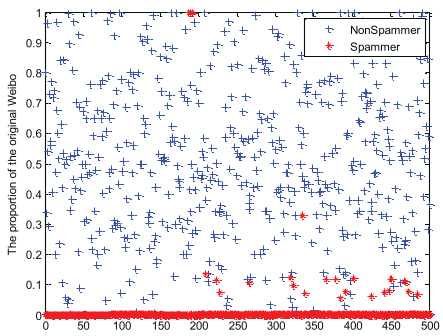 Fig 2. Analysis of (a) Original message proportions and (b) URL density between spammers and normal users.
Critical Insight: Beyond Hand-Crafted Features
While the paper proves that ELM is a superior "engine" for classification, the authors conclude with an important reflection on the future. Spammer detection relies heavily on Feature Engineering—manually deciding that "URL density" or "account age" matters.
The ultimate takeaway is that while ELM solves the efficiency problem of the classifier, the next frontier is Deep Learning, which can potentially learn these features automatically from raw text and graph structures, further reducing the human effort required to keep social networks safe.
Conclusion
This work demonstrates that for specific supervised tasks in social media, we do not always need deep, multi-layer architectures. A well-tuned, single-layer ELM can provide SOTA accuracy with a fraction of the computational overhead, making it a highly feasible solution for real-world deployment in anti-spam systems.