
SAE-FER: Decoding Human Emotions through the Language of Facial Muscles
A Novel Model for Emotion Detection from Facial Muscles Activity
This paper introduces a deep learning-based Facial Emotion Recognition (FER) model that utilizes facial muscle activation (Action Units) as raw input. By combining OpenFace for feature extraction and a Stacked Auto Encoder (SAE) for high-order feature fusion, the model achieves SOTA accuracies of 95.63% on CK+ and 95.58% on MMI datasets.
TL;DR
Researchers have developed a novel deep learning model that shifts the focus of Facial Emotion Recognition (FER) from raw pixels to facial muscle dynamics. By utilizing a Stacked Auto Encoder (SAE) to analyze Action Units (AUs), the model achieves over 95% accuracy on major benchmarks, outperforming traditional CNN-based architectures by capturing the "hidden" logic of muscular combinations.
Motivation: Why Pixels Aren't Enough
Most modern FER systems treat the face as a static image, feeding raw pixels into heavy Convolutional Neural Networks (CNNs). While effective, this approach is often a "black box" that struggles with high-dimensional complexity and environmental noise.
The authors of this paper argue for a sign-based approach. Instead of looking at the face as a whole, why not look at the underlying drivers? According to the Facial Action Coding System (FACS), every emotion is a symphony of specific muscle movements called Action Units (AUs). However, because humans often express "mixed" emotions (e.g., a "sad surprise"), manually coding these rules is nearly impossible. This is where the Stacked Auto Encoder comes in—to find the latent patterns in muscle activity that humans can't see.
Methodology: From Muscle Activity to Emotional Insight
The pipeline is elegant and consists of three primary stages:
- Extraction: Using the OpenFace toolkit, the system extracts activation values for 15 key AUs (e.g., Inner Brow Raiser, Lip Corner Puller) in both binary and regression scales.
- Feature Learning (The Core): A Stacked Auto Encoder (SAE) acts as a bottleneck. It takes the 30-digit input vector and compresses it through multiple hidden layers. This forced compression compels the network to learn the "most pivotal" combinations of muscles that define an emotion.
- Classification: The refined 10-dimensional feature vector is fed into a Softmax layer to output the final probability for one of the six basic emotions: Happiness, Sadness, Fear, Anger, Disgust, and Surprise.
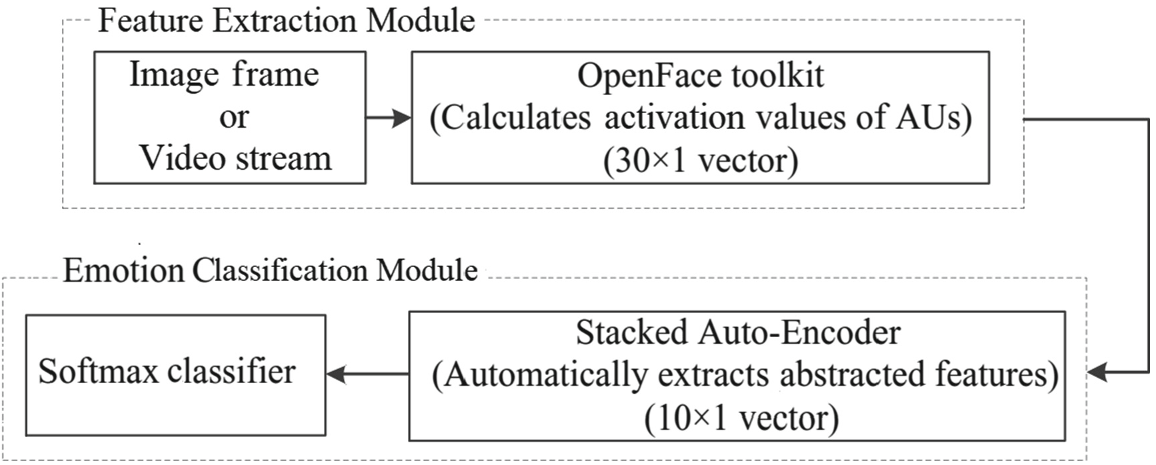 Figure 1: The proposed SAE architecture, showing the transition from 30 AU inputs to 6 emotion classes.
The "Pivotal" Muscle Table
One of the most valuable outputs of this methodology is the validation of which AUs matter most for which emotion.
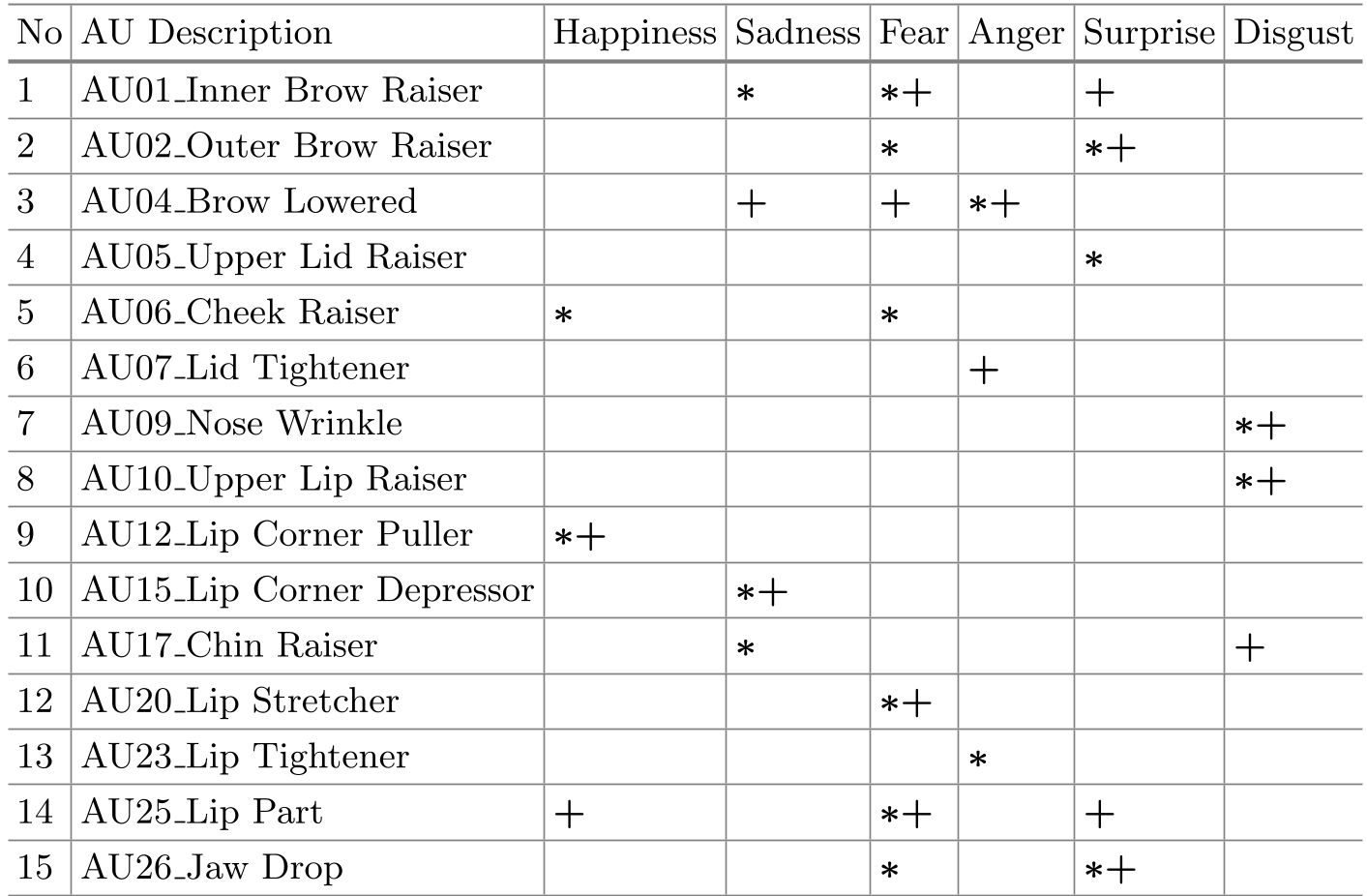 Table 1: The mapping of Action Units to specific emotions as identified by the model.
Experimental Results: SOTA Performance
The model was put to the test against three major datasets: CK+, MMI, and RAVDESS.
- CK+ Performance: The SAE model achieved 95.63% accuracy, notably hitting a perfect 100% for Happiness and Surprise. It significantly beat the previous SVM-based SOTA (93.9%).
- MMI Performance: The gap here was even more widening. The proposed model reached 95.58%, whereas previous CNN-CRF models only managed 78.67%. This suggests the SAE is far better at handling the "subtle" expressions found in the MMI dataset.
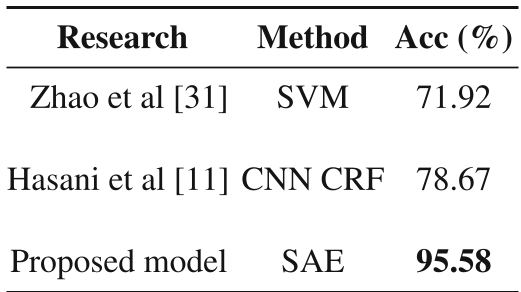 Table 2: Comparison of the proposed SAE model against existing CNN and SVM baselines.
Critical Analysis & Conclusion
The true power of this work lies in its dimensionality reduction. By focusing on 30 AU values instead of thousands of pixels, the model is lightweight and highly efficient for real-time applications, such as social robots (e.g., Pepper or Probo) interacting with humans in the wild.
Limitations:
- The model currently focuses on six basic emotions. Real-world "compound expressions" (like happily disgusted) remain a frontier.
- Performance on the RAVDESS dataset (84.91%) was lower than CK+, likely due to the varied actor-based expressions which introduce higher variance in muscle intensity.
Future Outlook: The authors plan to integrate head pose and gaze direction into the SAE to further refine the context of the detected emotion. This work paves the way for robots that don't just "see" a face, but "understand" the muscular intent behind a smile or a frown.