
Beyond Consensus: How Interdependent Issues Shape Our Belief Systems
Novel Multidimensional Models of Opinion Dynamics in Social Networks
The paper introduces a multidimensional extension of the Friedkin-Johnsen (FJ) model to describe opinion dynamics on multiple interdependent topics within social networks. It utilizes a Multi-issue Dependence Structure (MiDS) matrix to capture how beliefs on one topic introspectively influence others, achieving a mathematically rigorous framework for belief system evolution.
TL;DR
While most AI and social models assume we judge issues in isolation, this paper by Parsegov et al. introduces a multidimensional "Belief System" model. By adding a Multi-issue Dependence Structure (MiDS) matrix to the classic Friedkin-Johnsen framework, they prove that our opinions are not just influenced by our friends, but by the internal logical constraints that bind different topics together.
Background: The Limits of Scalar Opinions
Classical models like DeGroot focus on the "wisdom of the crowd," where agents eventually reach a consensus through iterative pooling. However, real social networks rarely agree. The Friedkin-Johnsen (FJ) model improved this by adding "Stubbornness" (prejudices). Yet, even FJ models usually treat each topic—say, "Climate Change" and "Electric Vehicle Subsidies"—as independent dimensions.
The authors argue that human cognition involves a "schema" or "ideology." If you change your mind about the health benefits of fish, your opinion on salmon must naturally follow. This internal consistency is the "missing link" in social network theory.
Methodology: Entangling Logic with Social Influence
The core innovation is the introduction of the MiDS matrix (C). In the proposed model, the opinion update rule becomes:
Where:
- (Social Influence): Who you listen to.
- (Introspective Coupling): How topics interact within your mind.
- (Prejudice): Your original stance.
The Architecture of Influence
The model uses the Kronecker product to describe the evolution. This means the total dynamics are a "multiplex" of social ties and logical ties.
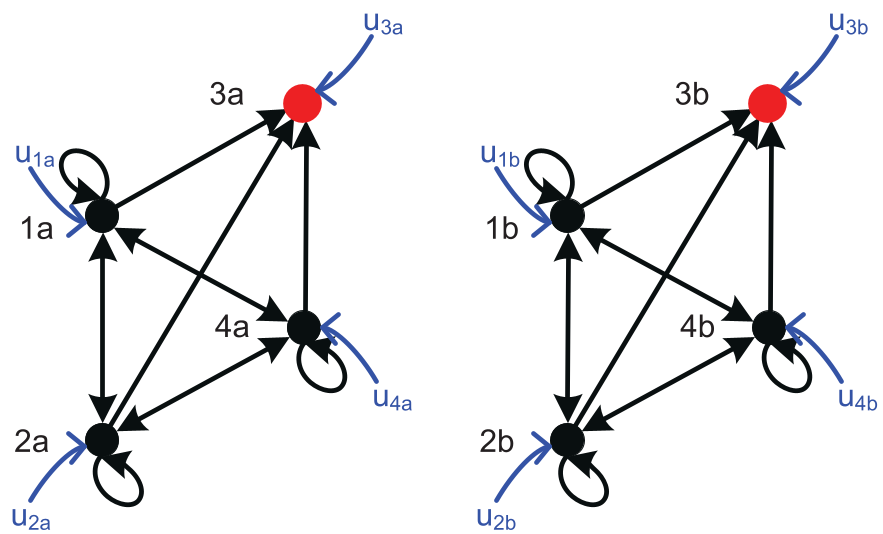 Fig 1: The structure of a 2D FJ model where extra green ties represent the interdependent logic between topics.
Stability and Convergence
One might worry that coupling issues leads to chaotic oscillation. The authors derive a clean stability criterion:
The system is stable if and only if the product of the spectral radii of the social susceptibility matrix and the logic matrix is less than one: .
Interestingly, even if the matrix is "unstable" (some eigenvalues > 1), the social network can "anchor" the opinions and maintain stability if the agents are sufficiently stubborn or the network is well-damped.
Experimental Insights: Clustering and Polarization
Through numerical simulations, the authors demonstrate that when topics are positively coupled, agents tend to move toward a single "logical center." However, when topics are negatively coupled (e.g., supporting "Vegetarianism" vs. "All-meat diets"), the network naturally polarizes into hostile camps, even without negative social ties.
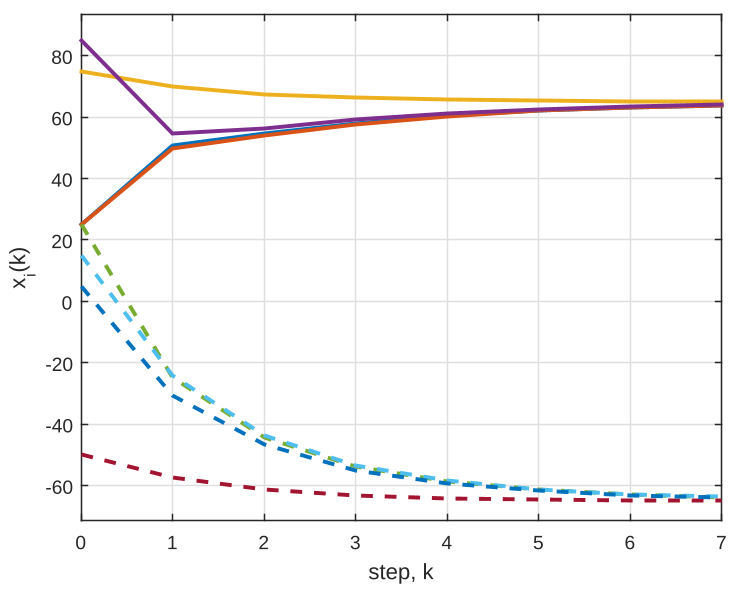 Fig 2: Polarization under negatively coupled topics. Even with a shared social structure, the logical contradictions drive opinions to the extremes.
Real-world Application: Gossip and Estimation
The paper doesn't just stay in the realm of synchronous math. It proves:
- Gossip Protocols: The same equilibrium is reached if agents only talk in pairs (asynchronous) rather than all at once.
- MiDS Identification: We can actually reverse-engineer a group's hidden ideology (the matrix) by observing their opinion trajectories over time using Convex Optimization.
Critical Analysis & Conclusion
This paper provides a rigorous mathematical bridge between Control Theory and Social Psychology.
Takeaway: Social polarization isn't always caused by "echo chambers" or bad actors; it can be an emergent property of how different logical issues are bundled together into ideologies.
Limitations: The model assumes the matrix is the same for all agents (homogeneous). In reality, a liberal and a conservative might have entirely different logical associations (), a problem the authors began to address in their follow-up work.
Future Outlook: For AI safety and alignment, understanding how "belief systems" evolve as a multidimensional manifold is crucial for predicting how LLM-agent societies might diverge or converge.