
PASO-WPR: Bridging Swarm Intelligence and Semantic Mining for Healthcare Recommendations
A novel approach on Particle Agent Swarm Optimization (PASO) in semantic mining for web page recommender system of multimedia data: a health care perspective
The paper introduces Particle Agent Swarm Optimization (PASO) for a Web Page Recommender system (PASO-WPR) specifically designed for health care multimedia data. By integrating semantic ontology and multi-agent cooperation, the system achieves SOTA performance in predicting patient-oriented information needs.
TL;DR
Researchers have developed a novel Particle Agent Swarm Optimization (PASO) framework to overhaul how healthcare web pages are recommended. By treating user sessions as semantic ontology instances rather than raw URLs and optimizing the search process with specialized agents, the system achieves a 94% Hit-Ratio, outperforming traditional collaborative filtering and social recommender systems by up to 19%.
Background: The Multimedia Healthcare Information Gap
Modern clinical databases are no longer just text; they are rich with multimedia—images, videos, and audio—scattered across various silos. For patients trying to understand their health status (e.g., Chronic Obstructive Pulmonary Disease or COPD), navigating these resources is overwhelming. Traditional recommenders face two massive hurdles:
- The New Item Problem: They can't suggest new pages because they rely on historical URL patterns.
- Semantic Blindness: They don't understand that two different URLs might represent the same clinical concept.
Methodology: The PASO Framework
The core innovation lies in the PASO-WPR (Web Page Recommendation) architecture, which utilizes a multi-agent system governed by swarm intelligence.
1. Dual-Agent Cooperation
- User Particle Agent: Acts as the interface, building interest models based on browsing history and optimizing the search trajectory in the information space using PSO equations.
- Semantic Particle Agent: Preprocesses queries and maps requested content to OWL (Ontology Web Language) individuals. This ensures the system understands what the patient is looking for, not just where they clicked.
2. Semantic Clustering & Rule Mining
The system doesn't just look for frequent patterns; it uses Sequential Association Rule Mining on ontology instances. It then applies Fuzzy C-Means (FCM) Clustering to group user sessions based on semantic similarity.
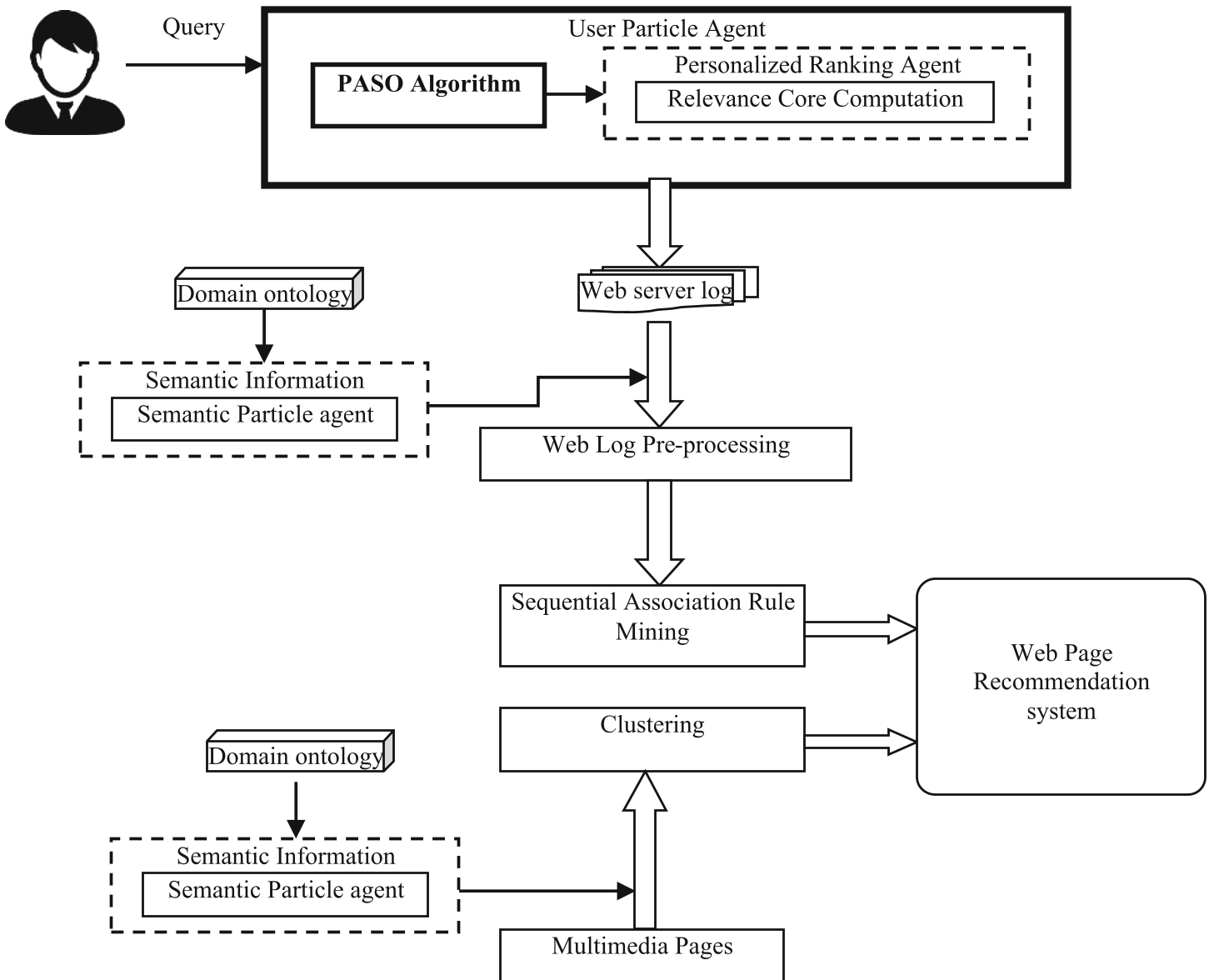 Figure 1: The five phases of PASO-WPR: Agent interaction, Preprocessing, Rule Extraction, Page Clustering, and Recommendation.
Mathematics of Motion: PSO in Information Retrieval
To solve the latency issues typical of agent-based systems, the authors employ a modified PSO algorithm. Every particle (agent) adjusts its velocity () and position () based on its local best () and the global best () search time:
This mathematical approach ensures that agents converge on the most relevant information in a multidimensional user-interest space with minimal computational overhead.
Experimental Results: SOTA Performance
The system was tested against three major baselines: WARM (Weighted Association Rule Mining), PLWAP (Tree Mining), and SRS (Social Recommender System).
Key Breakthroughs:
- Accuracy: In sessions of length 10, PASO-WPR reached 94% Hit-Ratio, whereas SRS lagged at 84%.
- Precision and Coverage: The system provided a precision of 91.43%, proving that its recommendations were highly relevant to the actual patient needs.
- Error Reduction: The Mean Absolute Error (MAE) was dropped to 0.798, significantly lower than the WARM baseline (0.936).
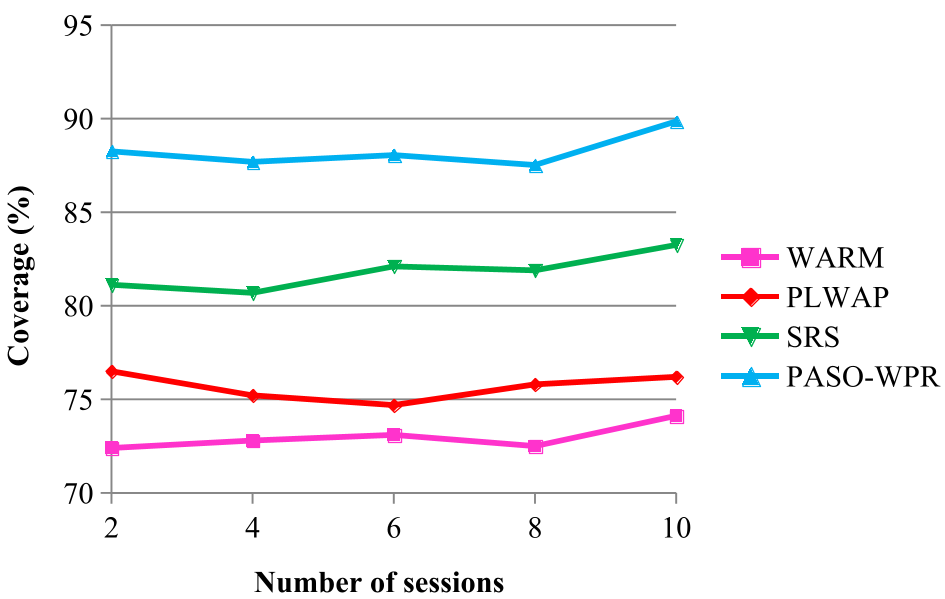 Figure 2: Coverage performance vs. session length, highlighting PASO-WPR's superior ability to predict upcoming requests.
Critical Insight: Why it Works
The "magic" of this approach is the Semantic Mapping. Because the system creates rules based on Ontology Individuals (e.g., the concept of "COPD Education") rather than URLs, it can recommend a brand-new video on the topic even if no one has ever visited that specific URL before. The Particle Agents simply "vibrate" toward the most semantically similar cluster center in the knowledge graph.
Conclusion & Future Outlook
PASO-WPR represents a significant leap in Scalable Semantic Mining. By moving beyond simple text-mining and embracing the multimedia nature of modern healthcare, it provides a blueprint for next-generation patient portals. Future work aims to extend this to social networking sites (Facebook, Twitter) and cross-domain applications like Amazon-style e-commerce, where semantic context is equally vital.
Limitations
- Currently requires manual mapping for some complex semantic extractions.
- Optimized for healthcare; cross-domain performance is theorized but not yet extensively proven.