
Intelligent Forex Management: Fusing Neural Networks with KKT Optimization
A novel portfolio optimization method for foreign currency investment
This paper presents a hybrid foreign currency investment framework that integrates exchange rate prediction with multi-objective portfolio optimization. Utilizing Support Vector Machines (SVMs), Neural Networks (NNs), and Simple Moving Averages (SMA), the authors optimize currency allocations for AUD, EUR, and CHF using Karush-Kuhn-Tucker (KKT) conditions to achieve superior Effective Annual Yields (EAY).
TL;DR
Predicting foreign exchange (Forex) rates is notoriously difficult due to market noise and chaos. This paper moves beyond simple "buy/sell" heuristics by proposing a novel framework: it uses Neural Networks (NN) and Support Vector Machines (SVM) to forecast rates, then applies the Karush-Kuhn-Tucker (KKT) theorem to find the mathematically optimal investment weights for a currency portfolio. The result? A significant boost in annual yield compared to traditional benchmarks.
The Evolution of Forex Strategy
The Forex market is a $1.5 trillion-a-day beast. Historically, traders relied on ARIMA models or Moving Averages (SMA). However, these methods assume linearity and stationarity—traits seldom found in real-world financial data. Modern researchers have pivoted to Computational Intelligence (CI), but a gap remains: How do we translate a model's prediction and its inherent uncertainty into a specific portfolio allocation?
The authors address this by defining Risk not just as market volatility, but as the accuracy of the prediction model. If a model's training error is high, the "risk" associated with that currency's predicted return increases.
Methodology: From Prediction to Optimization
1. The Predictive Engine
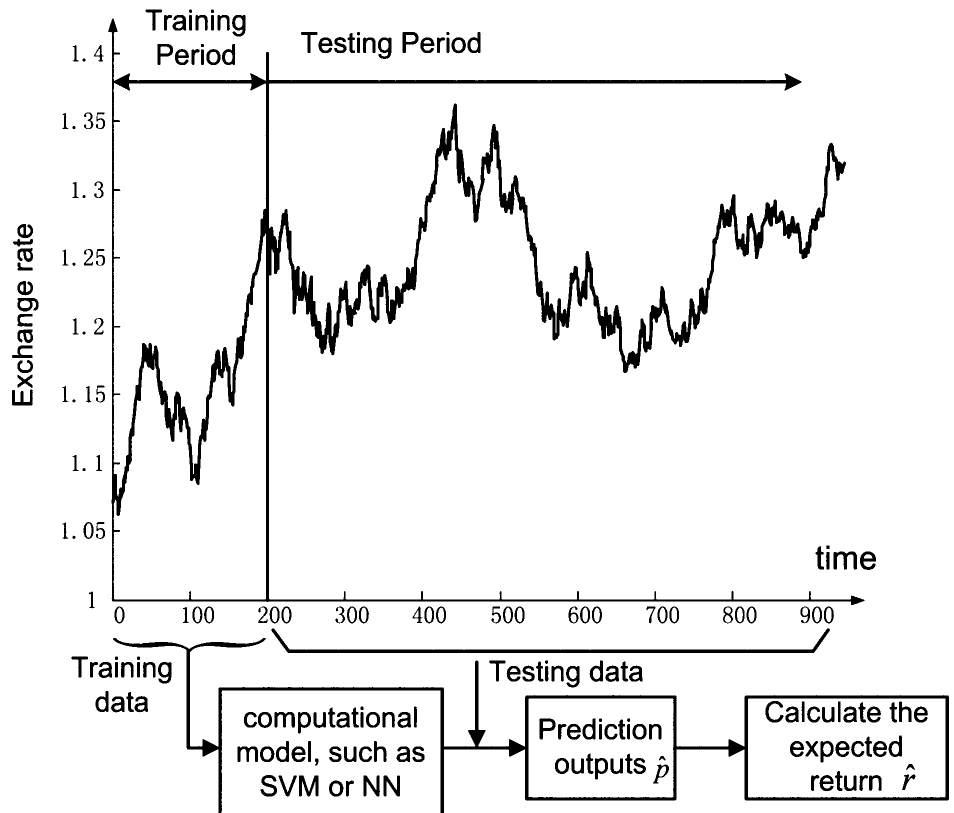
The framework utilizes five technical indicators (MA5 to MA120) as inputs for:
- Neural Networks (MLP): A 3-layer backpropagation network.
- SVM: Utilizing Radial Basis Function (RBF) kernels to handle non-linear trends.
- Moving Averages: Serving as the classical baseline.
2. The KKT Portfolio Optimizer
The core innovation lies in the objective function: Where:
- is the predicted return.
- is the covariance matrix of the prediction errors, representing model-specific risk.
- is the risk-aversion coefficient.
By using KKT multipliers, the authors derive analytical solutions for seven different market cases (e.g., when one currency is favored entirely vs. a balanced split), ensuring that the portfolio is always on the "Efficient Frontier" under budget constraints.
Experimental Battleground
The model was tested on a decade of data (1996–2006) focusing on AUD, EUR, and CHF against the USD.
Performance Metrics
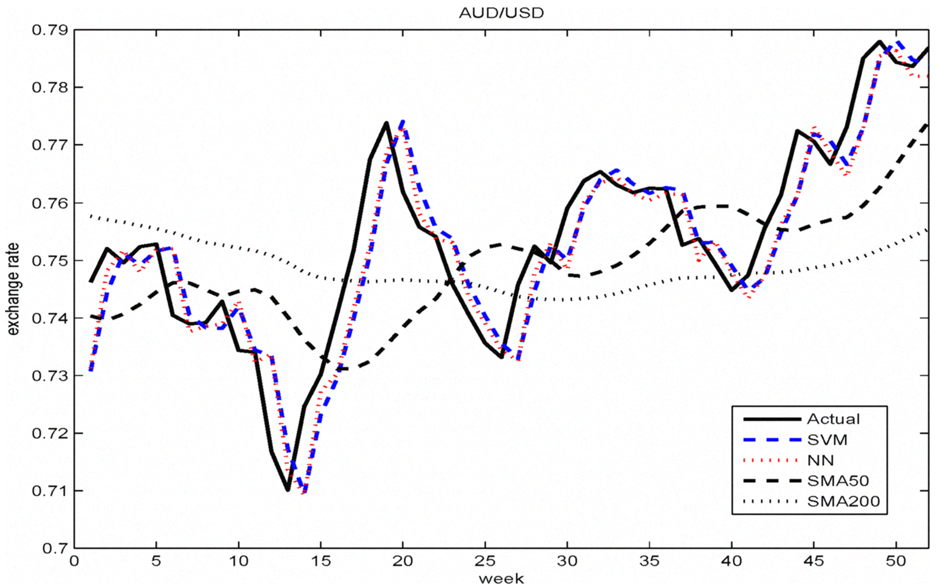
The researchers tracked Normalized Mean Square Error (NMSE) and Directional Symmetry (DS). A key insight emerged: A lower NMSE (error) does not always mean higher profit. The ability to predict the direction (Up/Down trend) is often more valuable for trading than absolute price accuracy.
The Payoff: Effective Annual Yield (EAY)
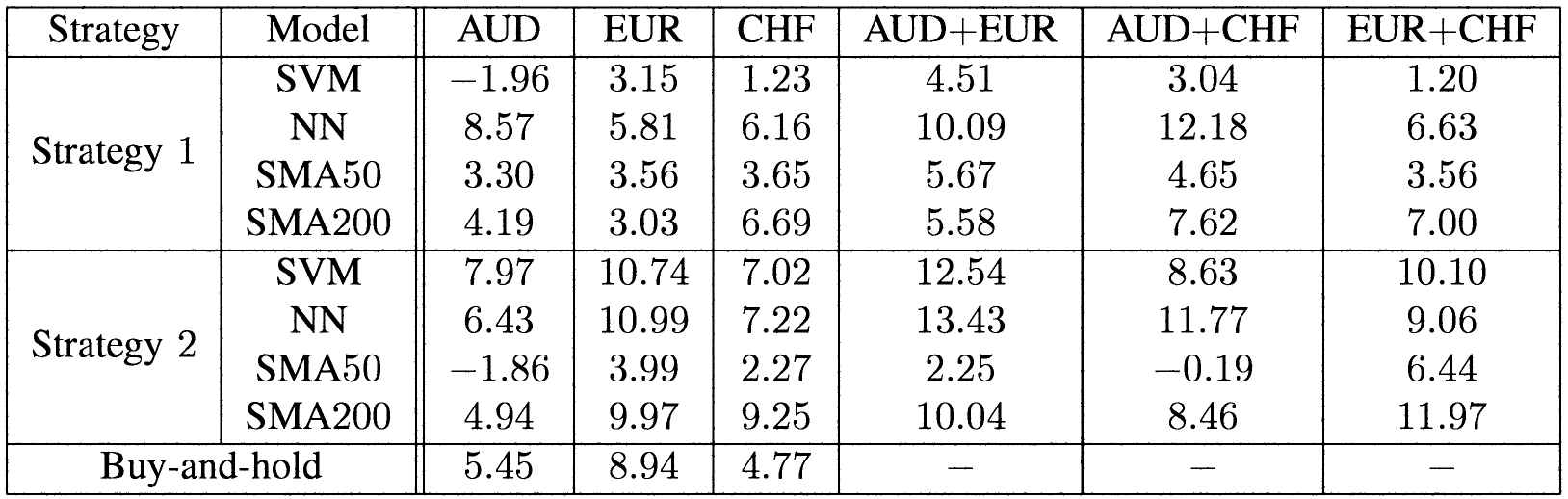
The optimal portfolio consistently outperformed "Buy-and-Hold" and single-currency strategies. For instance, using Neural Networks to manage an AUD+EUR portfolio yielded 13.43%, compared to just 8.94% for a EUR-only strategy.
Critical Insight & Perspective
What makes this work stand out in the sea of AI-Finance papers is the grounding of Machine Learning in classical Optimization Theory.
- Insight: By defining risk as "prediction error volatility," the authors create a self-aware system. If the NN knows it is bad at predicting the Swiss Franc, the KKT optimizer will naturally reduce the CHF weight in the portfolio.
- Limitations: The study ignores transaction costs and slippage, which in high-frequency or weekly rebalancing can eat into the EAY. Furthermore, the 2006 cutoff means the model hasn't been tested against extreme "Black Swan" events like the 2008 financial crisis.
Conclusion
This paper proves that a hybrid approach—machine learning for "expert opinion" and KKT for "rational allocation"—is a powerful recipe for sovereign currency investment. For practitioners, the takeaway is clear: don't just trust the prediction; quantify the error and optimize the risk.