
Leveraging Social Identities: A Hybrid Cure for the Cold-Start Problem
A novel recommendation system approach utilizing social network profiles
The paper proposes a novel hybrid Recommendation System (RS) that combines Demographic Filtering (DF) and Community-Based Filtering (COBF). By utilizing existing Social Network Service (SNS) profiles as the primary data source, the method aims to eliminate the traditional registration burden and effectively mitigate the Cold-Start Problem (CSP).
TL;DR
Recommendation Systems (RS) are the engines of modern e-commerce, but they fail when they don't know who you are—a dilemma known as the Cold-Start Problem (CSP). This paper explores a novel hybrid model that ditches manual registration in favor of Social Network Profiles. By combining Demographic Filtering (DF) and Community-Based Filtering (COBF), the authors propose a system that knows your taste before you even click "Like."
The Friction of Discovery: Why Traditional RS Fails
Most recommendation engines rely on your history. But what happens when you are a new user?
- New User Problem (NUP): No history means no baseline for similarity.
- Sparsity Problem (SP): In a sea of millions of products, even active users only interact with a tiny fraction, leaving the "similarity matrix" mostly empty.
- The Registration Burden: Users hate filling out forms. When forced, they often provide fake data, which poisons the recommendation algorithm with "noise."
The authors' core insight is simple yet powerful: You already have a digital identity. Why build a new one from scratch for every website?
Methodology: The DF + COBF Hybrid
The paper proposes a dual-layer defense against the Cold-Start Problem:
1. Demographic Filtering (DF) via Social Login
Instead of asking for your age, gender, and occupation, the system pulls this from your Facebook, Twitter, or LinkedIn profile.
- The Logic: People of similar demographics often share stereotypical interests.
- The Gain: Immediate recommendations (Zero-shot) the moment you log in.
2. Community-Based Filtering (COBF)
COBF is a "Social Recommendation" logic. Unlike Collaborative Filtering, which matches you with anonymous users who have similar tastes, COBF matches you with your actual friends.
- Trust Factor: Users are statistically more likely to accept a recommendation from a friend than from a system-generated "peer."
- Trust Propagation: If User A trusts Friend B, and Friend B trusts C, the system can infer a level of trust between A and C, expanding the reach of potential recommendations.
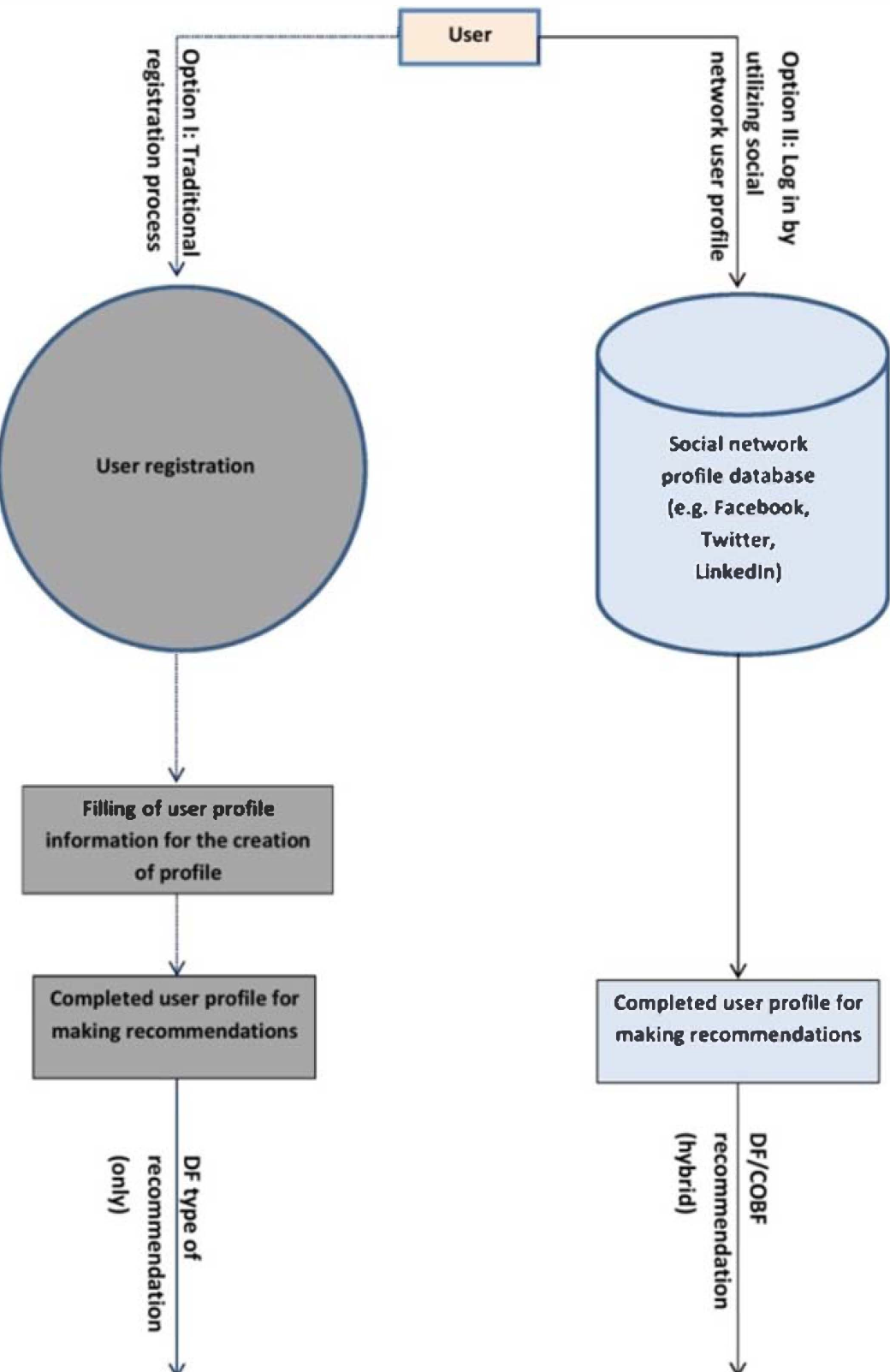 Figure 1: Comparison between traditional registration (Option I) and the proposed social-network-integrated hybrid system (Option II).
Comparative Advantage
The authors highlight several key metrics where this social-first approach wins:
- Controversial Items: Social filtering handles items with split opinions better because friend groups often share similar cultural or ethical filters.
- User Effort: By moving from Option I (Manual) to Option II (Social), the registration process is shortened, reducing user churn.
- Accuracy vs. Novelty: While friends' recommendations often act as "reminders" of existing interests, the DF layer provides the "unexpected" novelty that keeps the experience fresh.
Critical Analysis & Future Outlook
While the paper presents a compelling architectural shift, it acknowledges certain hurdles:
- Privacy Paranoia: Users may be hesitant to link their LinkedIn or Facebook to diverse e-commerce sites due to data privacy concerns.
- The "No-Friend" Edge Case: If a user has a social profile but zero connections on that specific platform, the COBF module still collapses back into a standard DF model.
Conclusion: The integration of social graphs into recommendation engines is no longer just a "feature"—it is a necessity for solving the cold-start bottleneck. As we move toward a more decentralized web, the ability to carry your "interest graph" from one platform to another will become the gold standard for personalized UX.