
Beyond Keywords: Reimagining Search Through the Lens of Social Relationships
A Novel Search Engine Based on Social Relationships in Online Social Networking Website
This paper introduces a novel social search engine that integrates Social Network Analysis (SNA) with traditional text retrieval. By combining Facebook interaction data ("Likes" and "Messages") with TF-IDF keyword similarity, it proposes a "Social Ranking" value to prioritize search results from friends with whom a user has strong social links.
TL;DR
Search engines have long mastered the "What" (keyword relevance), but they often struggle with the "Who" (source reliability). This paper proposes a Social Search Engine that leverages Facebook interaction data to rank results. By calculating a Social Ranking value—a blend of interaction weights (Likes/Messages) and TF-IDF—the system ensures that information from your "Strongest Links" reaches the top.
Problem & Motivation: The Missing Social Context
Current search paradigms are largely solitary experiences. They analyze global webpage popularity (like Google's PageRank) but ignore the intrinsic trust we place in our social circles. Historically, Personalized Search attempted to fix this using cookies or history logs, but these methods take months to mature.
The authors argue that social networking sites (SNS) like Facebook hold the key. Since users are more interested in content shared by friends they interact with frequently, why not bake those Social Relationships directly into the ranking algorithm?
Methodology: The "Social Ranking" Formula
The core innovation lies in how the authors quantify "friendship quality." The process involves three main stages:
1. Data Harvesting and NLP
Using the Facebook Graph API, the system collects profile data and "feed profiles." It uses CKIP (Chinese Knowledge Information Processing) for segmentation and applies TF-IDF to determine the uniqueness and relevance of keywords within those posts.
2. Quantifying Interaction
The methodology identifies three types of social interactions:
- Public Broadcasting: User A posts to their wall.
- Direct Interaction: User B replies to User A or clicks "Like."
- Bidirectional Flow: A combination of both.
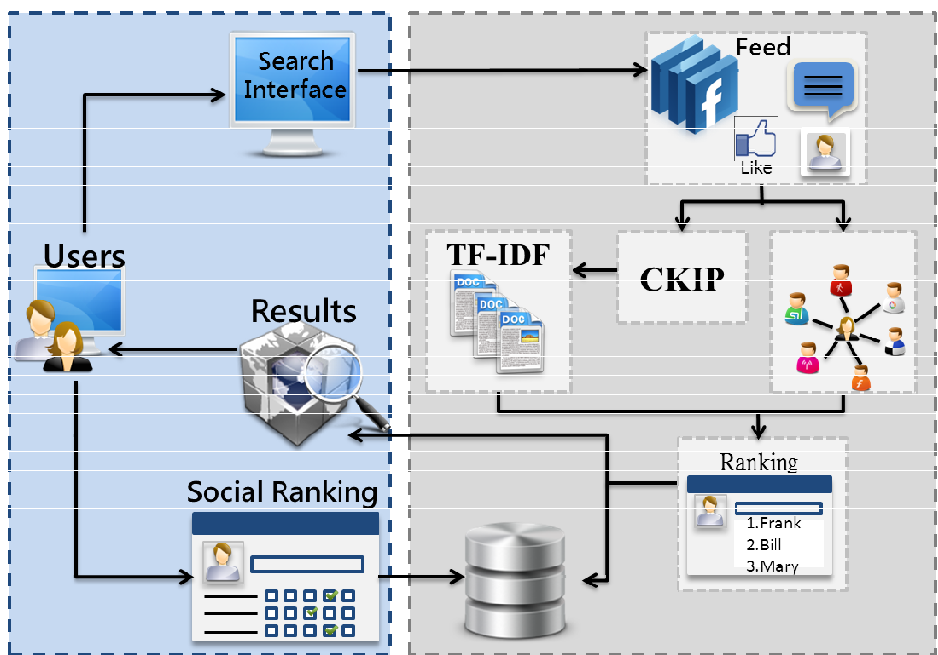 Figure: The proposed social search system architecture.
3. The Ranking Equation
The authors define the final score () as: Where:
- represents the weighted interaction of Likes () and Messages ().
- is a binary value indicating if the users are confirmed friends.
- and are tuning constants (set to 0.5 in this study).
Case Study: The "Christmas" Scenario
To prove the concept, the authors tracked interactions between three users: Vender, Bill, and Mary. Even if multiple users mention "Christmas," the system ranks the results based on who Vender interacts with most.
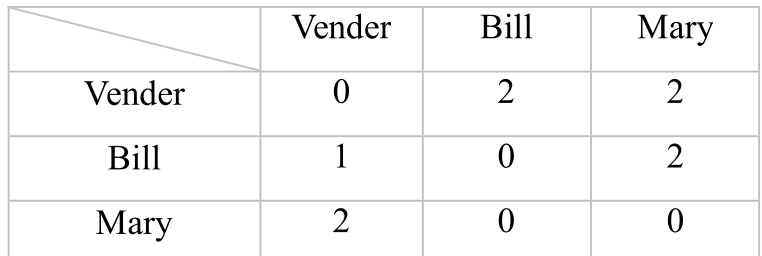 Table: Response weights between users based on message frequency.
By analyzing the specific counts of "Likes" and "Responses," the search engine produces a personalized leaderboard of results, moving away from static similarity to dynamic social relevance.
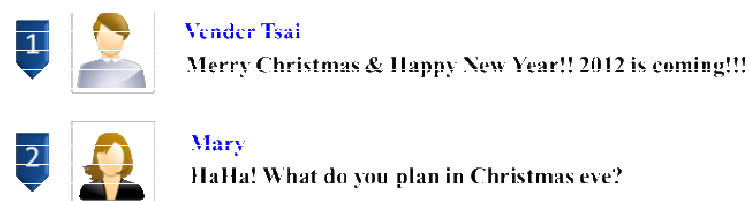 Figure: The final UI showing results ranked by social weight.
Critical Analysis & Conclusion
Takeaway
The paper successfully bridges the gap between Social Network Analysis (SNA) and Information Retrieval (IR). It moves beyond "Tags" or "Hyperlinks" by looking at the intensity of human interaction.
Limitations
- Subjectivity of Weights: The 0.5/0.5 split between "Likes" and "Messages" is arbitrary; in reality, a comment might carry significantly more "Strong Link" weight than a simple click.
- Privacy Concerns: The reliance on Graph API permissions is a significant hurdle in the modern era of high data privacy (post-GDPR).
Future Outlook
The authors suggest integrating Ontologies to better understand the semantic meaning of interactions. This approach paves the way for "Cognitive Search"—where the engine knows not just what you are looking for, but whose opinion you value most on that specific topic.