
Social Event Recommendation: Overcoming the "One-and-Only" Sparsity via Friendship Analysis
A Novel Social Event Recommendation Method Based on Social and Collaborative Friendships
The paper introduces a novel social event recommendation method that leverages explicit, implicit, and collaborative friendships. By integrating user interaction patterns and content-based attendance history, it achieves SOTA recall performance on real-world datasets from Facebook and Meetup.
TL;DR
Unlike movies or books, social events are ephemeral—once they are over, they are gone. This "one-and-only" property breaks traditional recommendation engines that rely on historical ratings. This paper proposes a hybrid approach that identifies a user's Acquaintances through a mix of social interactions (likes/comments) and "Collaborative Friendships" (shared event tastes), proving that who your friends are is the best predictor of where you'll go next.
The "One-and-Only" Bottleneck
In the world of RS (Recommendation Systems), social events present a unique nightmare:
- Rating Sparsity: You can't rate an event until it's finished, but once it's finished, the recommendation is useless.
- The Novelty Paradox: Content-based filtering (CB) suggests things similar to what you've done. However, if you just attended a "Pizza Making Workshop," you probably don't want to go to another one the next day.
- The Cold Start: Every new event is a brand-new item with zero historical data.
Methodology: The Power of Acquaintances
The authors' core insight is that Social Influence is the primary driver for event participation. If your inner circle is going, you likely will too. The system works in two distinct phases:
1. Acquaintance Identification
They don't just look at a "Friend List." They calculate a multi-dimensional friendship score :
- Explicit Social Friendship: Are they connected on the platform?
- Implicit Social Friendship: Do they interact? (Formula 1: Normalized "Likes" and "Comments").
- Collaborative Friendship: Do they attend similar types of events? Instead of a standard Jaccard coefficient (which is too sparse), they use a content-weighted similarity to see if users frequent the same niches.

2. Recommendation Generation
The final score is a weighted balance between the user's own past interests and the aggregate preference of their top acquaintances.
Experimental Insights
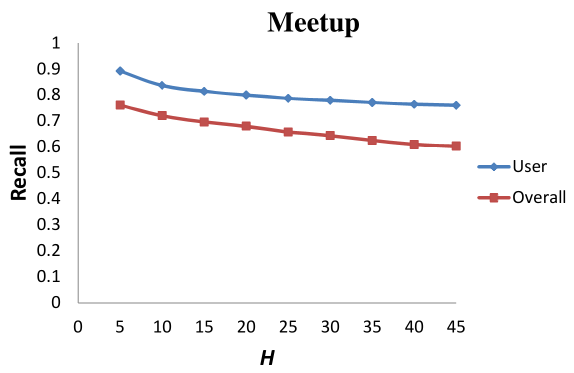
The researchers tested this on two real-world datasets: a Facebook group-buying community and a Meetup entrepreneur group.
The "Less is More" Rule (Parameter H)
Surprisingly, the best results came from using only the top 5 acquaintances. As increased, the recommendation quality dropped. This suggests that in social circles, only a tiny core of "true" friends actually influences our decision-making.
Taste vs. Interaction (Parameter α)
When (only social interaction), the system performed poorly. When increased (considering event taste), performance surged. Conclusion: Just because you "Like" someone's photo doesn't mean you'll attend the same technical seminar. Shared interests in past events (Collaborative Friendship) are much more "honest" signals.
Performance Comparison
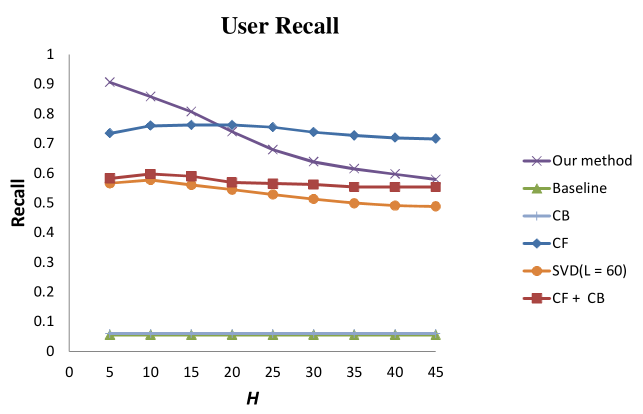
The proposed method consistently outperformed standard Collaborative Filtering (CF) and SVD.
- Content-Based (CB) failed because it was too repetitive for the "one-and-only" nature of events.
- The Proposed Method achieved superior recall because it captures the social "pull" of the community.
Deep Insight & Future Outlook
This work highlights a critical shift in recommendation philosophy: moving from item-similarity to social-dynamics.
Limitations: The reliance on "comments and likes" might be susceptible to noise in very large, public networks. Furthermore, the "TF-IDF" bag-of-words approach for event content is now somewhat dated compared to modern Transformer-based embeddings (like BERT).
Industry Takeaway: For platforms like Eventbrite or Meetup, the value is in the social graph, not just the event tags. Mapping who influences whom in specific niches is the key to solving the cold-start problem for non-recurring items.