
Elevating Social Graphs: Trust-Based Relationship Formation through Tertiary Contacts
A Novel Social Network Model for Forming Relationships
This paper introduces a novel social network growth model specifically designed for the formation of trust-based relationships, such as marriage alliances in the Indian context. By incorporating "Neighbor of Neighbor of Initial Contact" (NNIC) as a tertiary connection mechanism, the model achieves a significantly higher clustering coefficient () while maintaining an asymptotically scale-free degree distribution.
TL;DR
Most social network models stop at immediate neighbors, but real-world trust flows deeper. This paper proposes a novel growth algorithm that incorporates Neighbor of Neighbor of Initial Contact (NNIC) to simulate high-trust environments like marriage alliances. The result is a complex, scale-free network with a superior clustering coefficient of , significantly outperforming previous 1st-degree referral models.
Background: The Trust Deficit in Network Science
While Barabási-Albert (BA) models and Small-World theories explain how networks become "scale-free" or "highly connected," they often miss the human element: Trust. In specific contexts—such as professional collaboration or community-based marriage alliances—connections aren't just random or based on popularity (preferential attachment); they are mediated through trusted intermediaries.
The author argues that prior models [19] utilized friend information but ignored the "friend-of-a-friend" (Tertiary Contact) potential, which is the cornerstone of trust-based referrals in many cultures, particularly in India.
Methodology: The Three-Tier Attachment Algorithm
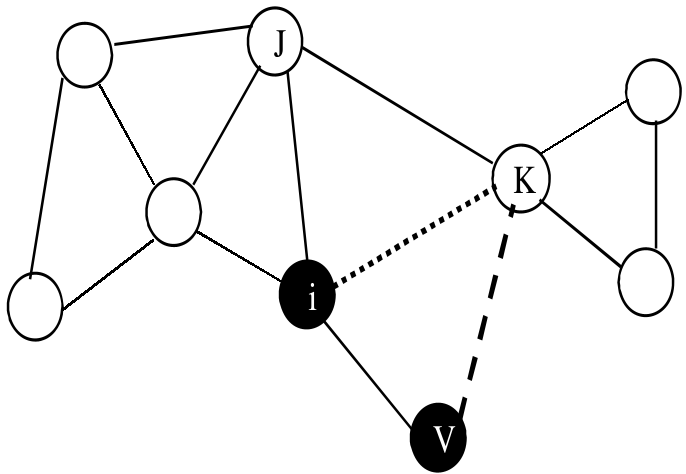
The core innovation is the Network Growth Algorithm, which moves beyond the 2nd degree of separation to the 3rd degree.
The 3-Step Connection Process:
- Random Attachment: A new vertex (family/person) picks initial contacts.
- Secondary Contact (NIC): The vertex connects to neighbors of those initial contacts.
- Tertiary Contact (NNIC): Crucially, the vertex then connects to neighbors of the secondary contacts.
Mathematical Intuition
By using the Mean Field Approximation, the author derives the rate equation for vertex degree ():
This formula suggests that the "preferential attachment" effect is amplified by the existence of secondary and tertiary tiers, allowing nodes that are well-connected deep in the network to be more easily discovered through trusted paths.
Experimental Results: High Clustering & Efficiency
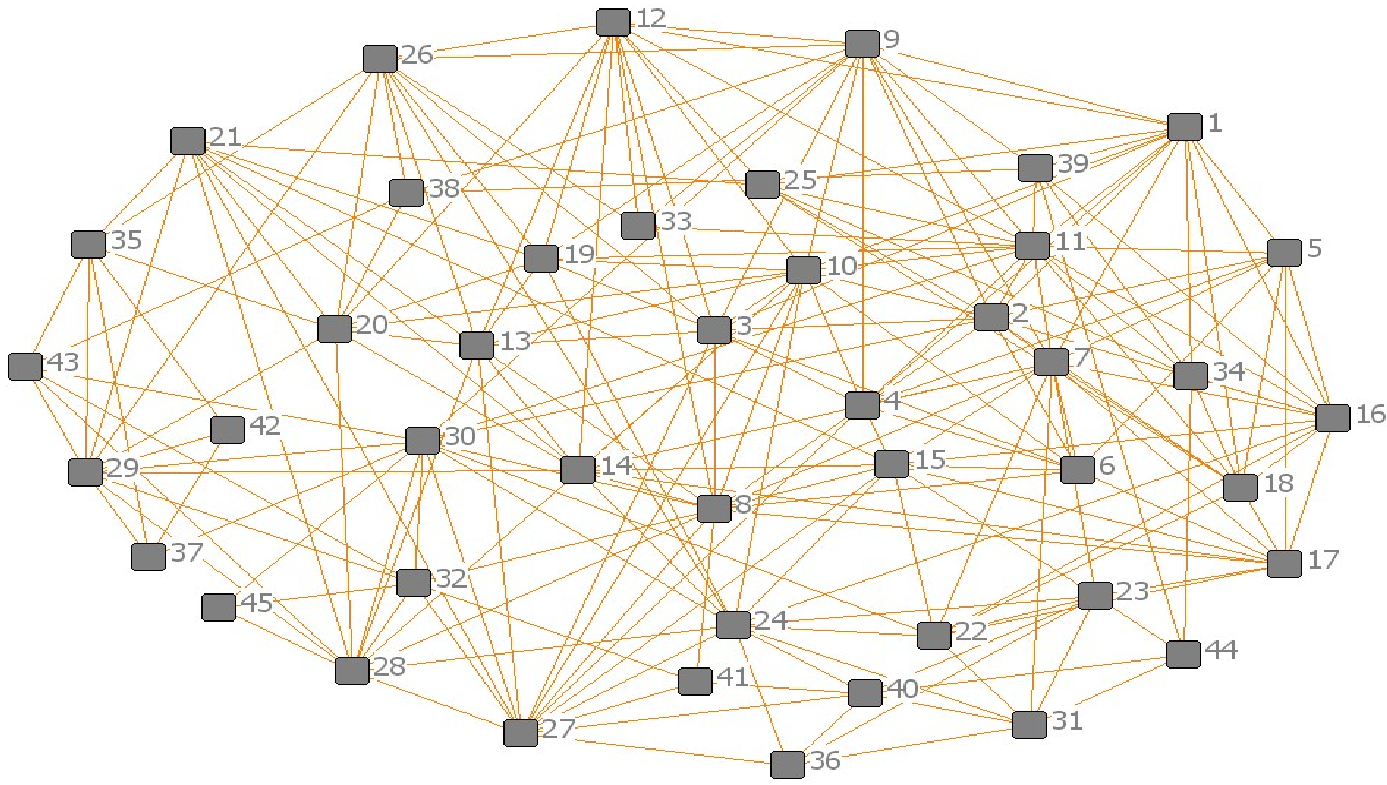
The study simulated a network of 45 families to validate the growth dynamics. The introduction of NNIC contacts led to a dramatic increase in "Triangles" (mutual relationships), which is the bedrock of community structure.
Key Performance Metrics:
- Scale-Free Nature: The degree distribution follows , where remains bounded at 3, preserving the robust architecture of a scale-free network.
- Clustering Leap: Previous models yielded . This model achieves . For large networks, this logarithmic improvement means the network is far more tightly knit than standard models would predict.
| Metric | Initial Contact (IC) | Secondary (SC) | Tertiary (NNIC) |
|---|---|---|---|
| Avg. Vertices | 2.63 | 5.36 | 2.91 |
| Avg. Triangles | 0.6 | 6.45 | 7.35 |
Critical Analysis & Future Outlook
The "NNIC" model successfully bridges the gap between abstract graph theory and sociological reality. By focusing on "tertiary contacts," it mathematically proves why "trust-based" searching is faster and yields better "matches" without diluting the reliability of the contacts.
Limitations:
- The model assumes a "homogeneous" community (e.g., same caste/region). Future iterations should explore inter-community interactions where trust may decay as one moves across different social clusters.
- The sample size of 45 families is useful for proof-of-concept but lacks the "large " behavior analysis traditional in statistical physics.
Conclusion: This research is a significant step for designing specialized social platforms—be it for marriage, research collaboration, or high-stakes financial networking—where a simple "friend" suggestion isn't enough, but a "trusted referral of a referral" is everything.
Keywords: Scale-free Networks, Clustering Coefficient, Social Discovery, Trust-based Modeling, NNIC.