
SODPSO: Leveraging Social Opinion Dynamics to Solve the Premature Convergence Problem in PSO
A Novel Social Opinion Dynamics Guided Particle Swarm Optimization
This paper introduces Social Opinion Dynamics-guided Particle Swarm Optimization (SODPSO), a novel metaheuristic that integrates sociopsychological models into the PSO framework. It leverages Bounded Confidence and Social Heterogeneity to achieve superior performance on CEC'17 benchmark functions, significantly reducing premature convergence.
TL;DR
The Social Opinion Dynamics-guided Particle Swarm Optimization (SODPSO) is a breakthrough variant of the classic PSO algorithm. By borrowing concepts from social psychology—specifically how humans exchange opinions and form "bounded confidence" clusters—this algorithm fixes the age-old problem of particles blindly following a leader into a local trap. In 30D benchmark tests, it showcases elite exploration capabilities, outperforming SOTA variants like CLPSO and HCLPSO.
Problem & Motivation: The "Blind Following" Trap
In standard PSO, particles are governed by a simple urge to follow the best local and global performers. While this leads to fast convergence, it creates a lack of diversity. Once the global leader is stuck in a local optimum, the whole "swarm" quickly follows it over a cliff.
The authors' insight is grounded in Sociology: In a real human society, we don't listen to everyone. We listen to people whose opinions are somewhat similar to ours (Bounded Confidence), and we have different personalities—some of us are "stubborn" and stick to our guns, while others are "followers" who pivot easily. SODPSO translates these social behaviors into mathematical operators.
Methodology: The Core Social Mechanics
1. Adaptive Bounded Confidence Learning
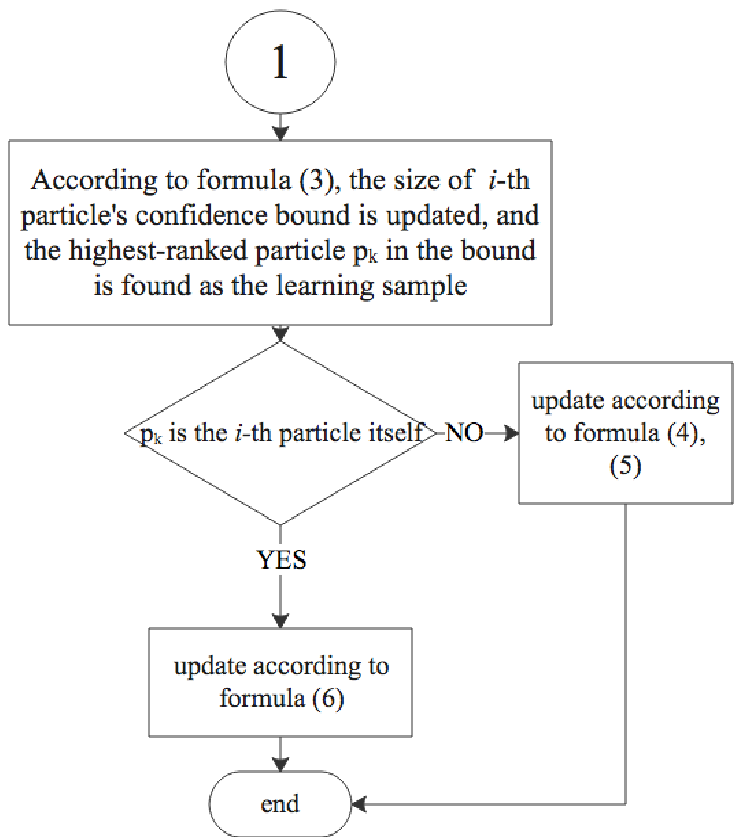
Instead of every particle learning from the same global best (), SODPSO introduces a "Confidence Bound." A particle only interacts with a learning object within a specific range determined by its ranking and stagnation count.
- The Logic: If you are performing poorly (low rank) or have been stuck for a long time, your "Confidence Bound" increases, forcing you to look further afield for better ideas.
- The Fallback: If a particle is already the best within its bound, it uses a Differential Evolution (DE) operator to search its surroundings, ensuring it doesn't just sit still.
2. Social Heterogeneity and Stagnation Recovery
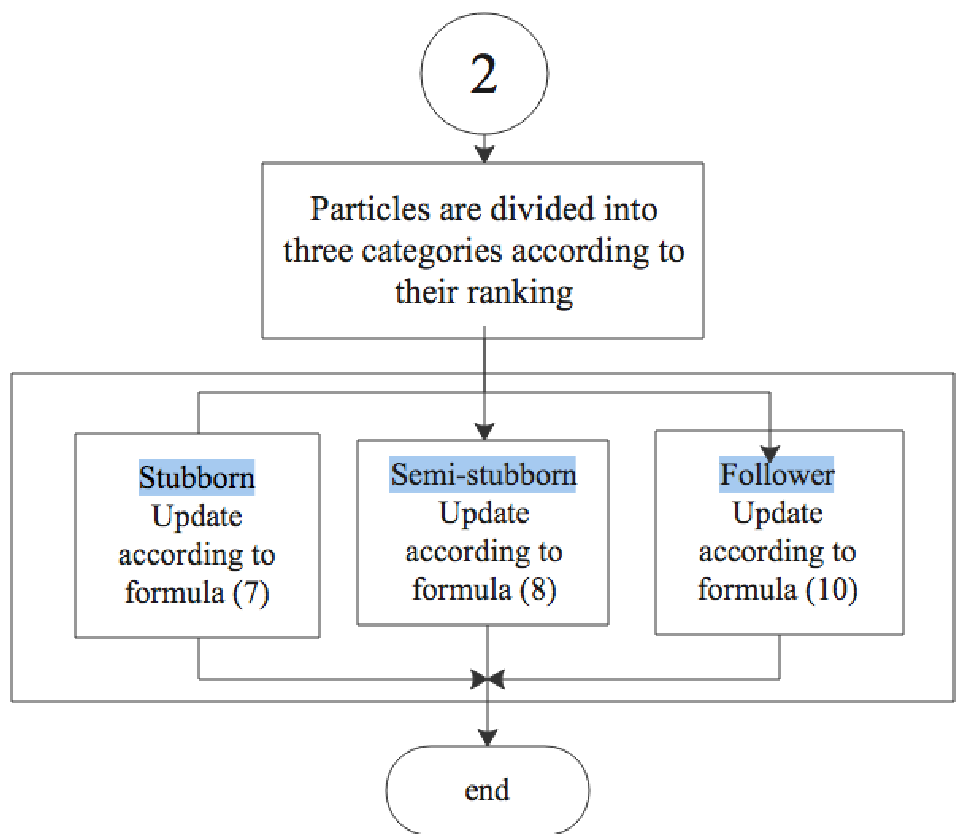
When the population stops improving (stagnation), SODPSO triggers a hierarchical update based on three classes of social agents:
| Agent Type | Selection Criteria | Behavior Strategy |
|---|---|---|
| Stubborn | Top 10% | Keeps its own position or learns only from the elite top 20%. |
| Semi-stubborn | Middle 70% | Balances its own historical best with the global best using the parameter. |
| Follower | Bottom 20% | Completely abandons its current position and uses DE to "teleport" to a new area. |
Experiments & Results: Dominating the CEC'17 Benchmarks
The authors tested SODPSO against five strong baselines (CLPSO, BBPSO, GPSO, HCLPSO, and OLPSO) on the CEC'17 benchmark functions across 10D and 30D dimensions.
- Unimodal Prowess: In functions like Bent Cigar (F1) and Zakharov (F2), SODPSO reached near-zero or zero error, while standard GPSO and BBPSO struggled significantly as dimensions increased.
- Multimodal Robustness: SODPSO's ability to maintain diversity meant it found better global minima in complex landscapes (F6, F7, F8).
- Stability: The box-and-whisker plots revealed that SODPSO has a much tighter distribution of results with fewer outliers than its competitors.
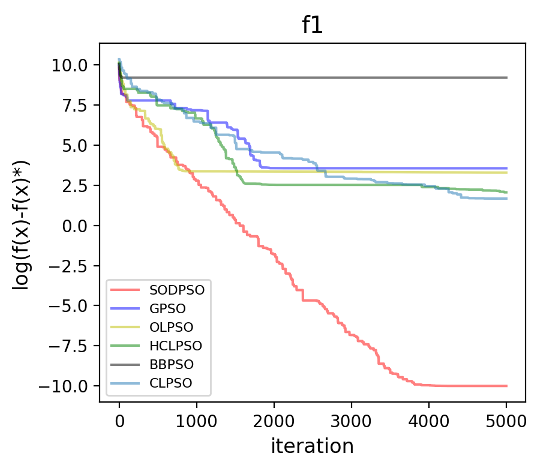 (Convergence comparison on Unimodal functions F1 and F2)
Critical Insight & Conclusion
The true value of SODPSO lies in its stagnation-aware dynamics. Most PSO variants use static topologies or cooling schedules for parameters. SODPSO, however, monitors the Population Stagnation Degree () and dynamically adjusts a threshold () to switch between social learning and heterogeneous exploration.
Limitations: The algorithm shows some instability in "Combination Functions" (F9, F10) in low dimensions, suggesting that the social rules might need further tuning for highly fragmented landscapes where every small cluster of particles becomes a separate island of "stubborn" agents.
Future Work: The transition to real-world time-series prediction optimization is the next frontier for this "sociological swarm."