
Beyond Proximity: Reimagining Social Search in LBSNs through Friend Clustering
A Novel Social Search Model Based on Clustering Friends in LBSNs
The paper introduces a novel social search model for Location-Based Social Networks (LBSNs) that ranks Points of Interest (POIs) using a multi-factor algorithm. By combining "Social Score," "Searching Score," and "Spatial Score," it achieves superior ranking accuracy in a real-world Foursquare dataset.
TL;DR
This paper presents a robust social search framework for Location-Based Social Networks (LBSNs). Unlike standard search engines, it leverages our social circles and physical locations to find the perfect "Starbucks." By clustering friends to overcome data sparsity and balancing social, professional, and spatial factors, the model delivers highly personalized and trustworthy results.
The Motivation: Why Your Friends Know Better Than Google
In the era of Foursquare and Yelp, a search query isn't just about keywords; it's about context. If you're looking for a restaurant in a new neighborhood, you don't just want the closest one—you want the one your friends loved.
However, LBSN data is notoriously sparse. Most users only check into a tiny fraction of available POIs, making it hard for traditional algorithms to find meaningful patterns. Previous research often sacrificed speed for accuracy or ignored the spatial "friction" of distance altogether.
Methodology: The Three Pillars of Ranking
The authors propose a system architecture that splits tasks into Offline Processing (heavy lifting) and Online Searching (real-time response).
1. Data Densification via K-means
To solve the sparsity problem, the model doesn't just look at direct friendships. It uses an updated K-means algorithm to cluster friends based on their check-in history. By treating check-in counts as vectors and using Cosine Similarity, the system groups users with similar tastes, effectively "filling in the blanks" of missing data.
2. The Multi-Factor Scoring System
The core innovation is the composite ranking formula ():
- Searching Score (): Powered by Apache Lucene, this measures how well the POI name and category match your query.
- Social Score (): This factor carries the most weight (0.6). It considers both the Activity (how often a friend checks in overall) and Evaluation (how specific friends rate a particular POI).
- Spatial Score (): Uses the Earth's radius and coordinates to ensure the POI is physically reachable.
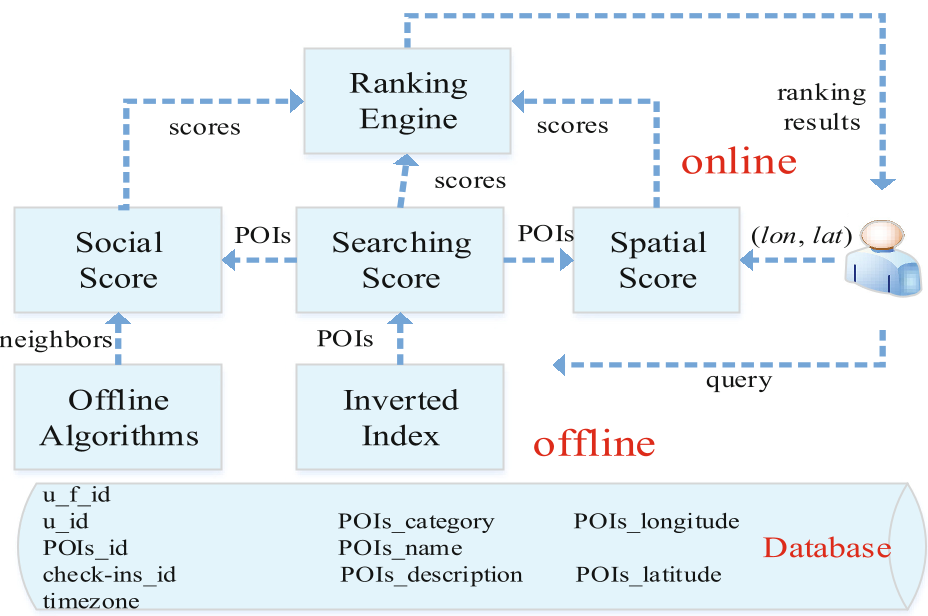 Figure 1: The Social Search Model workflow, illustrating the integration of offline database indexing and online ranking engines.
Experiments: Does it Actually Work?
The team tested their model on a Foursquare dataset from New York City, featuring over 413,000 check-ins. They compared four iterations:
- Method 1: Basic KNN (Baseline).
- Method 2: KNN + Friend Clustering.
- Method 3: KNN + Clustering + Search Relevance.
- Method 4: The Full Model (Clustering + Search + Social + Spatial).
The results were clear: Method 4 won across the board.
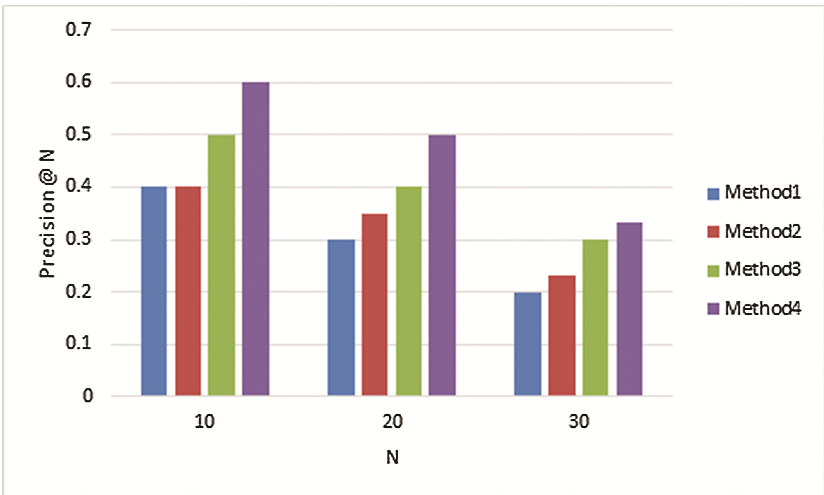 Figure 2: Precision of Top-N ranking. The steady climb of Method 4 demonstrates the value of integrating spatial data with social clusters.
Critical Analysis & Takeaways
The genius of this paper lies in its weighting strategy. By assigning the highest priority to the Social Score (), the authors acknowledge a fundamental human truth: we trust our social tribe more than a generic distance metric.
Limitations:
- The model relies heavily on "check-ins." In modern apps, "check-ins" are becoming less frequent than passive location tracking or text reviews.
- The K-means approach, while efficient, may struggle with the highly non-linear relationships found in modern social graphs.
Future Directions: Integrating Semantic Analysis (understanding the vibe of a review, not just the keywords) and optimizing for mobile battery/memory constraints will be the next frontier for this social search evolution.
Conclusion
This research proves that "Social Search" is more than just a buzzword. By mathematically modeling our social influence and geographic reality, we can transform a simple POI search into a personalized recommendation from a trusted friend.