
Beyond Mutual Friends: Leveraging Uncommon Neighbor Density for Precise Link Prediction
A Novel Strategy for Link Prediction in Social Networks
2014-12-02
Summary
Problem
Method
Results
Takeaways
Abstract
This paper introduces a novel link prediction strategy for social networks that combines common neighbor metrics with the connectivity of uncommon neighbors. Evaluated on four real-world datasets, the method achieves significant predictive accuracy, reaching an average AUC of 0.909 on the American College Football dataset.
## TL;DR
While most recommendation algorithms look at who we have in common, this paper argues that **who our unique friends know** is just as important. By introducing a novel scoring mechanism that measures the "bridge density" between two individuals' unique social circles, the authors significantly improved the accuracy of predicting future connections in networks ranging from jazz musicians to dolphin communities.
## The Missing Link in Link Prediction
In the study of social evolution, predicting a link between node $x$ and $y$ at time $t'$ based on a snapshot at time $t$ is a fundamental challenge. The prevailing wisdom follows the "Common Neighbors" logic: if you and I share many friends, we are likely to meet.
However, the authors identify a critical gap: **Prior work largely ignores the structure of uncommon neighbors.** Two people might have only one friend in common, but if their respective private social circles are heavily interconnected, the sociological pressure to form a link is much higher than if those circles were completely isolated.
## Methodology: The Two-Pronged Score
The proposed strategy moves beyond simple counting. The score is calculated as the sum of two distinct topological features:
1. **Shared Interest (Commonality)**: $\frac{|C(x,y)|}{|N(x,y)|}$ — This normalizes the common neighbors by the total union of their neighbors, similar to a Jaccard index.
2. **Social Cohesion (Uncommon Density)**: This is the "secret sauce." It counts every edge existing between the set of neighbors unique to $x$ and the set unique to $y$.
### Mathematical Intuition
$$Score(x, y) = \frac{|C(x, y)|}{|N(x, y)|} + \frac{|e_{jk} : v_j \in UC_{x}, v_k \in UC_{y}|}{|UC_{x}| imes |UC_{y}|}$$
The second term represents the **actual vs. potential links** between the two unique neighborhoods. If this value is high, it indicates that even though $x$ and $y$ don't share many direct friends *yet*, their social environments are already merging.
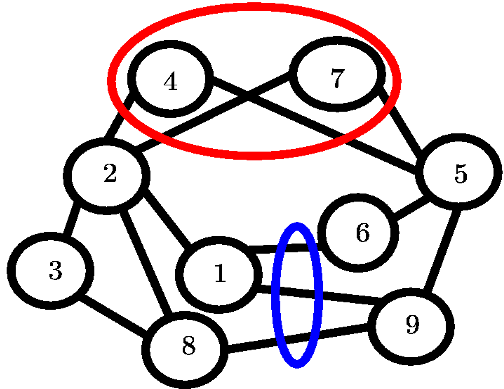
*Figure 1: Numerical walkthrough showing how common neighbors (red) and uncommon connections (blue) contribute to the final probability score.*
## Experiments & Results
The authors tested their algorithm on four classic datasets:
* **Zachary’s Karate Club**: A small social network of club members.
* **Dolphin Social Network**: Associations between bottlenose dolphins.
* **American College Football**: Games between Division IA colleges.
* **Jazz Network**: Collaborations between musicians.
### Performance Benchmarks
Using the **Area Under the ROC Curve (AUC)** as the primary metric, the results show that the model is significantly more accurate than random chance (0.5).
| Dataset | Avg. AUC | Max AUC |
| :--- | :--- | :--- |
| American College Football | **0.909** | 0.940 |
| Jazz Network | **0.882** | 0.891 |
| Dolphin Network | **0.760** | 0.828 |
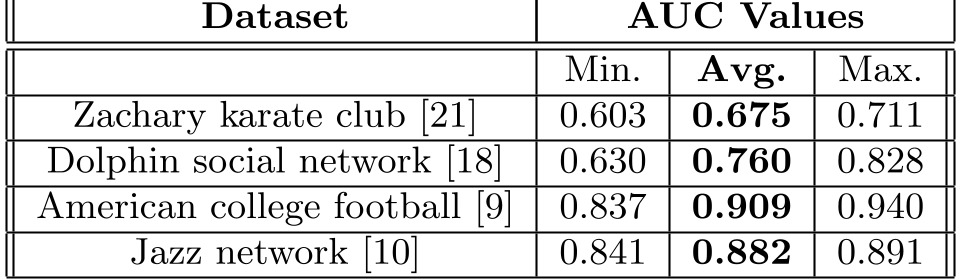
The high performance in the Football and Jazz networks suggests that in structured, professional, or hobby-based environments, the "inter-group density" of uncommon neighbors is an extremely reliable predictor of future collaboration.
## Critical Analysis & Future Outlook
**Why does it work?**
The method captures the *local clustering coefficient* in a more nuanced way. It recognizes that social networks are not just collections of triangles, but collections of densifying sub-graphs.
**Limitations:**
* **Computational Complexity**: Calculating the density between uncommon neighbors is more expensive than simple common neighbor counting, especially in "power law" networks with high-degree hubs.
* **Scale**: The paper focuses on relatively small networks (nodes < 200). How this scales to millions of nodes in a modern Twitter or Facebook graph remains to be seen.
**Conclusion:**
This work provides a refreshing perspective on link prediction by proving that "uncommonality" isn't just noise—it's latent structure. The authors suggest that this score could be reversed for **community detection**: links with consistently low scores despite existing are likely the "bridges" between different communities.