
INB-DenStream: Overcoming Asymmetry in Twitter Spam Detection via Incremental Learning
16541_A Novel Stream Clustering Framework for Spam Detection in Twitter.
This paper introduces INB-DenStream, a novel stream clustering framework for Twitter spam detection that enhances the traditional DenStream algorithm. By replacing the standard Euclidean distance with a set of Incremental Naïve Bayes (INB) classifiers in the online phase, the method achieves superior performance in identifying spam amid concept drift.
TL;DR
Twitter spam detection is a race against time and evolving tactics. INB-DenStream is a sophisticated upgrade to traditional stream clustering that abandons the rigid "one-size-fits-all" Euclidean distance. By training dedicated Incremental Naïve Bayes (INB) classifiers for each data cluster, it captures the actual shape and boundaries of spam patterns, leading to higher precision and faster adaptation to new types of attacks.
Context & Positioning
In the landscape of Online Social Networks (OSNs), Twitter generates over 400 million tweets daily. Spammers use shortened URLs and fake hashtags to bypass filters. While supervised learning offers high accuracy, it fails at scale due to labeling costs. Unsupervised stream clustering (like DenStream) is more scalable but inherently limited by the Symmetry Assumption—the idea that all clusters are nice, round spheres. In reality, spam data is messy, asymmetric, and constantly shifting (Concept Drift).
The Core Insight: Beyond Euclidean Distance
The fundamental flaw in current SOTA methods is their reliance on the mean of a cluster. If a cluster is asymmetric or reflects a complex distribution, the geometric center is a poor representative.
The authors' "Aha!" moment was realizing that microclusters can act as local training sets. By using an incremental classifier (INB) instead of a simple distance formula, the system learns the "personality" of each cluster—its mean, its variance, and its boundaries.
Methodology: How INB-DenStream Works
- Online Processing: As a tweet arrives, it is processed against existing INB classifiers. If a classifier identifies the sample with high probability (above
SimThreshold), it’s assigned there. - Fallback Mechanism: If no classifier is confident, the system reverts to Euclidean distance to see if it belongs to a new or emerging microcluster.
- Self-Evolution: Once a microcluster grows large enough (
MinC), a new INB is born. This allows the model to "learn" the shape of the data on the fly.
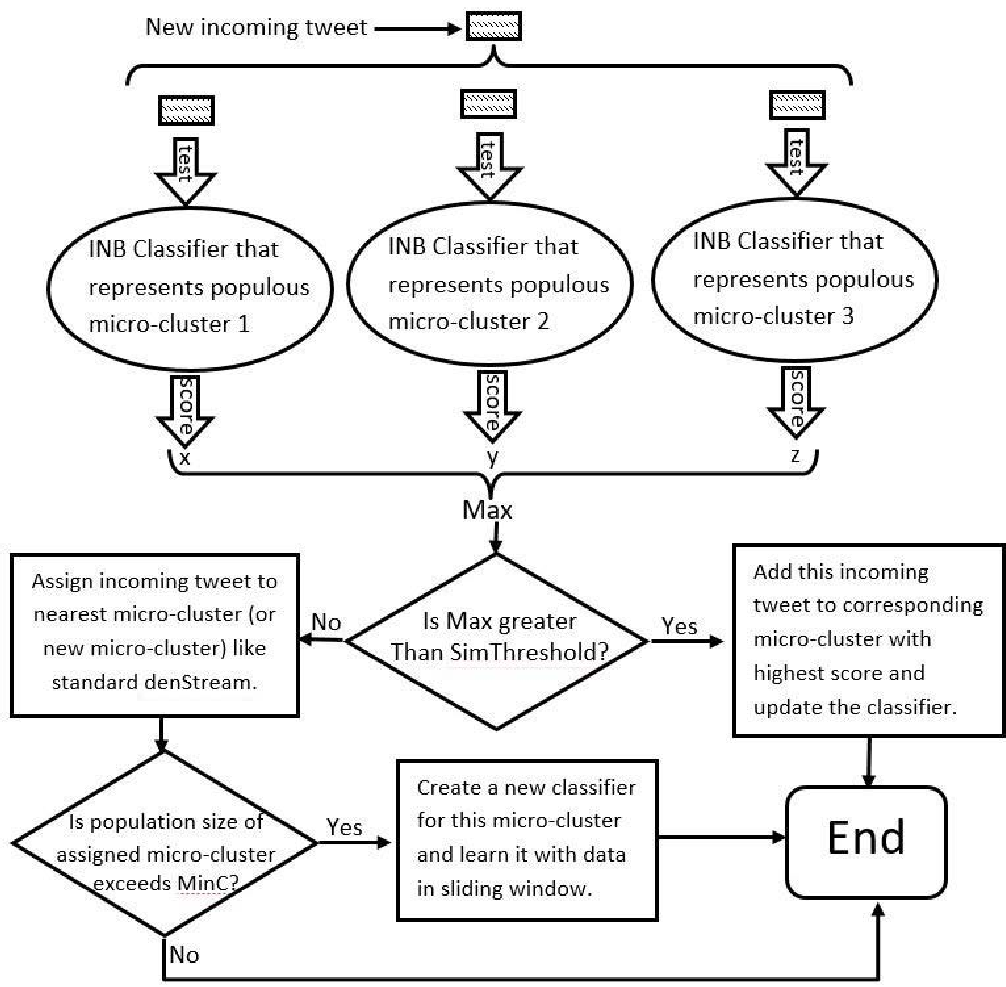 Figure 1: The INB-DenStream flowchart illustrating the hybrid classifier-distance logic.
Experimental Performance
The researchers tested the framework against DenStream, StreamKM++, and CluStream using Twitter APIs.
1. Superior Accuracy and Recall
On large datasets (Dataset-III and IV), INB-DenStream consistently achieved the highest F1-measures. It proved particularly effective at catching "outlier" spam that traditional distance-based methods would have misclassified as noise or normal traffic.
2. Adaptation to Concept Drift
One of the most impressive results is the adaptation speed. As shown in the time-series analysis, once the system sees enough samples to train its INBs (typically after 5,000–7,000 samples), its performance stabilizes at a much higher level than the baseline.
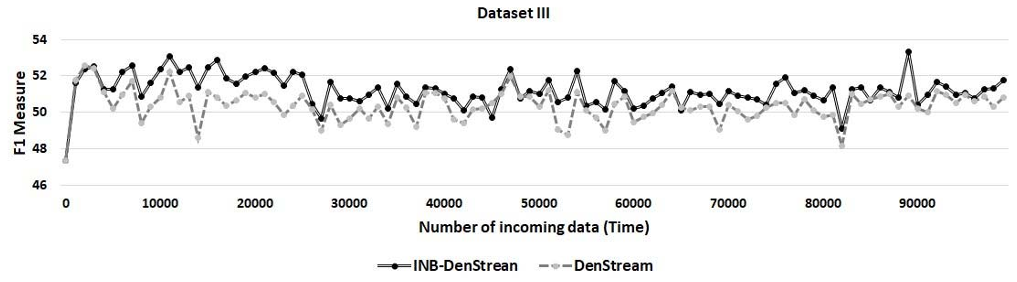 Figure 2: Time series comparison showing the rapid performance ascent of INB-DenStream compared to standard DenStream.
3. Feature Sensitivity
Using Infinite Latent Feature Selection (INFfs), the study identified that Account-age and # of characters were the most predictive features for spam, while follower counts were less reliable. This dimensionality reduction further boosted the performance of the DBSCAN-based offline phase.
Complexity and Robustness
Despite adding "intelligence" to the clusters, the computational overhead is negligible. Because INB updates are incremental (O(|F|)), the system remains real-time. Moreover, the probabilistic nature of the classifiers makes the system significantly more robust to noise (Signal-to-Noise Ratio tests) compared to rigid distance-based models.
Critical Analysis & Future Outlook
Takeaway: This work proves that "clustering-classification hybrids" are the future of stream mining. By letting the clusters define their own decision boundaries through local models, we solve the historical weakness of density-based clustering.
Limitations: There is a slight "adaptation delay" at the start of the stream while the system waits to reach the MinC threshold.
Future Work: The authors suggest exploring Distance Learning in the online phase to further refine how we measure "belongingness" in high-dimensional feature spaces.
Keywords: Twitter Spam Detection, Stream Clustering, DenStream, Incremental Naïve Bayes, Concept Drift.