
Balancing the Tug-of-War: A Two-Stage TWD Approach to Crowdsourcing Task Allocation
A novel approach of two-stage three-way co-opetition decision for crowdsourcing task allocation scheme
This paper introduces a two-stage three-way decision (TWD) framework for crowdsourcing task allocation, integrating Data Envelopment Analysis (DEA) and fuzzy measures. The method successfully models the "co-opetition" paradox—where candidates simultaneously compete for personal gain and cooperate for collective output—achieving superior group utility compared to traditional TOPSIS and binary decision models.
TL;DR
Crowdsourcing isn't just about picking the best worker; it's about managing a complex ecosystem where participants compete to get in but must cooperate to succeed. This paper presents a novel two-stage three-way decision (TWD) model that uses DEA to handle competition and fuzzy measures to optimize cooperation. Tested on a medical supply chain scenario, it significantly boosts total utility over traditional sorting methods.
The "Co-opetition" Paradox
In modern crowdsourcing, we often see a strange phenomenon: Co-opetition. Companies like Huawei and Qualcomm are rivals in the chip market (Competition), yet they are vital partners in supply chains (Cooperation).
Existing allocation algorithms often fail because:
- They assume a binary state (Accept/Reject), which ignores the risk of "not knowing enough."
- They treat participants as static entities, ignoring how their performance changes when paired with others.
Methodology: The Two-Stage Architecture
The researchers break the problem into a logical progression that mirrors real-world business negotiations.
Stage 1: The Competition-Optimization Model
Here, the goal is to respect the "rational agent" nature of candidates. Each candidate wants to showcase their best side.
- DEA (Data Envelopment Analysis): The model uses DEA to find the "dominant weight vector" for each candidate, effectively allowing them to highlight their personal strengths (e.g., hardware over intellectual property).
- Initial TWD: Instead of a hard cut-off, candidates are placed into three regions: Positive (Accept), Negative (Reject), and Boundary (Defer). This "Three-Way" approach reduces the loss associated with misclassification.
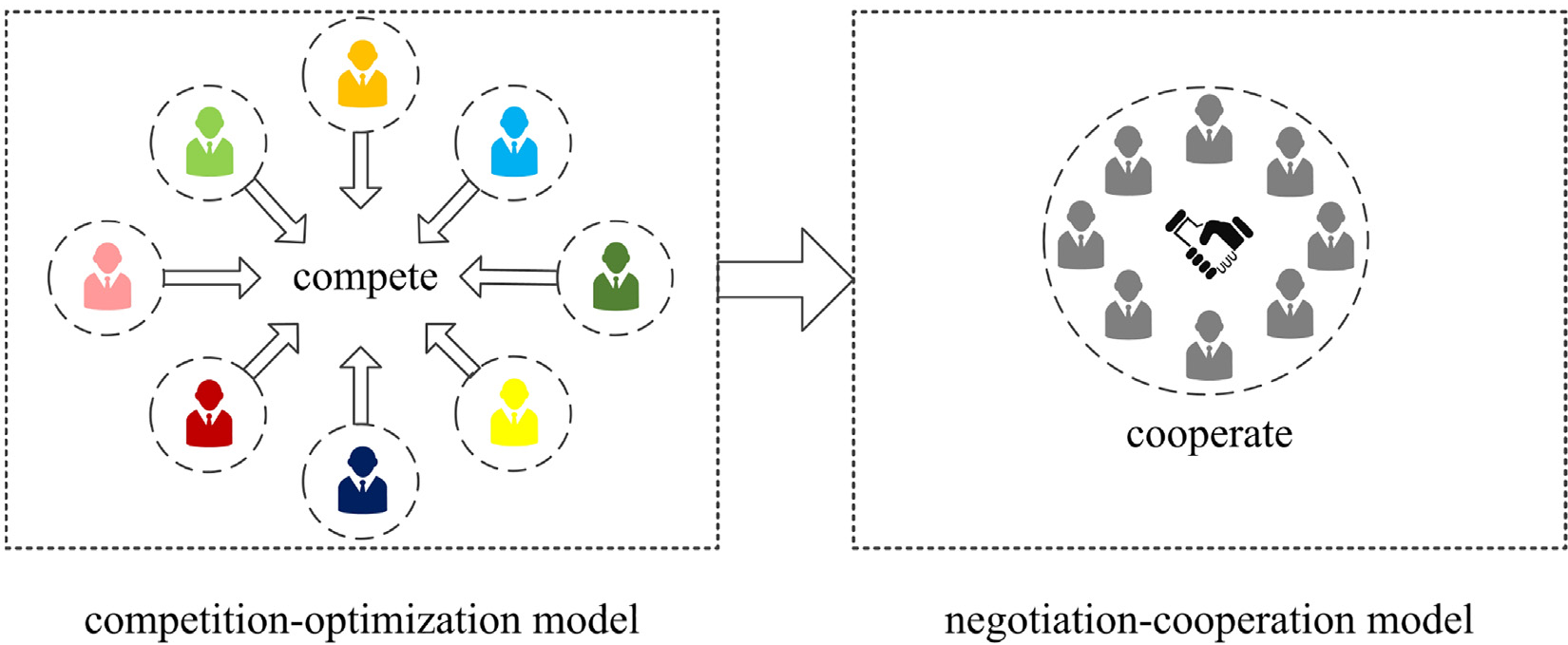
Stage 2: The Negotiation-Cooperation Model
Once we have a pool of "potential" winners, the model shifts focus to the Group.
- Fuzzy Measures (-fuzzy): This is the mathematical "secret sauce." It quantifies the synergy between candidates. If Candidate A and B work exceptionally well together, their combined "measure" is higher than the sum of their individual parts.
- Optimization Schemes: The authors propose two ways to adjust the initial pool:
- Scheme 1 (Utility Max): "Who gives us the best result together?"
- Scheme 2 (Loss Min): "How do we minimize the risk of a bad hire?"
Experimental Validation: Medical Supply Chain
The model was tested against the backdrop of the 2019-nCoV epidemic, where medical supply chain tasks (logistics, drug procurement, disinfection) required rapid, high-stakes allocation.
SOTA Comparison
Against benchmarks like TOPSIS and 0-1 Linear Programming, the Two-Stage TWD model provided higher utility scores consistently.
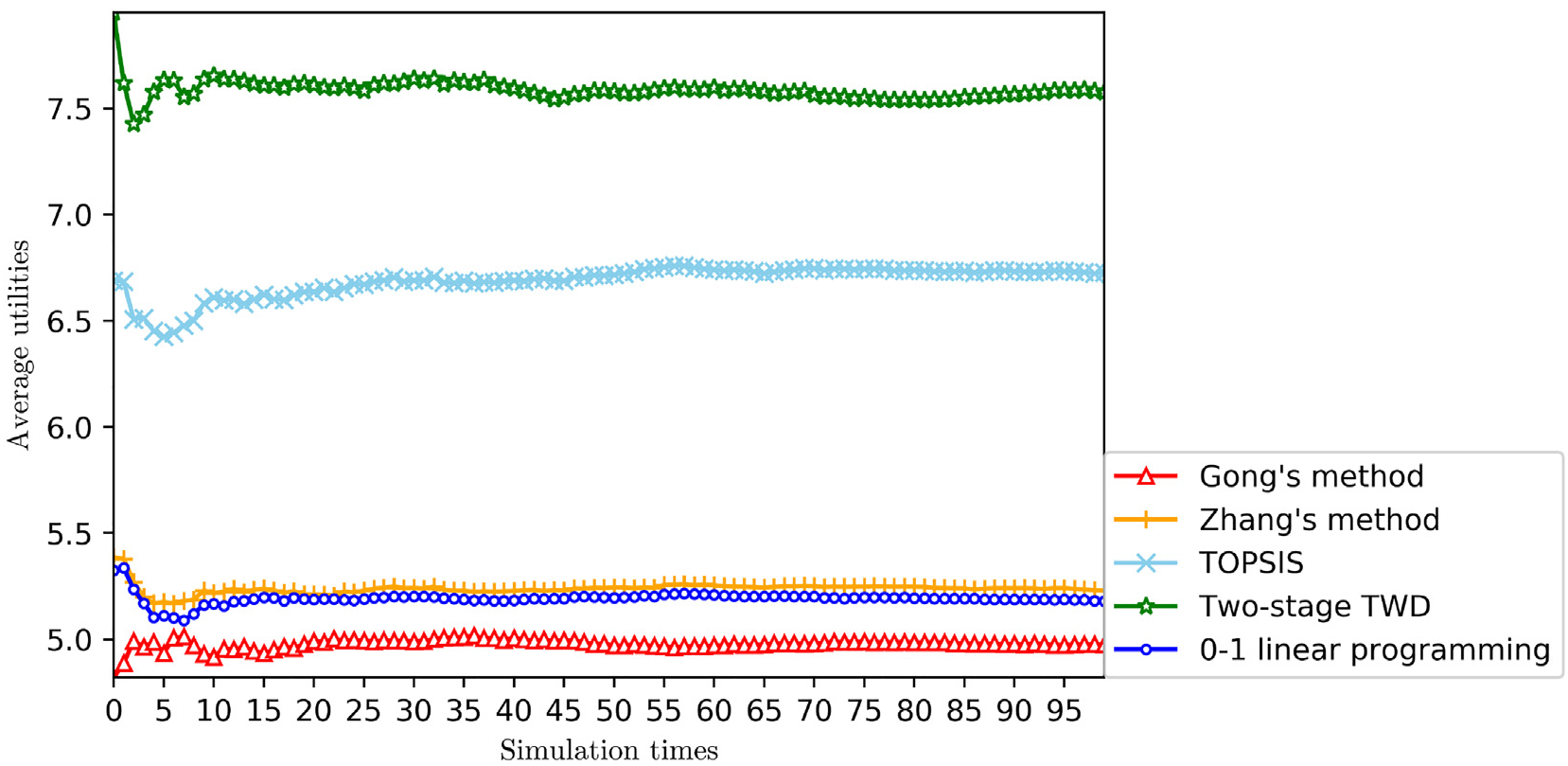
- Key Finding: As simulation rounds increased, the TWD approach maintained a superior and stable utility margin over traditional methods.
Sensitivity Insight
The researchers found that the preference coefficient ()—which balances objective evaluation data with risk-based loss functions—is critical. When is balanced (middle range), more candidates fall into the "Boundary" region, acknowledging the complexity of the information and preventing hasty, high-risk decisions.
Critical Insight & Conclusion
The brilliance of this work lies in its Inductive Bias: it assumes that human collaboration is non-additive. By moving away from simple linear rankings and embracing the "Three-way" cognitive logic (Accept/Reject/Wait), the framework provides a more robust tool for managers in volatile environments like emergency medical supplies.
Future Outlook: While powerful, the model currently relies on experts to define loss functions. Integrating Machine Learning to automatically learn these losses from historical performance data could make this an autonomous "AI Manager" for crowdsourcing platforms.