
UMM-CSGM: Unifying Multi-modal Medical Image Completion via Score-based Diffusion
A Novel Unified Conditional Score-based Generative Framework for Multi-modal Medical Image Completion
The paper introduces the Unified Multi-Modal Conditional Score-based Generative Model (UMM-CSGM), a novel framework for multi-modal medical image completion. By utilizing a multi-in multi-out Conditional Score Network (mm-CSN), it achieves state-of-the-art results on the BraTS19 dataset, effectively synthesizing missing MRI modalities from any available combination.
Executive Summary
TL;DR: UMM-CSGM is a groundbreaking framework that applies Score-based Generative Models (SGM) to the problem of missing medical image modalities. Unlike traditional GANs that produce "blurry averages" due to deterministic mapping, UMM-CSGM models the full conditional distribution, allowing it to synthesize highly detailed pathology (like tumor textures) from any available combination of MRI sequences using a single, unified network.
Academic Positioning: This work represents a shift from GAN-based medical image translation to Diffusion/Score-based paradigms. It is one of the first to successfully implement a "unified" conditional framework where a single model handles multiple missing-modality configurations without retraining.
Problem & Motivation: The Pitfalls of Determinism
In clinical practice, acquiring a full suite of MRI modalities (Flair, T1, T1c, T2) is often impossible due to time constraints or patient movement. While we can "predict" missing modalities, the relationship between, say, a T1 and a T2 scan is not 1:1.
Existing SOTA methods, largely based on cGANs (Conditional Generative Adversarial Networks), suffer from:
- Mode Collapse/Averaging: They often learn a deterministic mapping, outputting a safe "average" image that lacks the high-frequency textural details of tumors.
- Inflexibility: Most models are trained for specific pairs (e.g., T1 T2). If T1c is missing instead, a new model is needed.
The authors' insight is that Score-based models—which learn to reverse a diffusion process—are naturally probabilistic and can better represent the "one-to-many" nature of cross-modal translation.
Methodology: Score Matching in the Complete Space
The core innovation lies in the Unified Multi-Modal Conditional Diffusion. Instead of standard unconditional generation, the authors define a Forward SDE that only adds noise to the "missing" modalities () while keeping the "available" modalities () clean.
1. The Unified Diffusion Process
The framework operates in a joint space. During training, the model is taught to recover from noise, given as a constant condition. Because the sets and are partitioned randomly during training, the network learns the conditional score function for mathematically every possible subset of modalities.
2. mm-CSN Architecture
The multi-in multi-out Conditional Score Network (mm-CSN) uses a U-Net backbone. It takes the concatenated modalities (some noisy, some clean), the time step , and a configuration code.
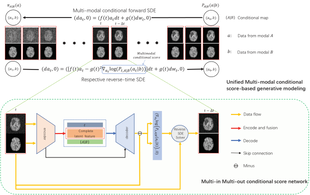 Figure 1: The upper panel shows the conditional reverse SDE process; the lower panel details the mm-CSN structure.
Experiments & Results
The model was validated on the BraTS19 brain tumor dataset. The results show a clear quantitative lead over established baselines like Hi-Net and MM-GAN.
Quantitative Edge
| Modality | Ours (PSNR) | MM-GAN (PSNR) | Improvement |
|---|---|---|---|
| Flair | 25.73 | 23.98 | +1.75 dB |
| T1 | 29.92 | 28.01 | +1.91 dB |
| T1c | 27.81 | 26.24 | +1.57 dB |
Qualitative Fidelity
The most striking difference is in lesion synthesis. As seen in the figure below, UMM-CSGM (red boxes) recovers the distinct contrast between grey and white matter and the complex, heterogeneous appearance of malignant tumors, whereas GAN-based methods (Hi-Net, MM-GAN) produce smoother, less realistic textures.
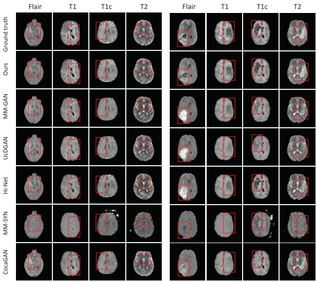 Figure 2: Comparison of synthesis quality. Note the superior detail in the tumor regions in the 'Ours' row compared to the blurry results of GAN-based baselines.
Critical Analysis & Conclusion
Takeaway
UMM-CSGM proves that Score-based SDEs are superior for medical imaging because they don't just "guess" the missing data; they model the distribution of what that data could be. The unified training strategy also makes it highly practical for real-world clinics where "available modalities" change patient by patient.
Limitations
- Inference Speed: Like all diffusion-style models, UMM-CSGM requires iterative sampling (1000 steps in the paper), which is significantly slower than the one-pass inference of a GAN.
- Dataset Scope: While BraTS is a standard benchmark, the performance on non-brain pathologies (where modality relationships differ) remains to be seen.
Future Outlook
The next logical step for this research is the integration of Fast Sampling techniques (like DDIMs or Consistency Models) to make this viable for real-time clinical workflows, and extending the framework to 3D volumes to capture spatial continuity.