
DWT-Otsu: A Robust and Imperceptible Authentication Shield for Social Network Images
A novel watermarking scheme for image authentication in social networks
This paper introduces a blind digital image watermarking scheme for color image authentication in social networks using a 4-level Discrete Wavelet Transform (DWT). The method employs an optimal color-channel selection and quantization technique to embed binary watermarks into the LH and HL sub-bands, achieving SOTA-level imperceptibility and robustness against common signal processing attacks.
TL;DR
Researchers have developed a novel blind watermarking scheme that leverages a 4-level Discrete Wavelet Transform (DWT) and optimal RGB channel selection to hide authentication data. By using an adaptive Otsu-based threshold for extraction, the method significantly boosts image quality (over 48 dB CPSNR) while remaining resilient to JPEG compression and noise—essential for images shared across social media.
Problem & Motivation: The Fragility of Digital Ownership
In the era of social media, millions of images are uploaded daily, yet users rarely retain verifiable copyright. Traditional watermarking—the process of embedding a "signature" into an image—often suffers from two fatal flaws:
- Perceptual Degradation: The "hidden" data becomes visible, ruining the aesthetics of high-quality photos.
- Fragility: Simple operations like resizing, filtering, or JPEG compression (common in social media uploads) often destroy the watermark.
The authors' insight was to move beyond the spatial domain and single-channel embedding (like just the luminance channel), aiming instead for a multi-channel wavelet-based approach that adapts to the specific characteristics of every image.
Methodology: Precision in the Wavelet Domain
The core of the system is the 4-level DWT decomposition. By focusing on the middle-frequency sub-bands (LH and HL), the method avoids the noise-sensitivity of low frequencies (LL) and the compression-vulnerability of high frequencies (HH).
1. Optimal Channel Selection
Instead of forcing bits into a specific color channel, the algorithm calculates a "quantization cost" for the Red, Green, and Blue channels for every single bit. It then selects the channel where the embedding will cause the least perceptual change. Mathematically, it chooses: This ensures that the watermark remains invisible to the human eye.
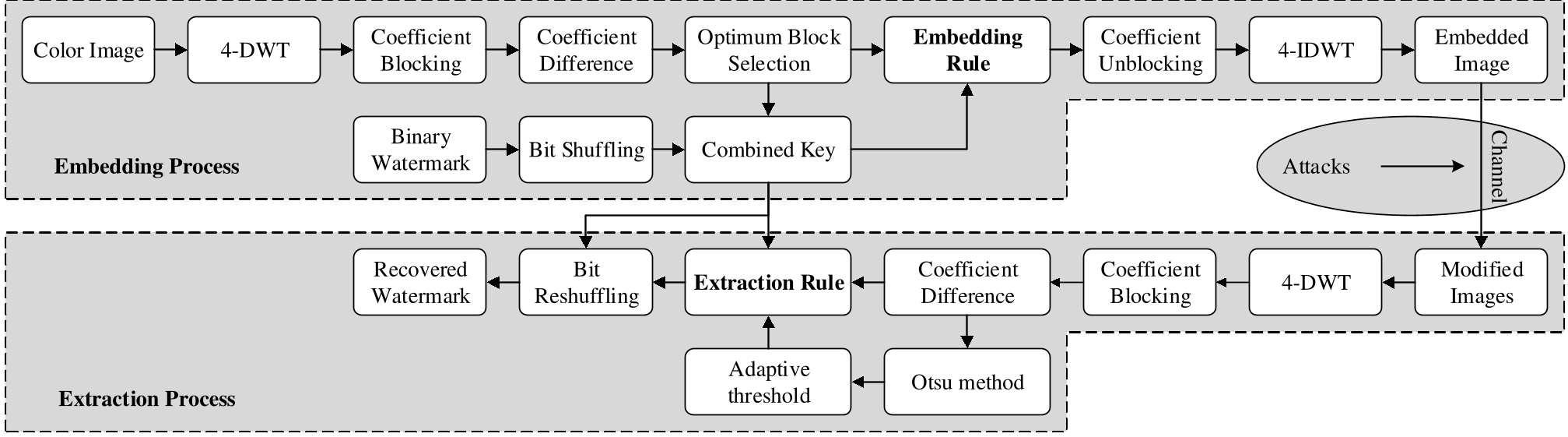 Figure 1: The overarching workflow for embedding and extracting the watermark using DWT and Otsu thresholding.
2. Blind Extraction via Otsu's Method
The "blind" nature of this model is its greatest strength—it doesn't need the original image to extract the watermark. It uses the Otsu Method, an algorithm typically used in image segmentation, to find the optimal threshold between 0-bits and 1-bits in the modified coefficients, adapting dynamically to whatever attacks the image may have undergone.
Experiments & Results: SOTA Performance
The researchers benchmarked the scheme against the USC-SIPI database, testing against geometric distortions, filters, and noise.
Performance Highlights:
- Imperceptibility: The method achieved a CPSNR of 48.17 dB on the Lena image, compared to 40.71 dB for existing SOTA methods like Niu et al. Generally, anything over 35 dB is considered excellent; 48 dB is virtually indistinguishable to the human eye.
- Compression Resilience: Even at a JPEG Quality Factor (QF) of 40%, the watermark recovery remained nearly perfect (NC = 0.994).
- Filtering: Both Median and Gaussian filters (7x7) failed to destroy the watermark, with Normalized Correlation (NC) hitting a perfect 1.000.
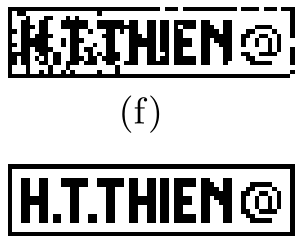 Figure 2: The watermarked "Lena" image under various attacks. Note that even under heavy compression (j, k, l), the visual quality remains high while the watermark is still recoverable.
The Trade-off: The Achilles' Heel
While the system is a powerhouse against noise and compression, it struggles with geometric rotations (e.g., rotating the image by 5 degrees) and cropping. Because the watermark bits are spread across the wavelet tree of the entire image, losing a large chunk of the spatial structure (cropping) or misaligning the grid (rotation) leads to a drop in extraction accuracy.
Critical Analysis & Conclusion
This work represents a significant step forward for unobtrusive digital signatures. By treating the three RGB channels as independent resources and selecting the "path of least resistance" for quantization, the authors have achieved a remarkably high fidelity.
Takeaway for the Industry: If you are building an authentication system for social media (where JPEG compression is inevitable), wavelet-based quantization with adaptive thresholding is far more reliable than traditional spatial domain steganography. However, for a complete solution, future work must integrate secondary "pilot signals" or Interest Point Extraction to counter rotation and cropping attacks.