
Empathy as a Catalyst: How Emotional Contagion Transforms Developer Mindsets
Improvement of Novice Software Developers’ Understanding about Usability: The Role of Empathy Toward Users as a Case of Emotional Contagion
This paper presents a quasi-experiment investigating how observing usability evaluations affects novice software developers' understanding of HCI principles. It introduces the "Emotional Contagion" (EC) framework to explain why direct user observation significantly outperforms traditional training in fostering developer empathy and usability awareness.
TL;DR
Why do developers often ignore usability despite extensive training? This paper argues that the problem isn't "knowledge"—it's a lack of empathy. By conducting a quasi-experiment with novice developers, researchers found that observing users creates a psychological process called Emotional Contagion, where developers unconsciously "catch" user frustration, leading to a 45% increase in their ability to identify usability flaws.
The "Broken Bridge" Between Code and Users
In the world of Software Engineering (SE), there has always been a friction point: developers focus on how it works (logic, efficiency), while Human-Computer Interaction (HCI) focuses on how it feels to the user.
Existing literature points to a "lack of understanding" as the primary barrier. However, the authors of this study suggest that this isn't just a cognitive deficit. Instead, it’s a motivation and empathy deficit. Traditional training lacks the "gut punch" of seeing a user fail to find a button you spent three days coding.
Methodology: The Quasi-Experiment
The researchers grouped nine students (SE and CS majors) and tasked them with conducting usability evaluations. They used a "Pre-test/Post-test" design (1DC and 2DC) to track how their perspectives shifted after watching real humans struggle with their code.
Data Collection Framework:
- Form F1: Identifying strengths (S) and weaknesses (W) of the software.
- Form F2: Ranking the relative importance of SE concepts (e.g., UML, Object-Oriented patterns) vs. HCI concepts (e.g., Gestalt Laws, User Interface Design).
- Interviews: Qualitative deep dives to uncover the "why" behind the shift.
From Technical Ego to User Empathy
The results were stark. Before the test, developers were blind to their own UI failures. After the test, the mask fell off.
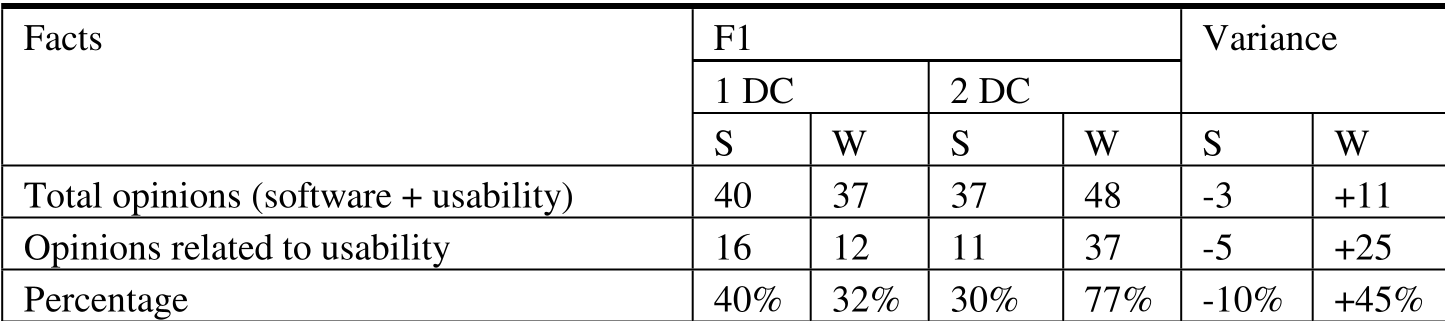
As shown in the table above, the number of usability weaknesses identified by developers jumped from 32% to 77%. This wasn't because they "learned" new rules in those two weeks; it was because they finally saw the reality of their design.
The Emotional Contagion (EC) Pivot
The core insight of this paper is the role of Emotional Contagion. EC is a process where an observer (the developer) unconsciously mimics and synchronizes with the emotions of the observed (the user).
- The Observation: During the tests, developers initially felt "hilarious" or "embarrassed."
- The Internalization: After the tests, these feelings transformed into a cognitive realization: "The user knows how the user wants the design; the designer does not."
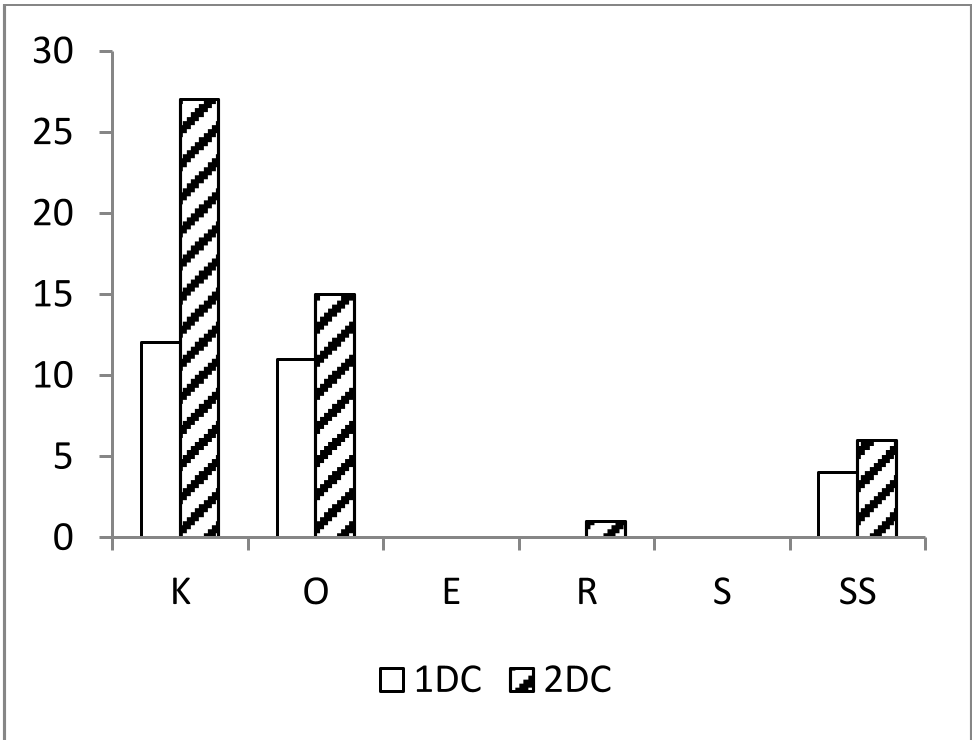
- The Result: The developers didn't just find bugs; they developed a preference for usability (categorized as "Knowability" and "Operability").
Critical Insight: Why This Matters
The study proves that usability isn't a "soft skill" you can teach solely in a classroom. It is an affective response.
- Direct Observation is Irreplaceable: Traditional HCI lectures provide the labels (e.g., "this is a Gestalt law"), but observation provides the motivation to apply them.
- The Unconscious Shift: Developers don't realize they are changing. The empathy is acquired unconsciously through the stress of watching someone fail at a task they deemed "easy."
- Role Reversal: In the EC process, the user becomes the "dominant" party (providing the emotional stimulus), and the developer becomes the "submissive" observer (receiving it), breaking the developer's "God-mode" complex over their code.
Conclusion & Limitations
The study concludes that Emotional Contagion is the engine behind usability awareness. If you want better software, you don't need more manuals; you need developers to feel the pain of their users.
Limitations: The study used a small sample size (9 students) and focused on novices. Experienced developers might have more rigid "ego defenses" that could resist Emotional Contagion, or they might be more cynical about user error.
Future Outlook: Integrating "Empathy Sessions" into the standard Sprint cycle could be more effective than any "Usability Handbook." When the developer "catches" the user's confusion, the code inevitably improves.