
NOYB: Can We Reclaim Privacy Without Quitting Social Media?
NOYB: Privacy in Online Social Networks
This paper introduces NOYB (None Of Your Business), a privacy-preserving framework for Online Social Networks (OSNs) like Facebook. It uses a pseudorandom substitution cipher to replace sensitive user data with "fake" but semantically valid atoms from a public dictionary, achieving SOTA-level privacy without breaking core social functionalities or requiring service provider cooperation.
TL;DR
In an era where "data is the new oil," Facebook and Google have turned personal privacy into a commodity. NOYB (None Of Your Business) is a vintage yet revolutionary approach that allows users to encrypt their profiles by replacing real data with "fake" information that looks identical to the real thing. It preserves the social experience for your friends while keeping the service provider completely in the dark.
Positioning: This work is a foundational "adversarial" privacy framework that operates under the assumption that the service provider is a hostile entity.
The Core Conflict: Privacy vs. Utility
The fundamental problem with cloud computing is the conflict of interest. Users want service; advertisers want data. Most privacy solutions (like full-disk encryption) are "all-or-nothing"—if you encrypt your Facebook profile, the site looks broken, and you’ll likely be banned for violating terms.
The authors discovered a clever loophole: Social networks don't actually care if your data is "true," they just care that it is "valid." If your profile says you enjoy "Classic Rock" (fake) instead of "Techno" (real), the site continues to function perfectly.
Methodology: The Art of Hiding in Plain Sight
NOYB’s genius lies in its Pseudorandom Substitution Cipher. Instead of turning your age "25" into a random string like "Xy9!z," NOYB turns it into "28"—a value that belongs to another legitimate user.
1. Atomic Partitioning
Data is split into "atoms" to maintain internal consistency. For example, (Name, Gender) are kept together so you don't end up with a profile that says "Name: David, Gender: Female," which would be a dead giveaway to a detection bot.
2. The Dictionary & FLookup
To ensure the "fake" data looks statistically normal, NOYB uses a dictionary.
- Lookup: Real Atom Index.
- Encrypt: Index Ciphered Index (via AES).
- FLookup: Ciphered Index Ciphered Atom (respecting the original frequency distribution).
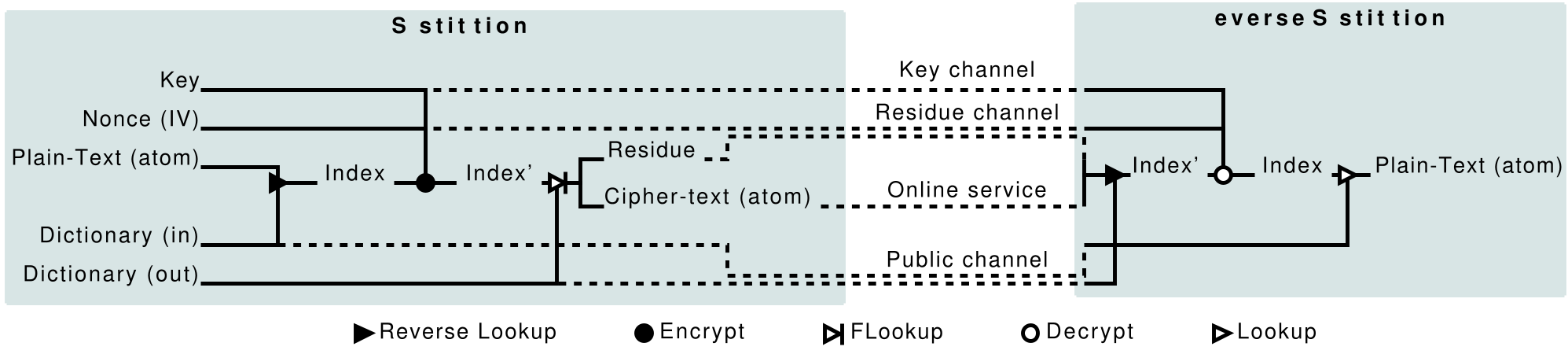
3. The Multi-Channel Strategy
To stay "under the radar," NOYB splits its communication:
- Public Channel: The OSN (stores the "fake" data).
- OOB Channel: Email or P2P (for key exchange).
- Residue Channel: Steganography hidden in profile pictures (to store the encryption nonces).
Experiments: Scalability and Stealth
The researchers built a Firefox plugin to test NOYB on Facebook. They found that because many users share the same interests, the dictionary grows sublinearly. This means the system can scale to millions of users without the metadata becoming a storage bottleneck.
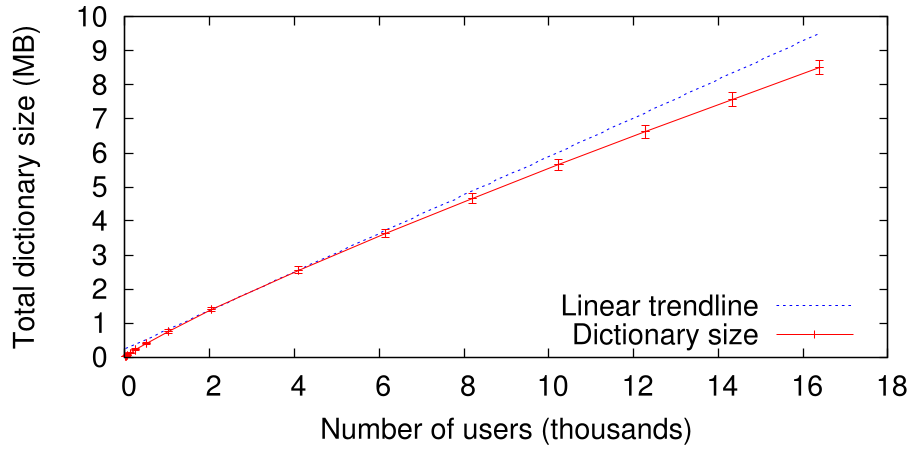
Key Findings:
- Stealth: By matching the marginal distribution of data, the "fake" profiles are statistically indistinguishable from real ones to basic Bayesian filters.
- Scalability: A dictionary for 1 million users would take only ~344 MB, which is easily manageable for modern client-side hardware.
Critical Insight: The "Why"
Why does this work better than standard encryption? Because of Inductive Bias Preservation. By ensuring the output of the encryption process yields "socially plausible" data, NOYB exploits the service provider's own need for high-quality (looking) data. The provider is hesitant to ban a user who looks like a normal, high-value target for advertisers, even if that target is a mathematical ghost.
Conclusion & Limitations
NOYB proves that we can achieve Contextual Integrity even on platforms that are designed to strip it away. However, it isn't perfect:
- Searchability: Because the encryption is probabilistic, you can't easily search for your friends unless you share a deterministic key for specific fields (like University).
- Targeting: While it protects you, it also breaks the "good" parts of targeting—you might get ads for things you truly don't care about.
Ultimately, NOYB is a powerful reminder that in the battle for digital privacy, the most effective weapon isn't always a stronger lock, but a better disguise.