
Nudge for Reflection: Beyond the Surface of Political Knowledge
Nudge for Reflection: More Than Just a Channel to Political Knowledge
This paper introduces an interface nudge designed to provoke "reflection" in online political discourse, specifically regarding public policy issues like fertility rates in Singapore. The researchers used a between-subjects experiment (N=168) to demonstrate that reflection is not merely a precursor to political knowledge but a critical mechanism for enhancing attitude certainty and private opinion expression.
TL;DR
In a digital landscape where online comments are often toxic and polarized, can a simple interface design change how we think? This CHI '21 paper demonstrates that "nudging" users to reflect—specifically by taking the perspective of their opponents—does more than just teach them facts. It fundamentally alters their attitude certainty and increases their willingness to discuss sensitive issues in private, effectively turning passive information consumption into active, structured deliberation.
Academic Positioning: This study moves beyond the traditional view of reflection as a simple "channel to knowledge." It shifts the focus toward opinion quality and the psychology of expression, situating itself at the intersection of HCI, Political Communication, and Behavioral Economics.
Motivation: The Chaos of Online Discourse
Most existing "Civic Tech" focuses on what information people see. However, the authors argue that the problem isn't just a lack of facts; it's a lack of reflection. Previous studies defined reflection as "elaborative processing"—connecting news to what you already know.
The authors identify a gap: reflection isn't just about you. In a democratic society, reflection should involve perspective-taking—the mental act of stepping into the shoes of someone you disagree with. Why don't people do this? Because it requires high cognitive effort. The solution? A nudge.
Methodology: Designing the Reflection Nudge
The researchers created an interface using interactive slides about Singapore's fertility policies. The core "nudge" was a mandatory question-asking phase.
The "Perspective-Taking" Task
Unlike simple surveys, the "High Reflection" group had to write out:
- Their own clarified opinion.
- Why someone might disagree with them.
- What the reasons behind that disagreement might be.
Experimental Design
The study used a 2x3 between-subjects design:
- Information Access: With vs. Without briefing materials.
- Reflection Level: No, Low, or High (determined by word count/engagement).
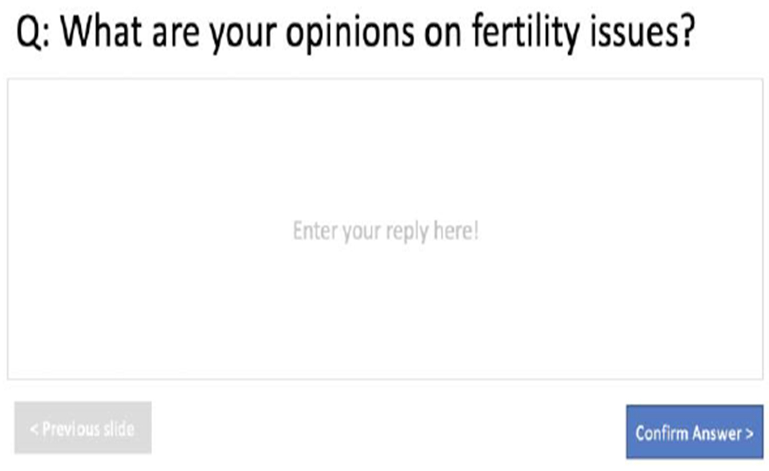 Figure 1: The UI used to nudge participants into reflecting on opposing viewpoints.
Key Insights: Why Reflection Matters
1. The "Ignorance is Bliss" Interaction
One of the paper’s most striking findings is the interaction between information and reflection.
- Without Information: Low reflection actually made people realize how little they knew (exposing ignorance), whereas those who didn't reflect at times felt more confident in their knowledge (ignorance is bliss).
- With Information: High reflection significantly boosted perceived knowledge.
Takeaway: Nudges are dangerous in a vacuum. To be effective, reflection must be anchored to factual information.
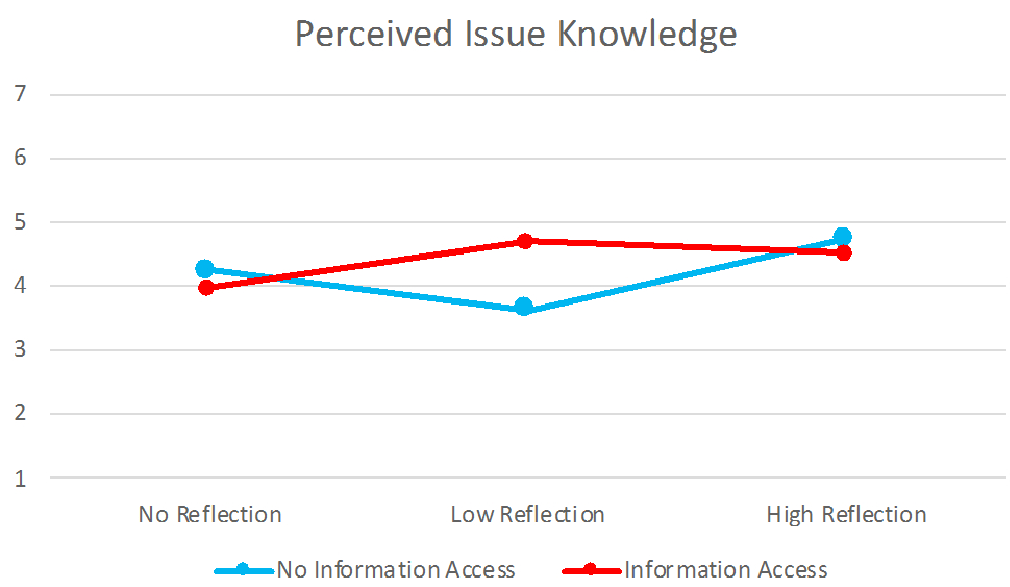 Figure 2: The interaction between information access and reflection on how much users "feel" they know.
2. Boosting Attitude Certainty
Reflection increased both Attitude Clarity (knowing what you feel) and Attitude Correctness (the sense that your view is justified). In public opinion research, "certainty" is a proxy for high-quality, stable attitudes that are less susceptible to manipulation.
3. Private vs. Public Expression
The study found that reflection encouraged users to talk about politics in private (friends/family) but not in public. This is a crucial distinction. Large-scale public forums are often perceived as hostile; reflection prepares the mind for dialogue, but it doesn't necessarily grant the "thick skin" needed for public internet brawls.
Critical Analysis & Future Outlook
Practical Implications
- For Social Media (e.g., Reddit/X): Platforms could introduce "Reflection Prompts" before users post on controversial topics, perhaps asking them to summarize the "other side" first.
- For Review Systems: TripAdvisor or Google Reviews could nudge users to reflect on both pros and cons, reducing "review bombing" or extreme polarization.
Limitations
The study was conducted in Singapore, a "hybrid" political system, on the specific (and highly personal) issue of fertility. Whether these results translate to more volatile or abstract issues (like global trade or AI ethics) across different cultures remains an open question for future researchers.
Conclusion
This work proves that reflection is "more than just a channel to knowledge." By designing interfaces that force us to pause and consider the "other," we can build a more certain, informed, and communicative citizenry. As the authors suggest, the goal isn't just to see new data—it's to restructure how we think about the data we already have.