
SNNIOD: Modeling the Ebb and Flow of Uncertain Opinions in Social Networks
Numerical Interval Opinion Dynamics in Social Networks: Stable State and Consensus
This paper introduces the Social Network Numerical Interval Opinion Dynamics (SNNIOD) model, an extension of the classical DeGroot model that accommodates uncertain opinions expressed as numerical intervals. It establishes a theoretical framework to identify stable and oscillation agents and provides conditions for consensus within social networks.
TL;DR
Most models of social influence assume we have precise opinions (e.g., "I support this policy 70%"). In reality, we are often uncertain (e.g., "I support it between 60% and 80%"). This paper introduces SNNIOD, a mathematical framework that models these "interval opinions." It discovers that while some people eventually settle on a stable view, others—oscillation agents—are doomed to fluctuate forever due to how they interpret the uncertainty of those around them.
Background & Motivation: The Gap in Opinion Dynamics
Since the inception of the DeGroot Model in the 1970s, mathematicians have viewed social influence as a simple weighted averaging process. However, this classical approach suffers from two major "blind spots":
- Exactness Fallacy: It assumes humans can quantify their subjective feelings with infinite precision.
- Guaranteed Stability: It assumes every social network eventually reaches a "frozen" state of consensus or distinct clusters (splits).
The authors argue that instability (oscillation) is not just noise but a fundamental byproduct of uncertainty tolerance. When you hear an uncertain opinion, how much of that uncertainty do you adopt? How do you estimate the "truth" from a range? This paper provides the first rigorous analysis of these dynamics within a social network context.
Methodology: The Core of SNNIOD
The SNNIOD model divides agents based on their Uncertainty Tolerance:
- Agents with Tolerance (): They update their upper and lower opinion bounds separately, effectively "carrying" the uncertainty of their neighbors.
- Agents without Tolerance (): When they encounter an interval, they try to "guess" a specific point within it (). Because these guesses are often random, they introduce a stochasticity that prevents the system from settling.
Architecture of Influence
The model relies on a network partition algorithm. The network is broken down into subnetworks based on Leadership. This structure dictates the flow of influence and determines who becomes a "stable" anchor and who becomes an "oscillation" drifter.
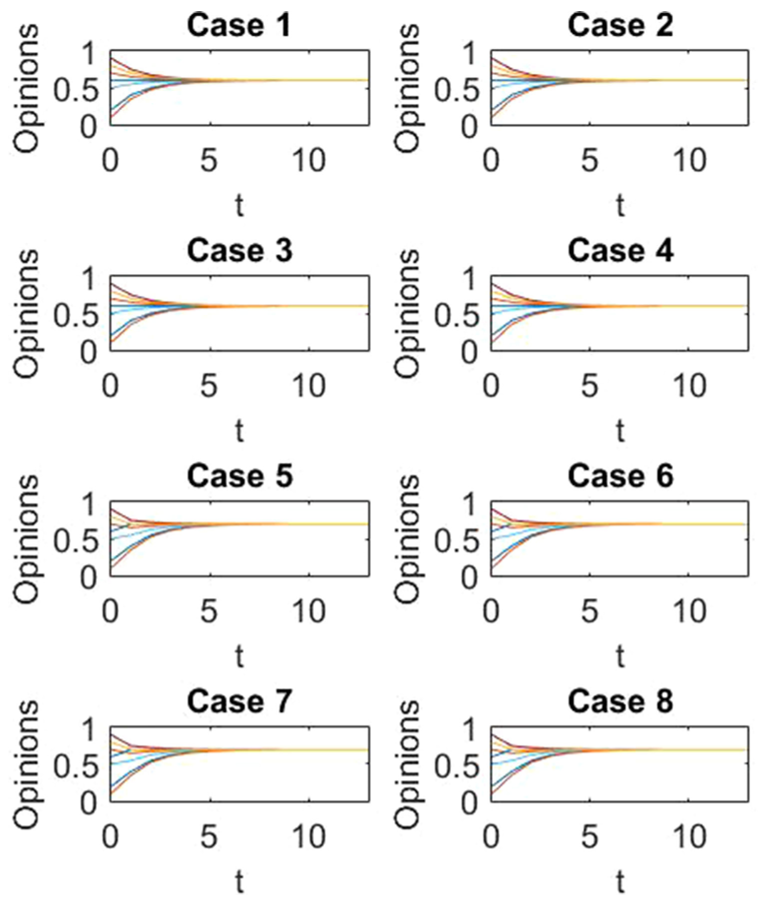 Figure 1: A social network partitioned into subnetworks (G1, G2, G3). This partitioning is crucial for identifying where consensus can actually form.
Why Some Agents Never Settle: Stability Analysis
A major contribution of the paper is the Identification Algorithm. It defines:
- Stable Agents: Their opinion bounds eventually converge to constant values.
- Oscillation Agents: Their opinions keep fluctuating. This usually happens when followers without uncertainty tolerance are influenced by leaders who hold interval (uncertain) opinions.
Key Theorem: The Consensus Condition
The research proves that for stable agents to reach a consensus, the set of Opinion Leaders must be non-empty. If the leaders themselves are uncertain, the entire network may adopt an "interval consensus," where everyone agrees on the range of the truth, rather than a single point.
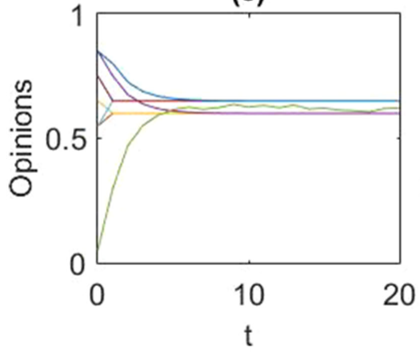 Figure 2: Evolution of opinions over time. Notice how in some cases (e.g., Case 9, 11), certain agents' opinions continue to fluctuate within a range, while others remain rock-solid.
Experimental Validation
Using numerical simulations (Example 1 and 2), the authors demonstrate that:
- Leader Influence: If leaders have exact opinions, followers eventually lose their uncertainty.
- The "Guesswork" Effect: If a follower tries to guess the "exact" value of a leader's interval opinion, they actually become an oscillation agent, moving back and forth within the leader's specified range.
- Opinion Splits: In networks without a global leader, different subnetworks reach different interval consensuses, mirroring "echo chambers" with varying levels of internal uncertainty.
Critical Insight: Takeaways for the Future
The SNNIOD model moves academic research closer to psychological reality. It shows that uncertainty is contagious. If you are an organization trying to build consensus:
- Identify your oscillation agents: These are likely the people trying to "force" precise interpretations out of naturally ambiguous information.
- Leader Transparency: If leaders express uncertainty (intervals), the "width" of that uncertainty acts as a bound for the entire group's potential disagreement.
Limitations: The model assumes weights () remain constant over time. Future work likely needs to explore Co-evolutionary SNNIOD, where friendships (edges) change as opinions diverge—a more accurate representation of modern social media polarization.
Conclusion
This work provides a robust mathematical foundation for "Numerical Interval Opinion Dynamics." It proves that stable states and consensus are properties of network structure and individual tolerance levels, providing a new toolkit for analyzing group decision-making under uncertainty.