
[CVPR 2026] NymeriaPlus: Bridging the 3D Gap Between Egocentric Vision and Embodied AI
NymeriaPlus is a major upgrade to the Nymeria dataset, providing a massive-scale, multimodal, in-the-wild egocentric collection for embodied AI. It introduces high-fidelity human motion in MHR and SMPL formats, 3D/2D bounding boxes for 10K+ indoor objects, and instance-level 3D reconstructions, establishing a new SOTA benchmark for scene-aware activity understanding.
Executive Summary
TL;DR: NymeriaPlus is an exhaustive enrichment of the 2024 Nymeria dataset, transforming it from a motion-capture collection into a comprehensive, scene-aware multimodal ecosystem. By introducing optimized human motion (SMPL/MHR), dense 3D object bounding boxes, and instance-level reconstructions, it provides the "missing link" for training AI that understands not just what humans are doing, but how they interact with the physical geometry of their environment.
Background Positioning: This work represents a massive infrastructure leap (SOTA benchmark) from Meta Reality Labs Research, targeting the core bottlenecks of Embodied AI: the lack of high-fidelity, in-the-wild 3D ground truth for both humans and objects.
1. The "Context Gap" in Egocentric Vision
For years, the research community has faced a frustrating trade-off. You could either have:
- High-Fidelity Motion: Lab-based MoCap (e.g., AMASS) with perfect joints but sterile, synthetic environments.
- Large-Scale Realism: In-the-wild video (e.g., Ego4D) with diverse activities but noisy, "pseudo-ground truth" 2D/3D labels.
The original Nymeria was a step forward, but its motion was plagued by foot sliding and wrist misalignment because it didn't fully utilize the visual sensor streams from the smart glasses. Furthermore, its environment was represented by "semi-dense" point clouds—essentially a cloud of dots that didn't know the difference between a table and a wall.
2. Methodology: Fusing Vision and Inertial Sensing
The core innovation of NymeriaPlus lies in its Joint XSens-Aria Optimization.
Motion Refinement
Instead of relying solely on the IMUs in the MoCap suit, the authors formulated an optimization problem that forces the body model (Momentum Human Rig) to align with the 6-DoF trajectories of the head (Aria glasses) and wrists (miniAria bands).
By adding a velocity-based foot-sliding penalty (), they successfully "grounded" the digital avatars, making them move realistically over the physical floor.
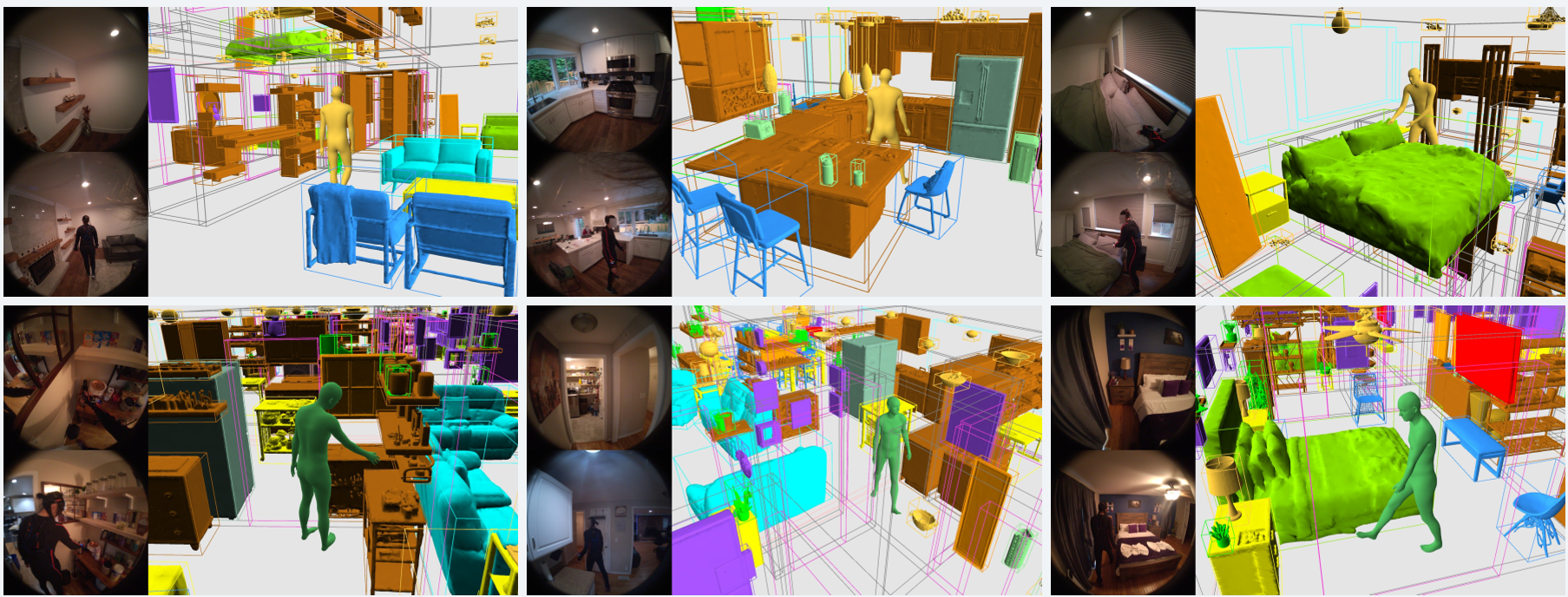 Figure 1: The NymeriaPlus ecosystem—Synchronized egocentric video, wristband views, and high-fidelity 3D human-scene alignment.
Semantic Scene Population
To turn "point clouds" into "objects," the team utilized Basemaps. They recorded static, interaction-free scans of 47 venues and manually annotated them with 9-DoF Oriented Bounding Boxes (OBB). These boxes are then "transferred" to the dynamic recordings. When an object (like a chair) moves, annotators refine it using a custom tool called Boxy.
3. From Boxes to Meshes: ShapeR Integration
A bounding box tells you where a chair is; a mesh tells you where you can sit. NymeriaPlus uses ShapeR, a probabilistic shape generator, to create 3D meshes for over 4,500 object instances.
The pipeline is rigorous:
- Isolate: SAM2 masks filter out background pixels.
- VLM Prompting: A vision-language model describes the object style.
- Refine: Human annotators rate 4 candidate meshes, ensuring only the highest-quality geometry is released.
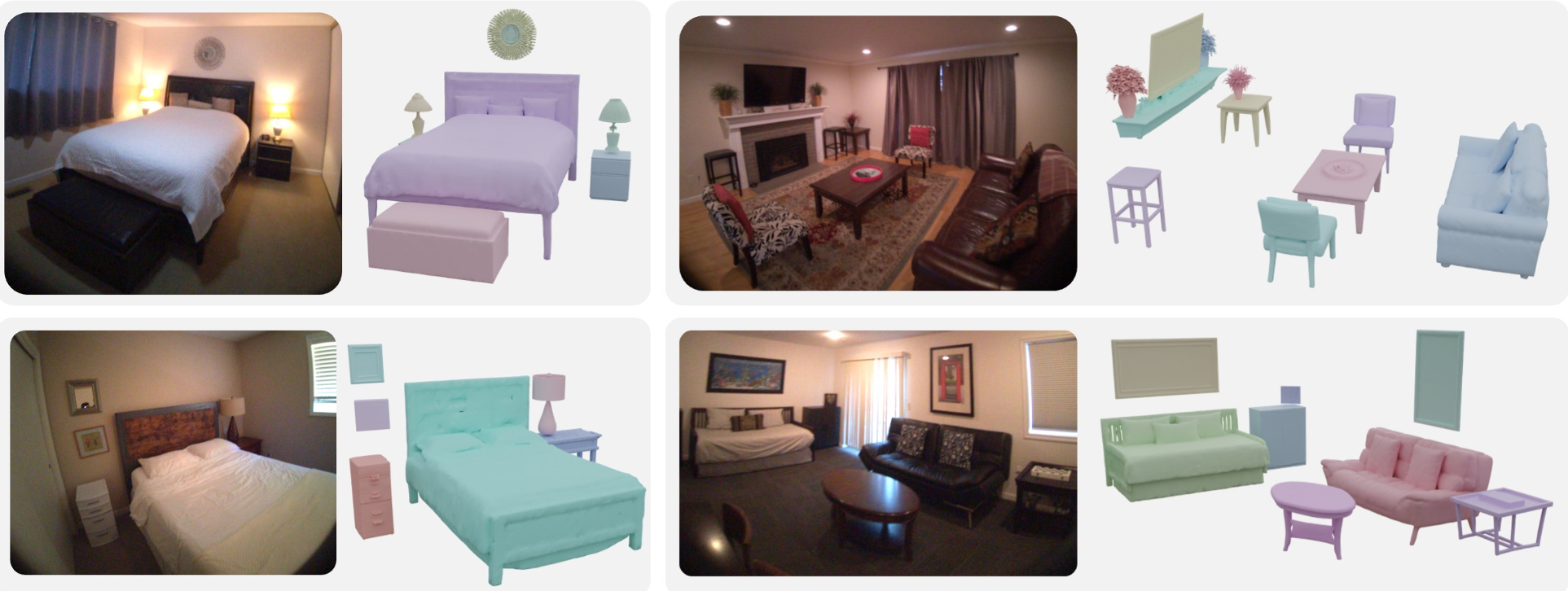 Figure 2: Dense shape annotations. Each color represents a distinct, reconstructed 3D instance within the real-world scene.
4. Key Results & Metrics
The improvements are quantitative and dramatic:
- Wrist Accuracy: Error dropped from 14.32cm to 5.07cm.
- Physical Plausibility: Self-penetration (arms clipping through the torso) was reduced from a score of 18.67 to 2.44.
- Scale: Over 10,000 unique 3D objects across 19 structural and movable categories.
5. Critical Analysis & Future Outlook
Takeaway
NymeriaPlus is no longer just a dataset; it is an Embodied Foundation Model trainer. It provides the first truly massive scale of paired 3D body motion and 3D object geometry in natural settings.
Limitations
- Dynamic Objects: While "Anything" labels capture movable items, the current toolset struggle with objects that change shape or articulate (like opening a laptop) during the session.
- The "Head-Only" Constraint: For lower-body motion, the system still relies heavily on the IMU suit because glasses cannot see the wearer's feet.
Future Prospect
This dataset will likely catalyze a new wave of Environment-Aware Motion Synthesis models. Expect to see agents that can realistically navigate cluttered kitchens or perform bimanual tasks, trained directly on the 600+ hours of wrist-perspective and third-person data provided here.
Reference: DeTone, D., Bogo, F., et al. (2026). NymeriaPlus: Enriching Nymeria Dataset with Additional Annotations and Data. arXiv preprint.