
OAK: Bridging the Gap Between Data Mining and Digital Agriculture with Ontology-Based Knowledge Maps
OAK: Ontology-Based Knowledge Map Model for Digital Agriculture
This paper introduces OAK (Ontology-based Knowledge Map), a novel framework for organizing and retrieving diverse agricultural knowledge. It combines a domain-specific agriculture ontology with a dynamic Knowledge Map model to effectively manage and standardize knowledge mined from data discovery processes (Data Mining) and academic expert sources.
TL;DR
Digital agriculture is drowning in data but starving for integrated knowledge. The OAK (Ontology-based Knowledge Map) model provides a scalable architecture to capture, standardize, and retrieve knowledge mined from heterogeneous datasets. By combining the formal structure of Ontologies with the flexibility of Knowledge Maps, OAK allows agronomists and data scientists to query complex farming insights using simple semantic tools.
The "Isolation" Problem in Agricultural Data Science
In current digital farming practices, knowledge is often trapped in silos. An expert's rule-based system might define "High Yield" one way, while a data scientist's regression model defines it another. Because these models are often stored as pre-trained files or static reports, they lack interoperability.
Previous works used static ontologies, but these are too rigid to handle the dynamic evolution of data mining results. OAK addresses this by introducing a mapping layer that translates dynamic "mined results" into a formal semantic language.
Methodology: How OAK Works
The OAK framework operates through a clear three-component architecture designed for scalability and logical consistency.
1. The AgriOnt Ontology (The Foundation)
The system begins with AgriOnt, a robust ontology covering agriculture, IoT, geography, and business sub-domains. It acts as the "vocabulary" for the system, containing:
- 361 Classes: From soil attributes to crop life cycles.
- 7,900+ Axioms: Defining the rules and relationships between these entities.
2. The Knowledge Wrapper (The Translator)
This is the core innovation. When a new data mining model (e.g., a clustering algorithm for wheat yield) is created, the Knowledge Wrapper identifies the concepts, generates instances, and links them to the ontology. It converts raw outputs into RDF Turtles—a standardized format for the semantic web.
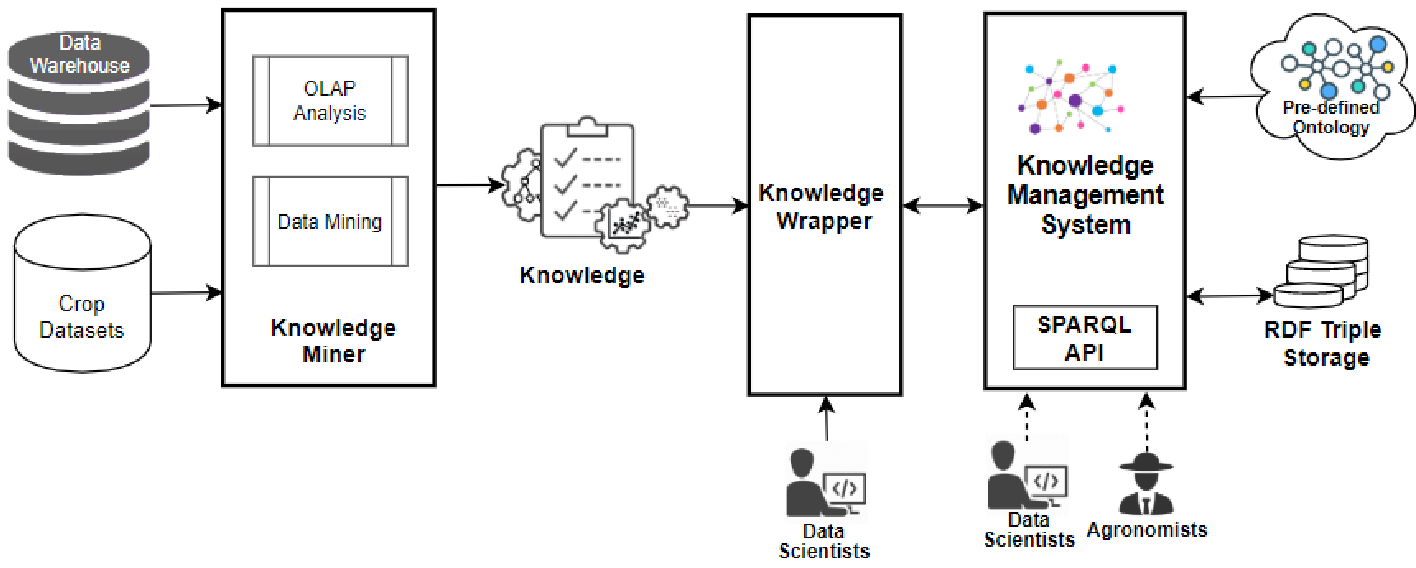 Figure 1: The OAK Architecture, showing the flow from Knowledge Miner to the RDF Management System.
3. Knowledge Management System
Stored in a graph database (using Apache Jena and Fuseki), the knowledge becomes searchable via SPARQL. This allows users to ask complex questions that a traditional database couldn't answer.
From Equations to Insights
OAK defines a Knowledge Map (KM) mathematically as: Where:
- C represents domain Concepts.
- T represents Transformations (the logic used to process data).
- S represents States (specific findings, like "Low pH").
- R represents the Relations connecting them.
This formalization ensures that every insight—regardless of which algorithm produced it—speaks the same "language."
Experimental Results: Real-World Utility
The researchers demonstrated that OAK could handle diverse agricultural tasks. For example, by querying the system, an agronomist could find all models capable of predicting Crop Yield and see exactly which input features (like Nitrogen levels or Soil pH) those models require.
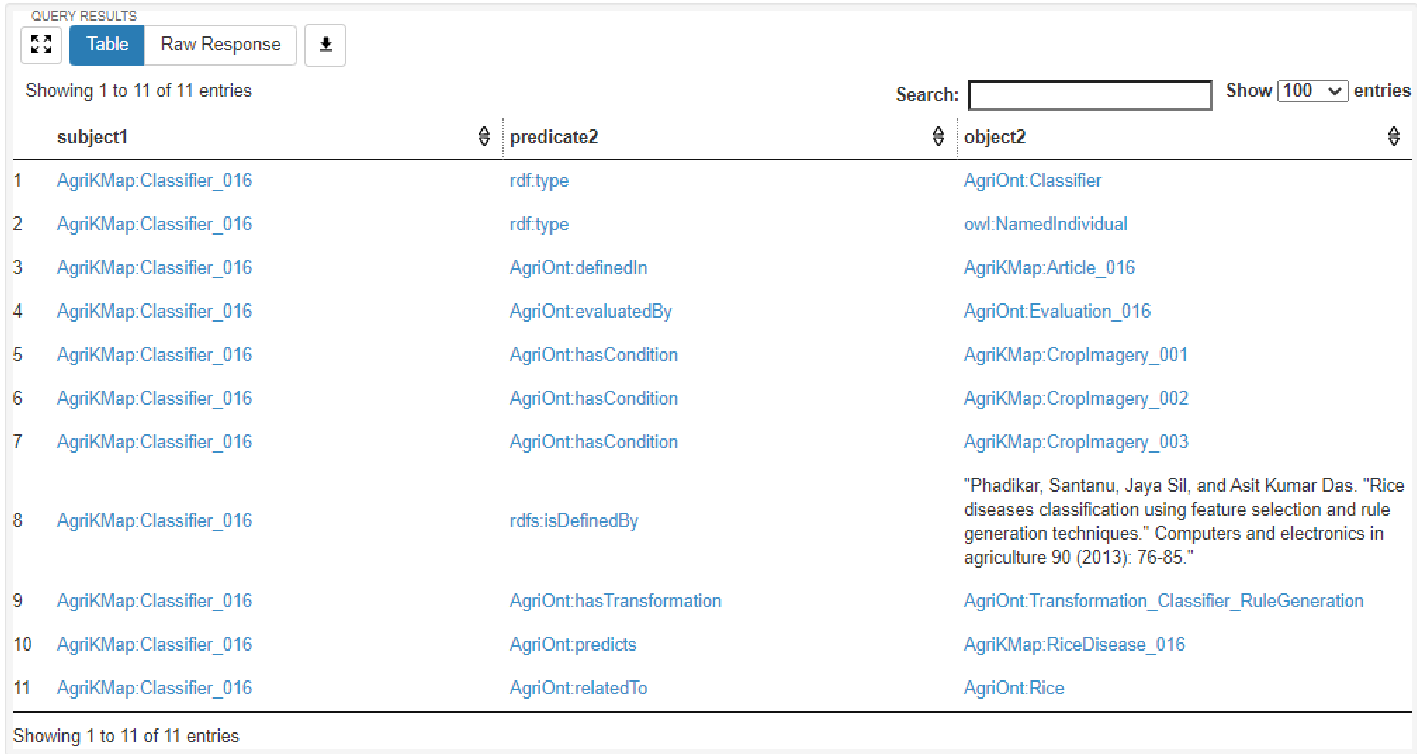 Figure 2: A SPARQL query interface identifying specific rice disease classification models (e.g., Classifier 016).
Critical Insight: Why This Matters
The true value of OAK lies in its transparency. Usually, data mining results are "black boxes"—you get a prediction, but you don't know the context. OAK provides the metadata and ontological context, allowing stakeholders to verify the coherence of different rules and refine them over time.
Limitations: While powerful, the current model still requires significant manual effort during the initial "Step 2" (Identifying Concepts) of the Knowledge Wrapper. Future iterations would benefit from LLM-based automated entity extraction to further reduce the burden on data scientists.
Conclusion
The OAK framework is a significant step toward a "Global Agricultural Brain." By standardizing how we represent mined knowledge, it ensures that every new data study adds to a cumulative, searchable, and logically consistent repository of human and machine intelligence.