
OASNET: Solving Influence Maximization via Optimal Resource Allocation
OASNET: an optimal allocation approach to influence maximization in modular social networks
The paper introduces OASNET, an optimal resource allocation approach for influence maximization in modular social networks. By partitioning networks into communities and treating the seed selection problem as a dynamic programming-based allocation task, it achieves superior influence spread compared to heuristic methods.
TL;DR
Influence Maximization (IM) is the quest to find a small set of "seed" nodes that trigger the largest possible cascade of information in a social network. OASNET (Optimal Allocation in a Social NETwork) reframes this NP-hard problem as a resource allocation task. By decomposing a modular network into communities and using dynamic programming to distribute seeds, it bypasses the inefficiency of global greedy searches while capturing the network's inherent community structure.
Problem & Motivation: The Modularity Gap
Most social networks are "modular"—they consist of clusters where internal ties are dense but external ties are sparse. Classic IM algorithms, like the Greedy Hill Climbing approach by Kempe et al., treat the network as a monolithic entity. This leads to two major issues:
- Computational Inefficiency: Simulating cascades across a massive global network is slow.
- Structural Blindness: Heuristics like "Top Degree" often pick nodes from the same dense cluster, leading to "influence overlap" where seeds redundantely target the same audience.
The authors’ core insight is that if we can understand how influence grows within individual communities (the Growth Function), we can use mathematical optimization to decide exactly how many seeds each community deserves.
Methodology: From Influence to Allocation
The heart of the paper is the transformation of IM into the Optimal Allocation Problem.
1. The Growth Function
The authors define a function that maps the number of seeds () to the expected spread. If communities were perfectly disconnected, the total influence would simply be the sum of these local growth functions.
2. Recursive Optimization
To solve the allocation, they propose a recursive relation: This formula determines the best number of nodes to give to the -th community by checking all possibilities against the optimal sub-solution for the remaining communities.
3. The OASNET Algorithm
OASNET follows a streamlined workflow:
- Community Detection: Partition the graph using fast modularity-based algorithms.
- Local Profiling: Simulate the diffusion process within each community to build the Growth Functions.
- Global Optimization: Use Dynamic Programming to find the ideal seed distribution.
 The logic relies on capturing the "slope" of influence growth within modules to avoid diminishing returns.
Experiments & Results
The researchers tested OASNET against four common baselines: Equal, Proportional, Random, and Top-Degree allocation.
Performance Highlights
- Superior Spread: In the Condensed Matter Physics network (co-authorship data), OASNET significantly beat the Top-Degree heuristic. The reason? Top-degree nodes often cluster in a single "celebrity" community, whereas OASNET forced seeds into diverse modules.
- Robustness: The method held up across both the Independent Cascade Model and the Linear Threshold Model, showing flexibility in how influence is defined.
- Higher Diffusivity Benefit: The advantage of OASNET becomes even more pronounced as the "diffusion probability" (the ease of spreading) increases, as the heterogeneity between communities becomes more apparent.
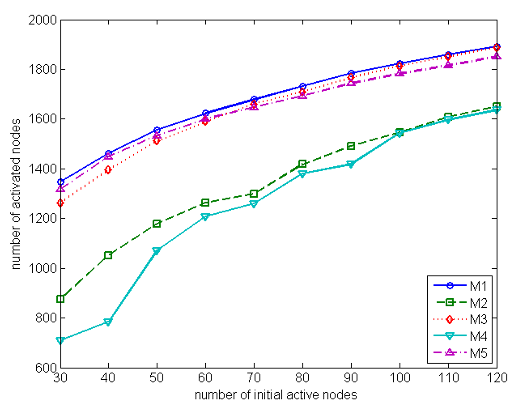 Figure (b) demonstrates how OASNET (M1, top blue line) consistently achieves the highest diffusion size compared to heuristics.
Critical Insight & Conclusion
OASNET succeeds because it acknowledges a fundamental truth of social dynamics: Influence is a local phenomenon. By treating communities as independent "markets," the algorithm avoids wasting seeds on saturated areas.
Takeaway: Effective viral marketing shouldn't just target the most popular people globally; it should target the most influential people within diverse, specific sub-groups.
Limitations & Future Work
The primary assumption—that communities are disconnected—is a simplification. While the "cross-community" edges are often weak, they do exist. Future iterations could integrate "leakage" between communities into the growth function. Furthermore, extending this to temporal networks (where connections change over time) remains a frontier for modular influence maximization.