
AGBAN: Bridging the Modality Gap in Social Media NER with Object-Aware Adversarial Learning
9239_Object-Aware Multimodal Named Entity Recognition in Social Media Posts With Adversarial Learning.
The paper introduces AGBAN (Adversarial Gated Bilinear Attention Network) for Multimodal Named Entity Recognition (MNER) in social media. It leverages fine-grained visual object features and adversarial learning to achieve a new SOTA on Twitter datasets, specifically improving the alignment between textual entities and visual evidence.
TL;DR
In the noisy world of social media, text alone is often insufficient for Named Entity Recognition (NER). While multimodal models use images as context, most rely on global image features that lack precision. This paper introduces AGBAN, a framework that uses fine-grained visual objects (e.g., "dog", "trophy") and Adversarial Learning to align text and vision in a shared subspace, pushing the F1-score to a state-of-the-art 73.25%.
Problem & Motivation: The Context Ambiguity
Consider the sentence: "Charlie is ready for this winter." Without an image, most NER systems would tag "Charlie" as a Person. However, if the accompanying image shows a dog, "Charlie" should be tagged as MISC.
Current Multimodal NER (MNER) systems face two hurdles:
- Granularity Gap: They use one vector for the whole image, failing when a sentence mentions multiple entities (e.g., "Ang Lee" and "Oscars") that correspond to different visual objects ("Person" and "Trophy").
- Distribution Disparity: Textual and visual features exist in different mathematical manifolds, making simple concatenation ineffective.
Methodology: Precision through Bilinear Attention
To solve these issues, the authors propose the Adversarial Gated Bilinear Attention Network (AGBAN).
1. Object-Level Perception
Instead of viewing the image as a single block, the model uses Mask R-CNN to extract the top visual objects. This allows the model to "look" specifically at entities mentioned in the text.
2. Gated Bilinear Attention (GBAN)
Bilinear attention is utilized to exploit the interactions between every pair of words and objects. Not all detected objects are relevant (e.g., a "bottle" in the background); thus, a Gated Mechanism acts as a filter to suppress noise from non-entity-related visual regions.
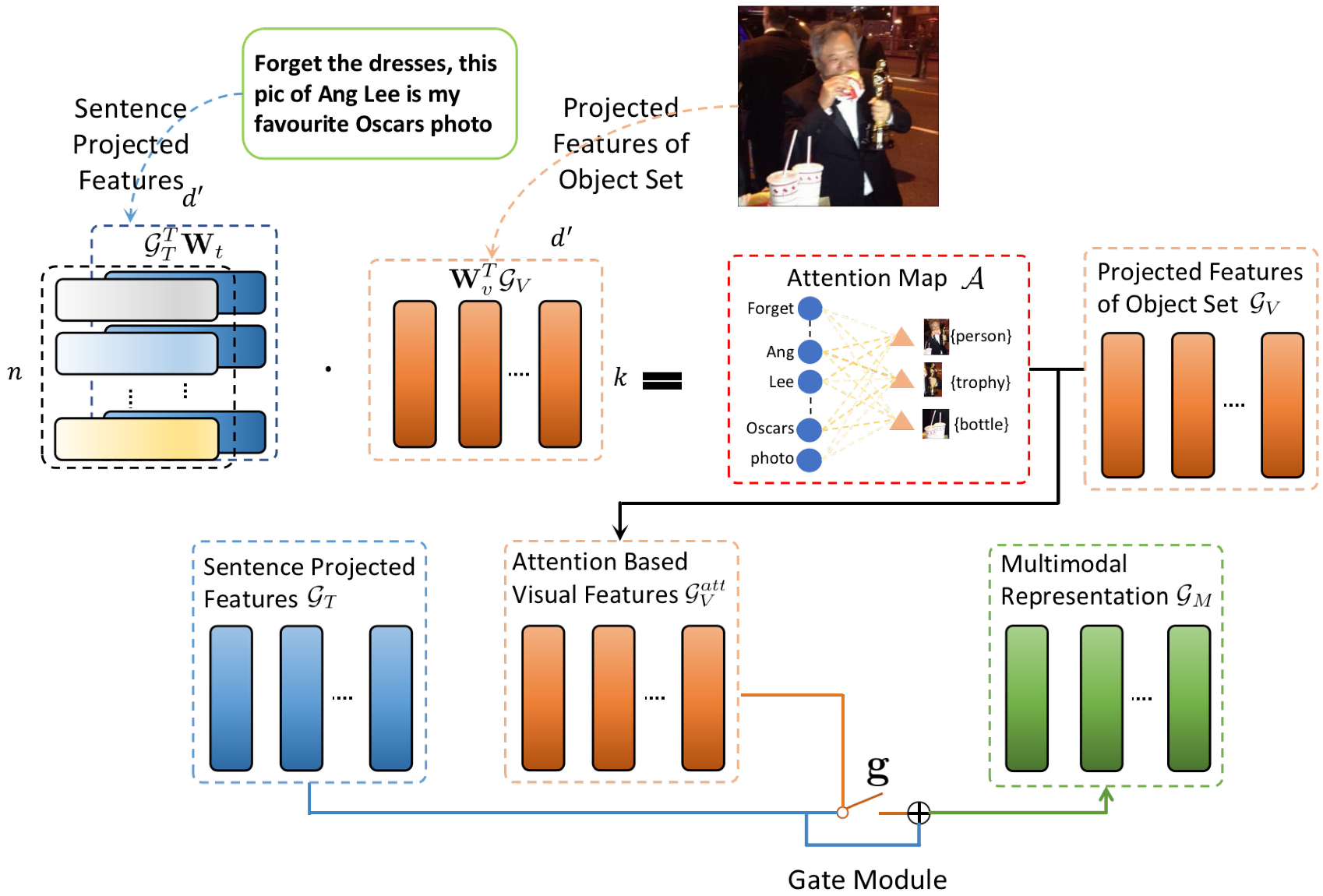 Figure 1: The overall architecture of AGBAN, highlighting the dual-stream feature projectors and the fusion through BAN.
3. Modality-Invariant Subspace (Adversarial Learning)
To bridge the "Modality Gap," the authors employ a Modality Classifier acting as an adversary. Using a Gradient Reversal Layer (GRL), the feature projectors are forced to learn representations that the classifier cannot distinguish by source. This ensures that the fusion happens in a unified semantic space.
Experiments & Results
The model was tested on a standard Twitter dataset against heavyweights like BERT-NER and Adaptive Co-Attention models.
- Performance Leap: AGBAN reached 73.25% F1, significantly higher than the text-only CNN+BiLSTM+CRF (67.15%) and the previous image-level SOTA (70.69%).
- The Power of Objects: Use of objects alone (Object-Concat) provided a base F1 of 71.85%, proving that "finer pixels" lead to "better labels."
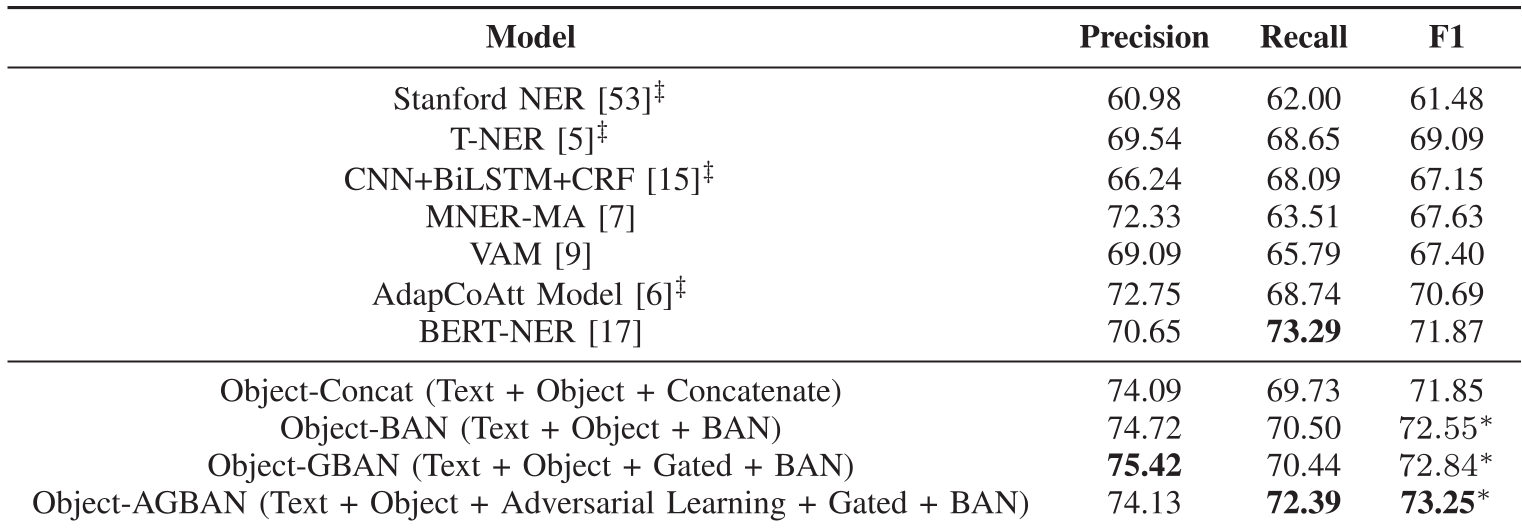 Table 1: Comparison with state-of-the-art models and ablation variants.
Visual Evidence: Modality Alignment
The effectiveness of the adversarial training is best seen in the t-SNE visualizations. Without adversarial learning, visual and textual features are clustered separately. With it, they merge into a single, cohesive distribution.
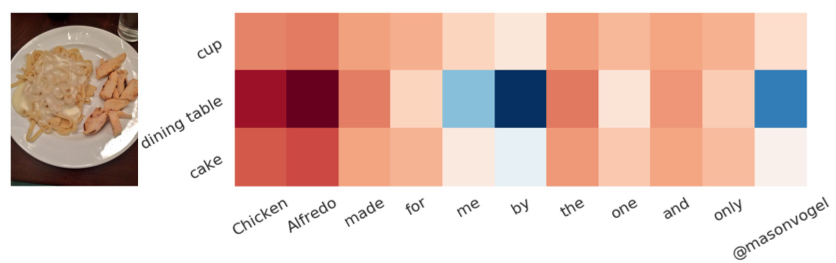 Figure 2: t-SNE visualization showing how adversarial learning bridges the modality gap (Orange: Text, Blue: Vision).
Critical Insight & Conclusion
AGBAN demonstrates that for multimodal tasks involving "short-form" content, alignment is everything. By treating images as a collection of semantic objects rather than raw pixels, and by using adversarial games to align distributions, the model achieves much higher robustness against the noise found in social media.
Future Outlook: The next logical step is integrating External Knowledge Graphs to further disambiguate entities that neither the text nor the image can fully clarify.