
AGBAN: Mastering Multimodal NER via Object-Aware Adversarial Learning
14873_Object-Aware Multimodal Named Entity Recognition in Social Media Posts With Adversarial Learning.
The paper introduces AGBAN (Adversarial Gated Bilinear Attention Network), a multimodal Named Entity Recognition (NER) framework designed for social media. It achieves state-of-the-art results on the Twitter dataset (F1: 73.25%) by leveraging fine-grained visual object features and adversarial learning to bridge modality gaps.
TL;DR
Recognizing entities in short, chaotic social media posts is like solving a puzzle with missing pieces. While images provide clues, global image context is often too vague. AGBAN (Adversarial Gated Bilinear Attention Network) solves this by focusing on specific visual objects (like a "dog" or a "trophy") and using adversarial training to align these visual cues perfectly with text. It achieves a 73.25% F1 score on Twitter data, surpassing even BERT-based baselines.
Background & Motivation: Beyond "Vague" Context
In traditional NER, text is the king. But on Twitter, text is short and context-free. Consider the sentence: "Charlie is ready for this winter." Is Charlie a person or a pet? Without the accompanying photo of a Labrador, a text-only model is guessing.
Previous multimodal efforts used global image features. However, the authors argue this is "noise-prone." If a photo contains a person (Ang Lee) and an award (an Oscar), a global feature might blur them together, failing to help the model distinguish between a PER entity and a MISC (award) entity. The core insight here is Object-Awareness: the model must map specific tokens to specific bounding boxes.
Methodology: The Architecture of AGBAN
The AGBAN framework consists of three elegant technical pillars designed to bridge the gap between "seeing" and "reading."
1. Fine-Grained Object Projection
Instead of passing the whole image through an encoder, the model uses Mask R-CNN to extract the top- visual objects. These objects are projected into the same vector space as the textual features (generated via Bi-LSTM and Character embeddings).
2. Bilinear Attention & Gating
Traditional attention mechanisms often calculate a single distribution. AGBAN uses a Bilinear Attention Network (BAN) to capture the 8×8 (or ) interaction matrix between every token and every object.
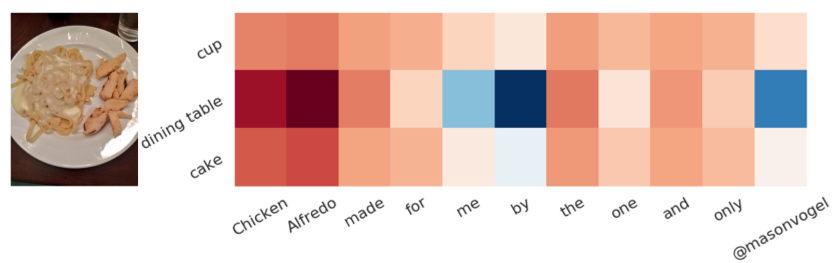
- The Gate: Not every object matters. If an image contains a "bottle" that isn't mentioned in the tweet, the Gated Module suppresses that visual noise, ensuring only relevant objects influence the final CRF (Conditional Random Field) layer.
3. Adversarial Modality Alignment
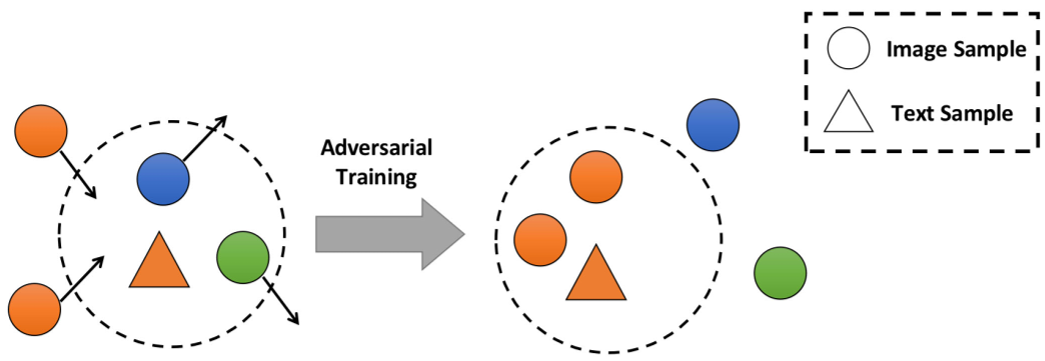
Textual vectors and visual vectors naturally live in different "neighborhoods" of mathematical space. AGBAN employs a Modality Classifier that tries to guess whether a feature is visual or textual. The feature projectors are trained to "fool" this classifier. This Adversarial Learning forces the model to learn a modality-invariant subspace, ensuring that the fusion of text and image is semantic rather than just structural.
Experiments & SOTA Performance
The model was tested on the standard Twitter MNER dataset, which includes categories like Person (PER), Location (LOC), Organization (ORG), and Misc (MISC).
Key Results:
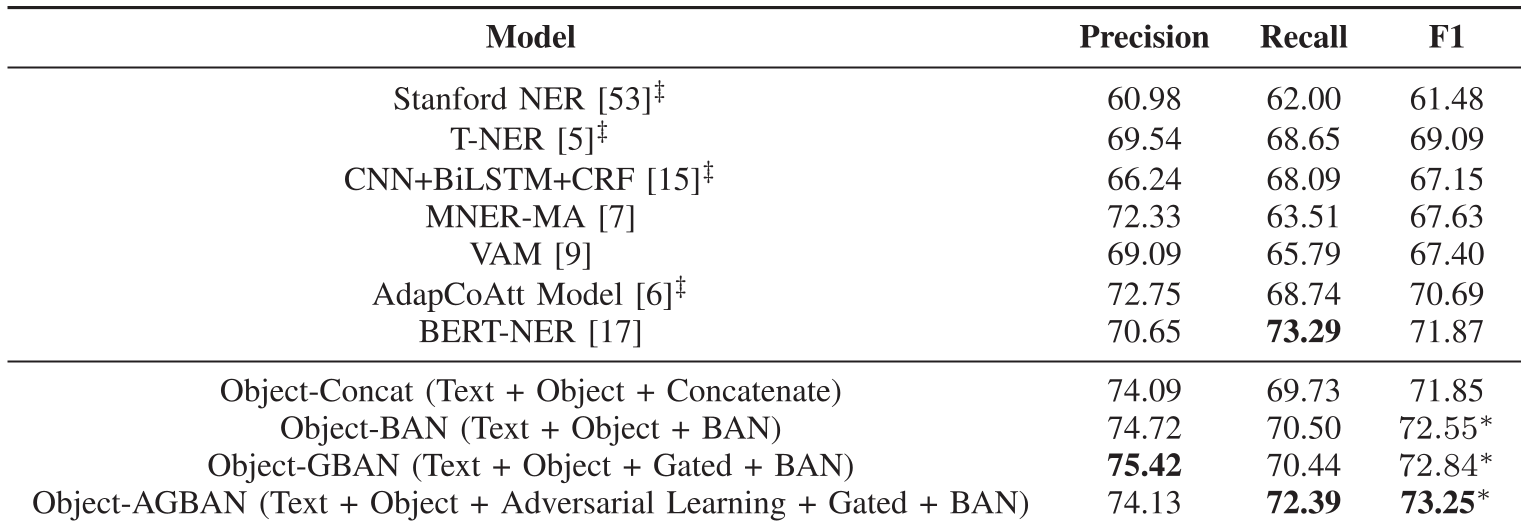
- Performance: AGBAN reached 73.25% F1, beating the Adaptive Co-Attention (AdapCoAtt) model (70.69%) and the BERT-NER base (71.87%).
- The Value of Objects: Even a simple concatenation of objects (Object-Concat) outperformed previous global image models, proving that fine-grained object detection is the superior inductive bias for this task.
Visual Proof: t-SNE Visualization
The impact of adversarial learning is most visible in the t-SNE plots. Without adversarial training, visual and textual features form separate clusters. With adversarial training, the distributions overlap, indicating a successful "common language" has been learned between the two modalities.
Deep Insight: Why It Works
The AGBAN's success stems from its ability to solve the "Entity-Object Alignment" problem. In the case study provided in the paper, a text-only model labeled "Mickey" as a PER (Person). However, AGBAN detected a "cat" object in the image and, through its Bilinear Attention, linked "Mickey" to the cat, correctly tagging it as MISC.
Limitations & Future Outlook
While AGBAN is powerful, it is not infallible. The authors note "failed examples" where if the object detection fails (e.g., mistaking a logo for an airplane), the NER performance suffers. This suggests that the model is highly dependent on the quality of the upstream detector (Mask R-CNN).
Future Work: The inclusion of external Knowledge Graphs could provide the "common sense" needed to resolve cases where visual objects are ambiguous, potentially pushing MNER performance toward human-level accuracy in noisy environments.
Conclusion
AGBAN proves that for Multimodal NER, how you fuse is just as important as what you fuse. By combining fine-grained object recognition with adversarial distribution alignment, it sets a new standard for extracting meaning from the unstructured chaos of social media.