
Beyond the Machine: Simulating the Social Nuance of Employment Agencies
Object-oriented simulation of social systems application to an employment agency
This paper introduces an Object-Oriented Multi-Agent System (MAS) to simulate social systems, specifically applied to the French National Employment Agency (ANPE). It distinguishes between "rational" and "relational" information flows, demonstrating that social network dynamics significantly outperform traditional mechanical matching in labor markets.
TL;DR
Is a job search merely a matter of matching skills to a checklist, or is it about who you know? This paper argues the latter. By building an object-oriented simulation of the French Employment Agency (ANPE), the authors prove that "relational information"—the subjective, social links between people—is five times more effective at securing jobs than "rational information" like resumes and formal qualifications.
Context: This work positions itself at the intersection of Sociology (Economics of Conventions) and Computer Science (Multi-Agent Systems), moving away from "mechanical" economic models toward "biological" organizational logic.
The "Walrasian" Trap: Why Agencies Fail
Most government agencies are built on the Walrasian paradigm: a world of mechanics and energy. In this view, the labor market is a transparent machine. If you perfectly codify a job's requirements and a seeker's skills, the "optimal" match will emerge.
However, the authors point out a glaring reality:
- Only 7.4% of recruitments actually happen through these formal channels.
- Only 30% of job offers are even registered with the agency.
The bottleneck isn't a lack of data; it's a lack of trust and context. The agency treats agents as objective transmitters, whereas they are actually subjective nodes in a social network.
Methodology: Designing "Mental" Agents
To capture this social complexity, the researchers used an Object-Oriented modeling process comprising four stages: System Analysis, Simulation Design, Execution Analysis, and Result Interpretation.
1. The Multi-Agent Architecture
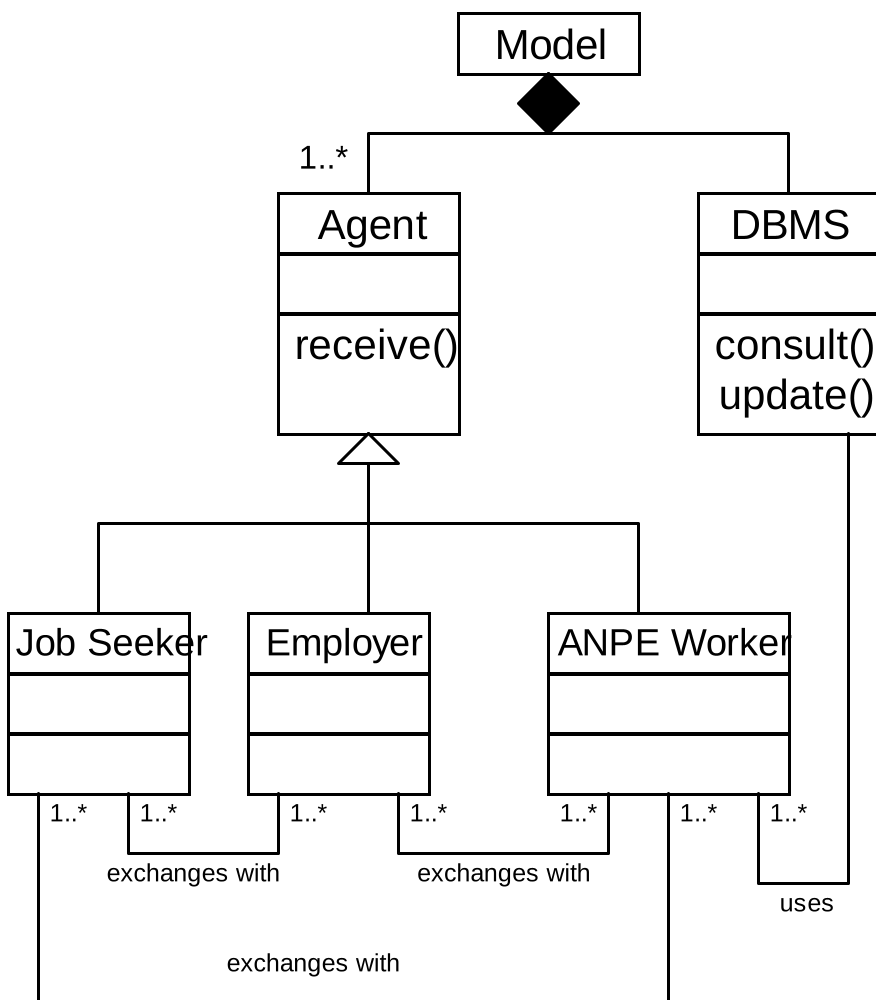
The system consists of three primary agent classes:
- Employers: Search for labor and evaluate "friendship" or "neutrality" based on previous interactions.
- Job Seekers: Navigate the market through different communication channels (mail, phone, interview).
- ANPE Workers: The "intelligent routers" who decide whether to use the central database or their own "local knowledge base" (their private social circle).
2. Rational vs. Relational Information
The core innovation is how messages are processed. Every message between agents has a relational level:
- Friend: High trust, rapid matching.
- Enemy: Low trust, active avoidance.
- Neuter: Unknown.
The agents use a simple but powerful heuristic: "The friend of my friend is my friend." This allows the simulation to mimic how trust propagates through a professional network.
Deliberation and Scripts
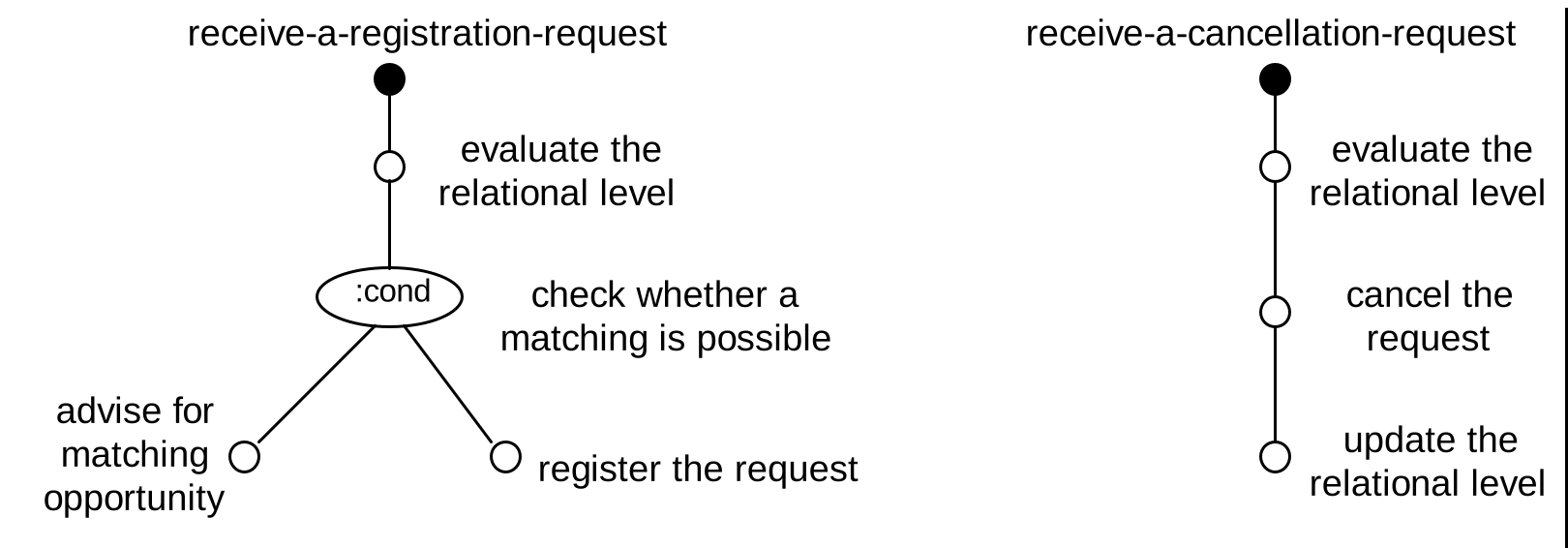
Instead of a simple "if-else" logic, the ANPE agents follow scripts for deliberation. When a job offer arrives, the agent doesn't just dump it into a database. They decide based on their Beliefs (is this employer reliable?) and Intentions (should I give this to my "friend" job seeker first?).
Key Results: The Power of Subjectivity
The simulation and accompanying econometric tests produced a startling contrast:
- The 5x Factor: A match triggered by relational information (social links) is 500% more likely to result in a hire than one based on rational information.
- Network Dominance: The "social network" function of an agency is twice as discriminant for efficiency than its "database management" function.
Critical Insight & Future Work
The takeaway is profound: Modernizing an agency doesn't mean buying a faster database. It means fostering better human interactions. The authors argue that by focusing on computerized matching of qualifications, agencies actually degrade their performance by ignoring the social "fuzziness" that actually makes markets work.
Limitations: The model uses a conservative time unit (one month), which may miss the rapid-fire nature of modern gig-economy interactions. However, as an exploratory tool for organizational policy, it provides a vital bridge between AI agents and human sociology.
Conclusion: This paper serves as a warning to technologists: if your system ignores the "relational" layer of human society, no amount of algorithmic optimization will make it efficient.