
Is the Objective Function a Silver Bullet? Debunking Community Detection Metrics
Is Objective Function the Silver Bullet? A Case Study of Community Detection Algorithms on Social Networks
This paper systematically evaluates community detection algorithms on social networks to determine if popular objective functions (e.g., Modularity, Internal Density) accurately reflect real-world performance. By comparing seven representative algorithms across heterogeneous and homogeneous networks, it investigates the reliability of these metrics against ground-truth data.
TL;DR
In the world of social network analysis, we often rely on mathematical objective functions like Modularity or Conductance to tell us if we've found a "good" community. This paper challenges that reliance, demonstrating through a "black-box" comparison of seven major algorithms that these metrics often contradict the Ground-Truth. High scores in internal density do not guarantee meaningful clusters, and optimization can sometimes lead to results that are mathematically perfect but practically useless.
Background: The Evaluation Crisis
Since the 1960s, community detection has exploded with diverse algorithms—from K-means to sophisticated spectral clustering. However, as the field grows, so does the confusion: How do we know which algorithm actually works?
The authors argue that the field is split between metrics that require knowing the "correct" answer (Ground-Truth) and those that just measure the structural properties of the graph (Objective Functions). The critical question is: Can we trust the latter when the former is unavailable?
Methodology: The Competitive Landscape
The authors selected seven representative algorithms and tested them on a mix of real-world datasets, ranging from the classic Karate Club to Mexican Political Power networks.
Algorithm Taxonomy
The study categorizes algorithms along two axes:
- Network Type: Designed for Homogeneous (similar nodes) vs. Heterogeneous (different types of nodes/edges) networks.
- Formalization: Whether the algorithm explicitly optimizes a specific mathematical objective function.
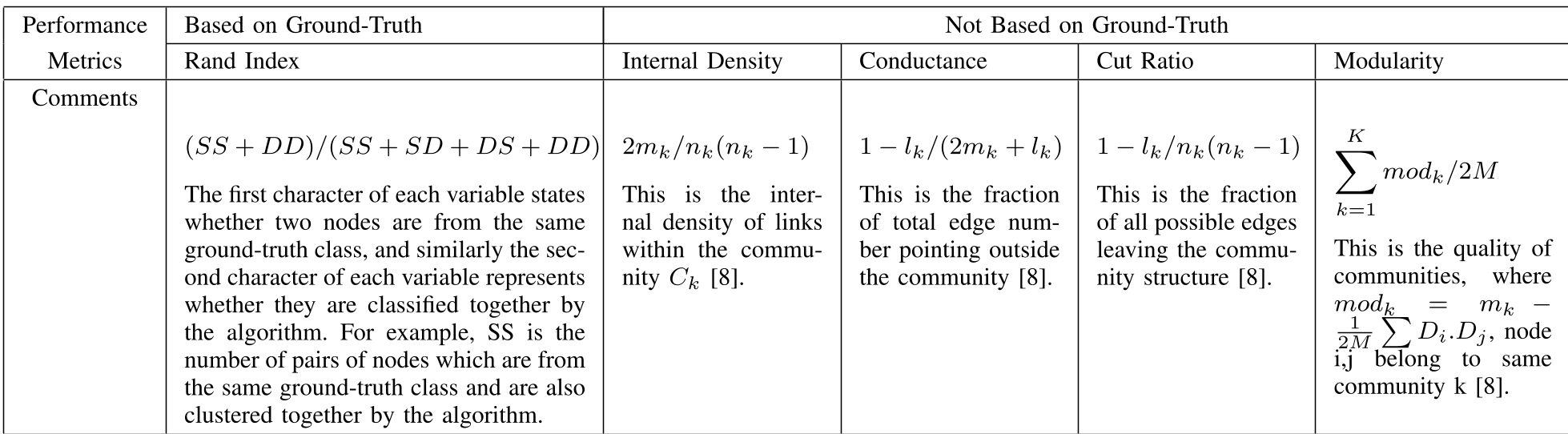
Core Insights: Why the "Silver Bullet" Fails
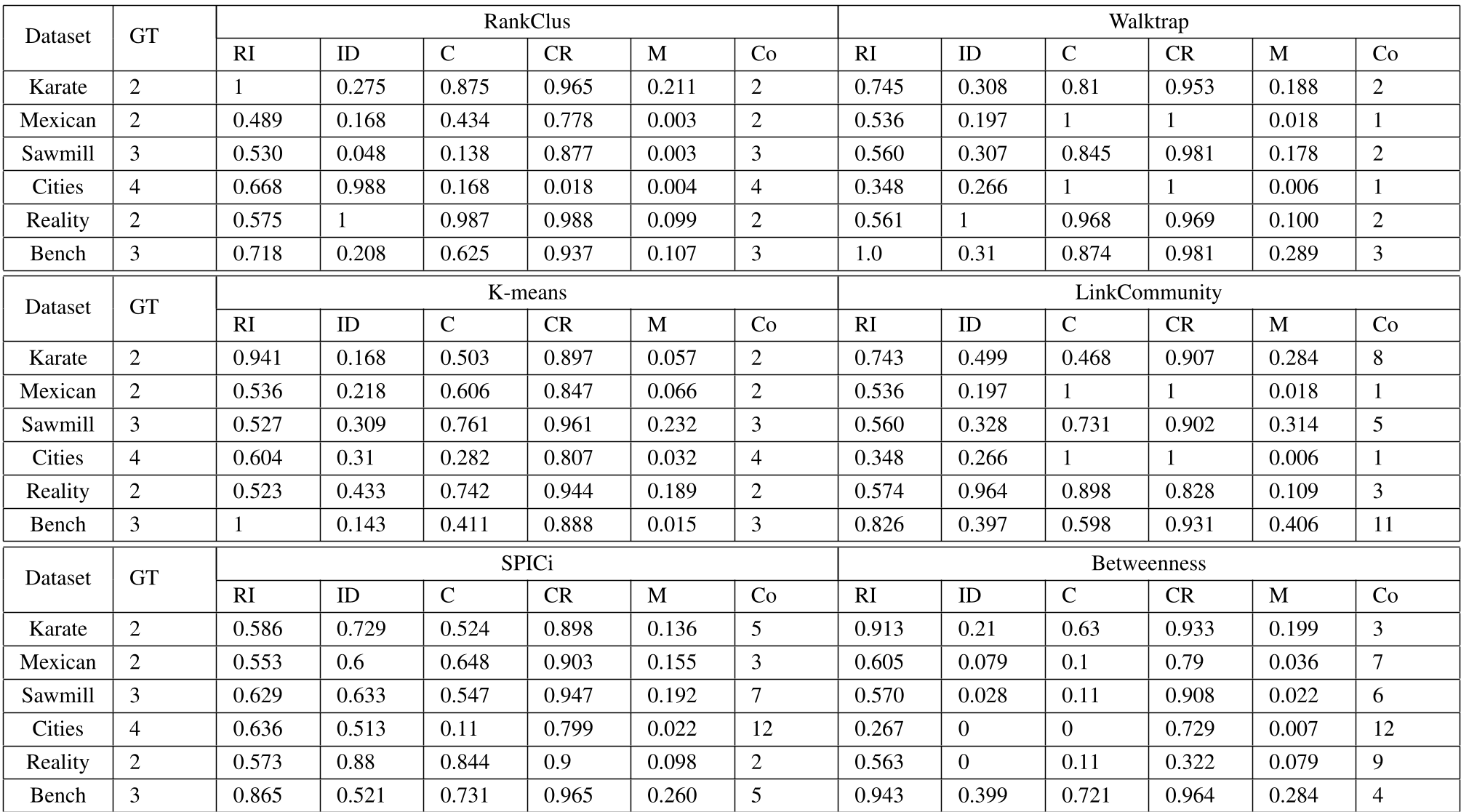
The experimental results (detailed in Table IV of the paper) highlight several alarming "performance paradoxes":
1. The Perfect Score Trap
The Walktrap and LinkCommunity algorithms performed poorly on the Mexican and Cities datasets, essentially failing to find any meaningful structure. However, their Conductance and Cut Ratio scores were "perfect." This suggests that optimizing for edge ratios can lead an algorithm to return a single giant cluster that satisfies the math but fails the logic of community detection.
2. Disconnect with Reality
On the Karate Club dataset, the RankClus algorithm achieved a perfect Rand Index (1.0)—meaning it matched the ground truth exactly. Yet, its Internal Density was lower than other algorithms that failed to match the ground truth.
3. The Heterogeneous Advantage
Interestingly, RankClus (designed for heterogeneous networks) performed surprisingly well on certain homogeneous networks, suggesting that the "type" of network an algorithm is designed for is not always a strict boundary for its success.
Visualizing the Difference
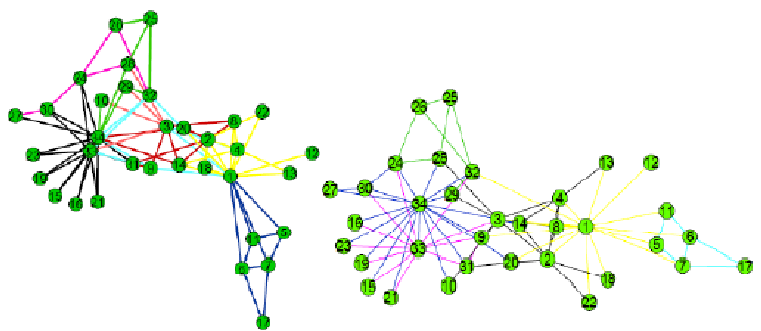
The paper provides a compelling visual comparison between LinkCommunity and Line Graph clustering on the Karate Club dataset. While both may produce high scores on certain metrics, the visual partition reveals which one aligns more naturally with social intuition.
Critical Analysis & Conclusion
Takeaway
The objective function is not a silver bullet. The correlation between structural metrics (like modularity) and ground-truth quality is dangerously weak. If you are developing a product or research model based on community detection, relying solely on an objective function to validate your results is risky.
Limitations & Future Work
The study focused on small-scale networks (under 200 nodes). The authors acknowledge that these insights may change as networks scale to millions of nodes. Future research must determine if these objective functions become more or less reliable as the volume of data increases, and whether synthetic "Benchmark Networks" can ever truly mirror the complexity of real-world social dynamics.
Final Verdict: In community detection, there is no substitute for ground-truth validation. Math can measure structure, but it can't always measure "meaning."