
From Forecasting to Discovery: The Era of Mechanistic World Models
From Observation to Insight: Mechanistic World Models and the Quest for Autonomous Discovery
The paper introduces Mechanistic World Models (MWMs), a novel design paradigm shifting AI from predictive forecasting to autonomous scientific discovery. By organizing knowledge around reusable computational mechanisms rather than monolithic predictive mappings, MWMs aim to bridge the gap between "what happens" (prediction) and "why it happens" (explanation).
TL;DR
Predicting the future is not the same as understanding it. While current AI can forecast weather or fold proteins with SOTA accuracy, it fails to explain the how and why. This paper proposes Mechanistic World Models (MWMs)—a new architectural paradigm that replaces monolithic neural networks with a library of reusable, composable mechanisms. By forcing models to be parsimonious and modular, MWMs aim to turn AI from a black-box predictor into an autonomous scientific discoverer.
The "Prediction-Insight" Gap
In the history of science, Archimedes didn't just notice objects float (prediction); he discovered the principle of buoyancy (explanation). Modern AI is stuck in the "noticing" phase. Even when a model predicts planet trajectories perfectly, it often fails to internalize Newtonian mechanics, relying instead on high-dimensional curve fitting.
The authors argue that the current path of "Scale + Human-in-the-loop" is insufficient for Autonomous Discovery. We need models that organize information such that:
- Variables represent stable entities (mass, velocity).
- Mechanisms represent universal laws (F=ma).
- Structure binds these together to explain a specific system.
Methodology: The Anatomy of a Discovery Engine
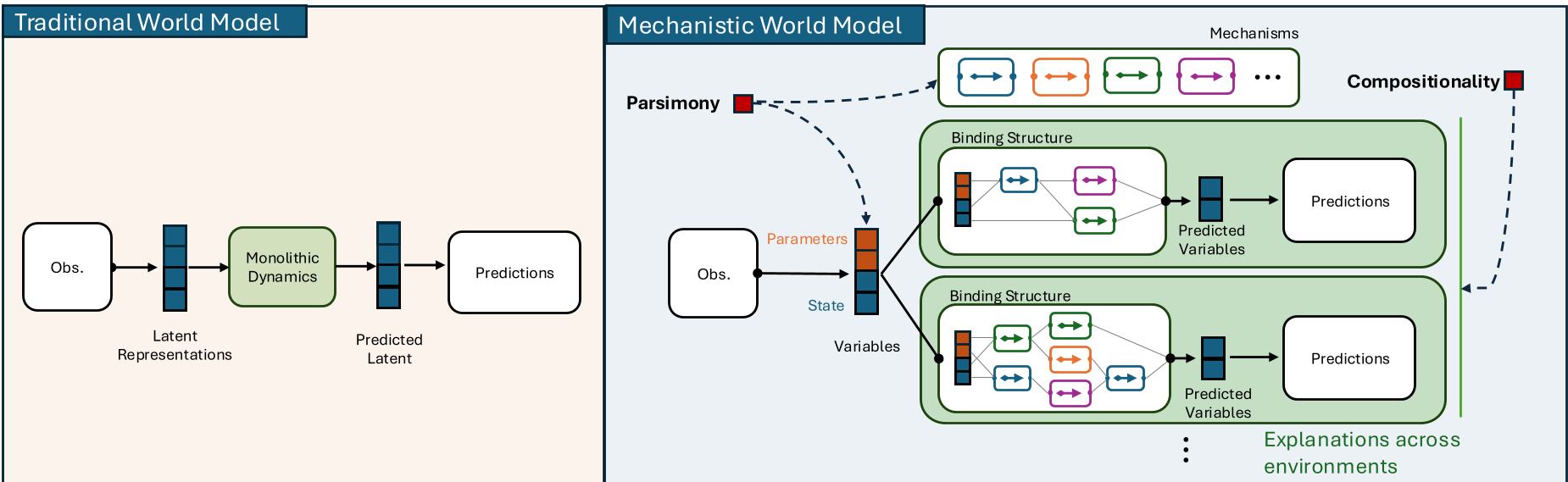
The MWM framework moves away from the "end-to-end" black box toward a structured latent space.
1. Variables and Semantic Types
Instead of arbitrary vectors, MWMs use Typed Latent Variables. A variable isn't just a number; it plays a "functional role" (e.g., a "Position Type"). This ensures that a mechanism designed for "Velocity" cannot be incorrectly applied to "Color."
2. The Reusable Mechanism Library
A mechanism is defined as a pair , where is the signature (what types of variables it affects) and is the transformation. Crucially, these are invariant. The same "Gravity" mechanism can be reused for a falling apple and a literal solar system.
3. Dynamic Binding Structure
This is the "glue." For any given environment, the model discovers a Binding Structure () that connects specific variables to specific mechanisms. This allow the model to generalize to new systems simply by reconfiguring the bindings of old mechanisms.
Inductive Pressures: Forcing "Insight" to Emerge
Why would a model bother to learn these complex structures? The authors propose two "pressures":
- Parsimony: Inspired by Occam's Razor, the model is penalized for having a bloated library. It must explain the maximum amount of data with the minimum number of mechanisms.
- Compositionality: The model is biased toward recombining existing mechanisms rather than inventing new ones for every new observation.
Comparing the Landscape
The paper provides a vital "state of the union" for AI for Science, showing where current SOTAs stand relative to the MWM ideal:
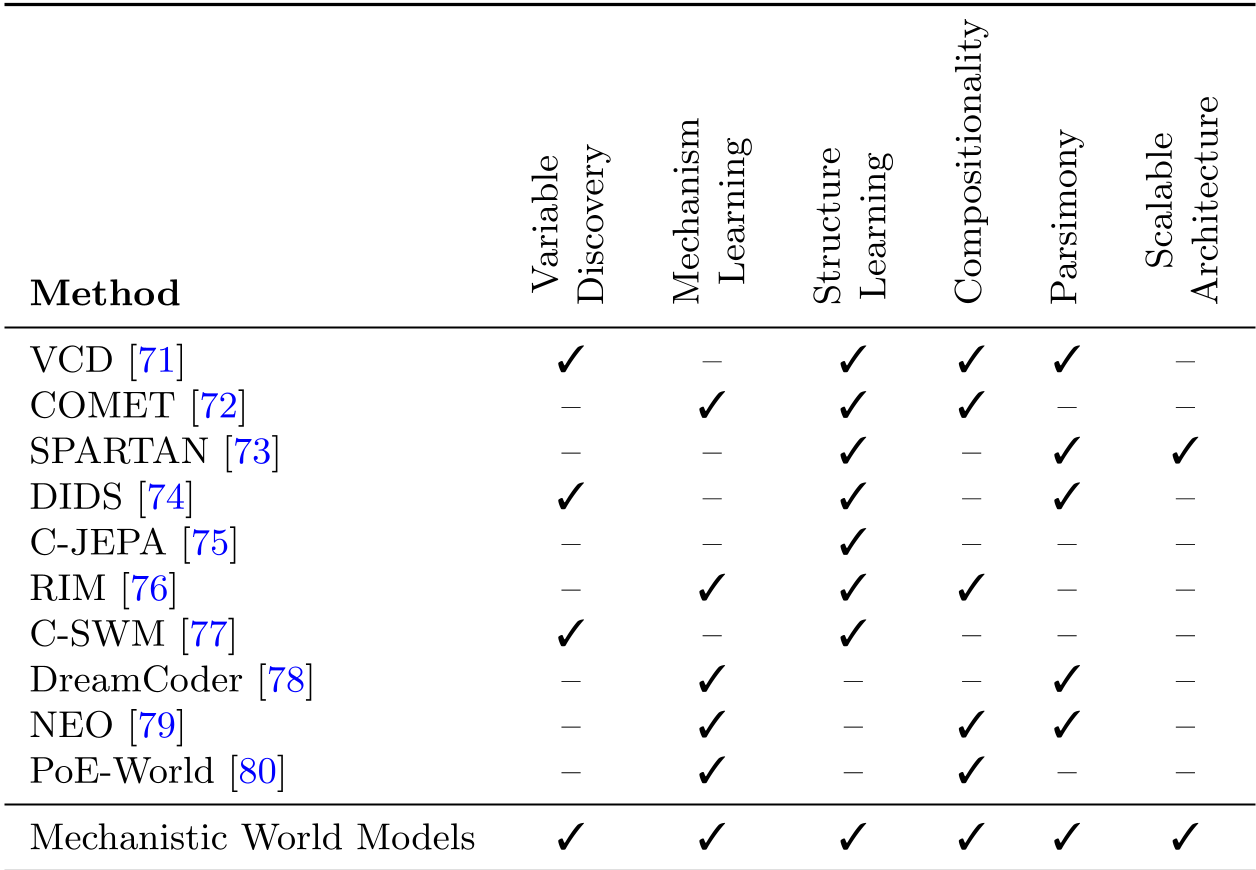
While methods like DreamCoder excel at symbolic parsimony and RIMs explore modularity, only the proposed MWM framework seeks to unify Variable, Mechanism, and Structure discovery into a single, scalable architecture.
Critical Insight: Interpretability by Design
The most profound takeaway is that interpretability shouldn't be post-hoc. We shouldn't build a 70B parameter model and then try to "guess" what it learned using probes. Instead, by using MWMs, the model’s internal computation is the explanation. If the model uses the "Gravity" module to predict a trajectory, we have successfully extracted a scientific insight.
Conclusion
The quest for Autonomous Discovery requires more than just more GPUs and more data. It requires a fundamental shift in how we think about Knowledge Organization. Mechanistic World Models offer a blueprint for building AI that doesn't just see the world, but seeks to explain it—one reusable mechanism at a time.