
Designing for Growth: How Observational Learning Can Scale Crowd Expertise
Learning From the Crowd: Observational Learning in Crowdsourcing Communities
The paper introduces a novel approach to worker training in crowdsourcing through "observational learning." It evaluates how exposing Amazon Mechanical Turk workers to peer-generated solutions and distributions—specifically in nutritional assessment tasks—comparatively impacts performance against expert feedback and control groups.
TL;DR
Crowdsourcing often hits a ceiling when tasks require specialized knowledge. This paper demonstrates that we don't always need expensive experts to train the crowd; instead, by allowing workers to observe the distribution of peer solutions (Implicit Peer Feedback), we can trigger "observational learning" that significantly boosts accuracy at zero additional cost or workload.
The Scalability Wall in Crowdsourcing
Crowdsourcing is a titan of efficiency for "common sense" tasks, but it falters in specialized domains like nutritional assessment or code debugging. Standard interventions—expert feedback or peer review—face a "trilemma" of scale:
- Expert Feedback: Effective but too expensive and slow.
- Explicit Peer Review: Adds time/cost and is often plagued by "the blind leading the blind."
- No Feedback: Leads to stagnant performance and high error rates.
The authors ask: Can we facilitate learning through observation alone, mirroring how humans learn social norms?
Methodology: The Power of Seeing Others
The researchers conducted a study on Amazon Mechanical Turk using a "nutritional assessment" task (mapping meal ingredients to macronutrients like protein, fat, and carbs). They tested several conditions, but the most innovative were the Implicit Peer Feedback designs.
Instead of being told "you are wrong," workers were shown how their answers stacked up against others:
- Simple Implicit: Showing only the most popular peer solution.
- Detailed Implicit (Aggregated): Showing a graphical distribution of all peer choices.
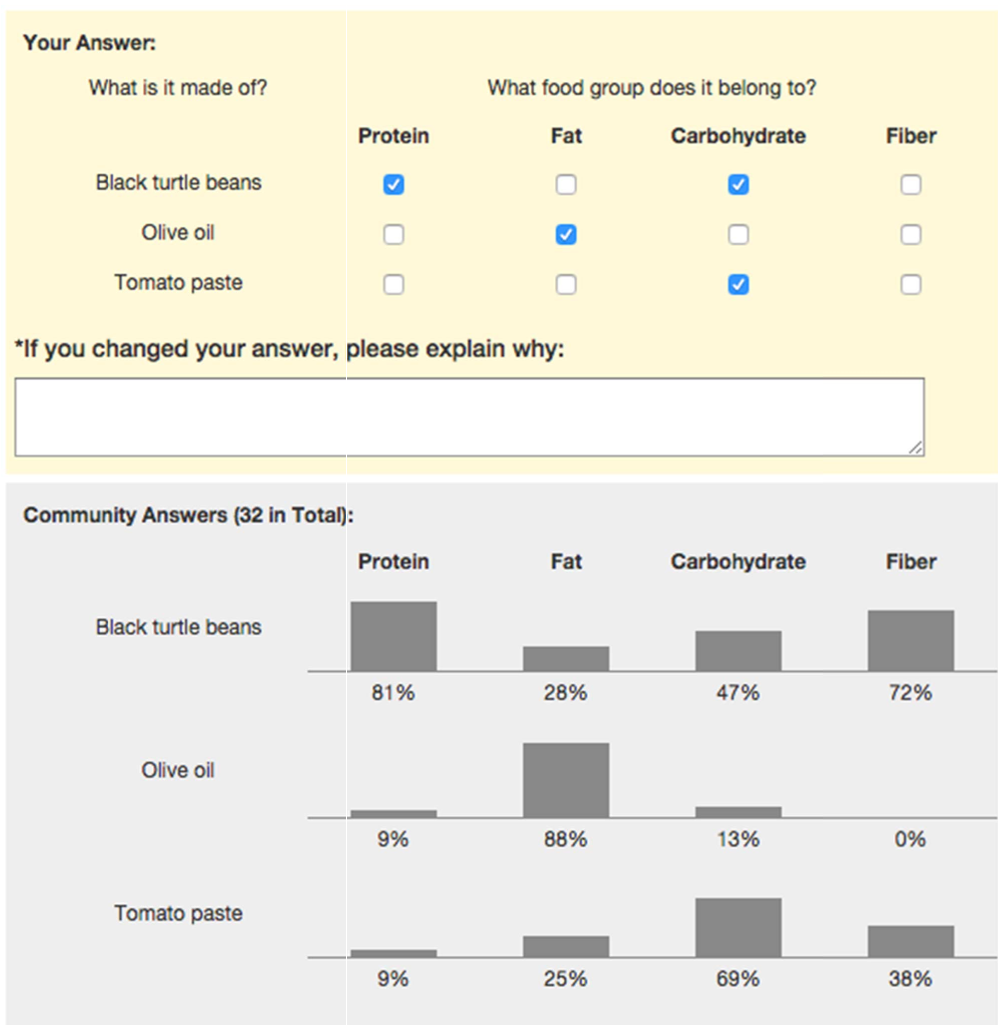 Figure 1: The UI for implicit feedback showing the worker's choice vs. the crowd's distribution.
This design targets Observational Learning by highlighting discrepancies, allowing for immediate "actionable" revision, and using the "wisdom of the crowd" as a motivational authority.
Key Results: Intuition vs. Reality
The experiment yielded a surprising hierarchy of effectiveness:
| Condition | Performance Gain (Key Ingredients) | Impact on Workflow |
|---|---|---|
| Expert Feedback | +11.1% | Very High Cost |
| Implicit Peer (Distribution) | +3.0% (Significant) | Zero Added Cost |
| Explicit Peer Review | No significant gain | Adds Workload |
| Control (No Feedback) | 0.17% | Minimal |
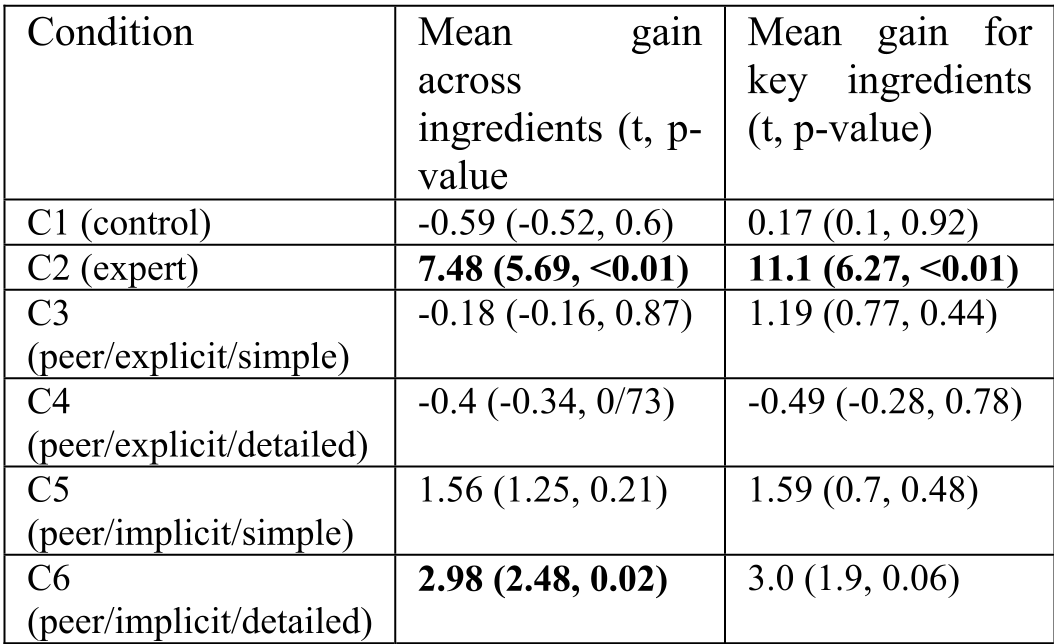 Figure 2: Statistical breakdown of accuracy gains across conditions.
Why did "Implicit" win over "Explicit"?
In the Explicit condition, workers received direct "Correct/Incorrect" labels from peers. If the peers were wrong (which happened often for complex items like avocado or nuts), the learner became confused, leading to a loss in self-efficacy.
In the Implicit (Distribution) condition, even if the "most popular" answer was wrong, the worker saw the variety of opinions. This complexity forced workers to think more deeply, reconsider their own logic, and eventually converge on more accurate nutritional patterns.
Critical Analysis & Takeaways
The "Distributed Knowledge" Factor
The success of this method relies on the task having distributed knowledge. In nutrition, one worker might know beans have protein, while another knows they have carbs. By showing the distribution, the interface effectively synthesizes these partial truths into a complete picture.
Limitations
- Cold Start Problem: How do you provide feedback for the very first workers who complete a task?
- The Bandwagon Effect: There is a risk of "information cascades," where early incorrect answers might mislead later workers.
Conclusion
This work provides a blueprint for "Learner-Centered Crowdsourcing." By moving away from costly expert-led training and toward interface-driven observational learning, platforms can upgrade their workforce from "cheap labor" to "evolving experts." For product designers, the takeaway is clear: Don't just collect data; show the crowd the mirror of their own collective intelligence.