
Navigating the Neural Landscape: How the High Seas Reshape the Seafarer's Brain
The Occupational Brain Plasticity Study Using Dynamic Functional Connectivity Between Multi-Networks: Take Seafarers for Example
This study investigates occupational brain plasticity in seafarers by analyzing resting-state fMRI data through Group Independent Component Analysis with Intrinsic Reference (GICA-IR) and Dynamic Functional Connectivity (DFC). Using sliding windows and Affine Propagation Clustering (APC), the authors identified unique DFC states and transition patterns that distinguish seafarers from non-seafarers, underscoring how extreme maritime environments drive functional brain reorganization.
TL;DR
Is a sailor's brain physically different from a land-dweller's? This study utilizes advanced Dynamic Functional Connectivity (DFC) analysis of fMRI data to prove that long-term seafaring leads to "occupational brain plasticity." By analyzing how different brain networks talk to each other over time—rather than just looking at a static snapshot—researchers discovered that seafarers possess unique "brain states" that help them adapt to the isolation, noise, and cognitive demands of the maritime environment.
The Problem: Why Static Imaging Fails to Capture the "Sailor’s Mind"
Most brain research relies on Static Functional Connectivity (SFC), which assumes that the connections between brain regions are constant throughout an fMRI scan. However, the human brain is a non-stationary system; it is constantly shifting between different states of integration and segregation.
For seafarers, the environment is extreme: constant engine noise, 24/7 vigilance, and months of social isolation. Standard static models often find no significant difference between seafarers and non-seafarers because they "average out" the most interesting temporal fluctuations. The authors of this study argue that the true signature of seafaring lies in the dynamics—how the brain recombines its functional networks to meet occupational challenges.
Methodology: Capturing the Chronnectome
The researchers moved beyond static maps to investigate the "Chronnectome"—the time-varying network of the brain.
1. Extracting the Networks (GICA-IR)
Using Group Independent Component Analysis with Intrinsic Reference (GICA-IR), the team identified 9 classical resting-state networks, including the Default Mode Network (DMN), Visual Networks (VIN/LVN), and the Cognitive Control Network (CCN).
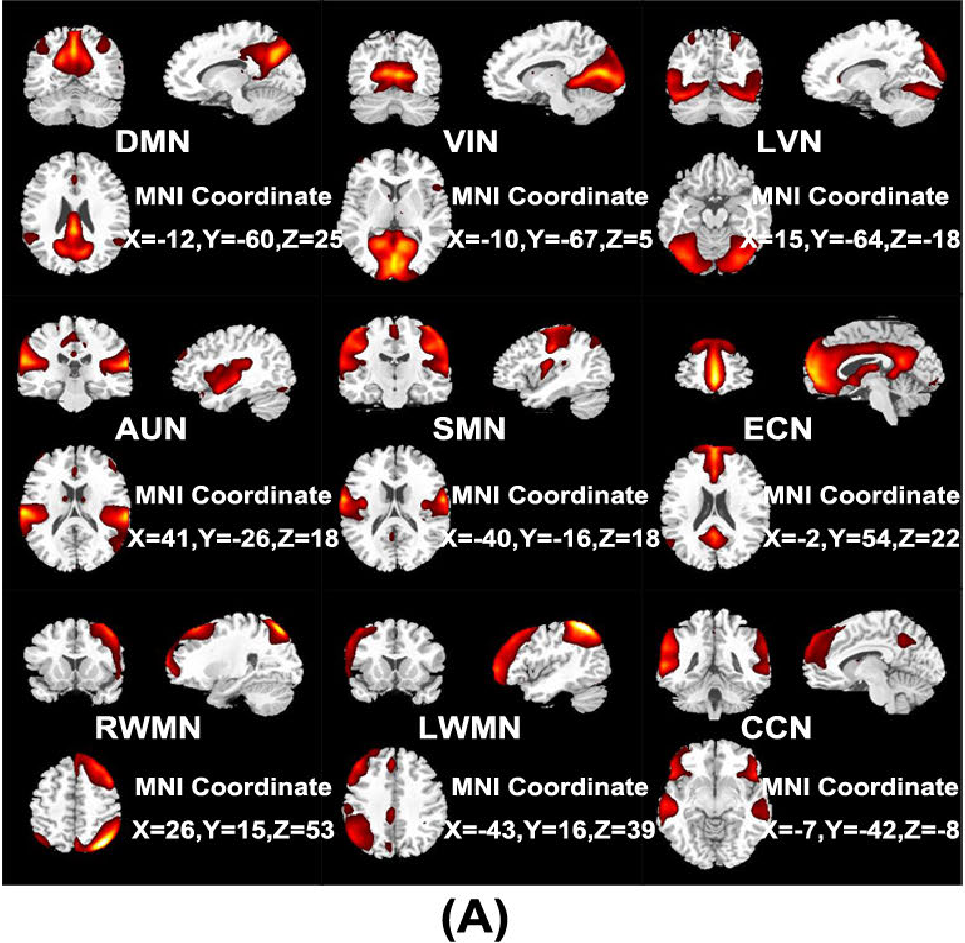 Figure 1: The nine identified brain functional networks (BFNs) used as the basis for connectivity analysis.
2. The Sliding Window Approach
To see how these networks interact over time, the researchers used a sliding time window of 40 seconds. This allows for the calculation of connectivity at hundreds of different points during the scan, revealing fluctuations that SFC would miss.
3. State Discovery via APC
Instead of using standard k-means (which requires pre-defining the number of clusters), they used Affine Propagation Clustering (APC). This algorithm "listens" to the data to determine how many distinct functional states exist. They identified 7 distinct states.
Experimental Results: The Dynamic Shift
The results were striking. When comparing seafarers to non-seafarers at a static level or a group dynamic level, there were virtually no differences. However, at the individual dynamic level, the differences became statistically significant (p < 0.05).
Key Transitions and State Ratios
Seafarers spent significantly more or less time in certain functional states (specifically States 1, 3, 5, and 6) compared to the control group.
- Vigilance Adaptation: In certain states, seafarers showed much stronger connectivity between the Auditory Network (AUN) and the Cognitive Control Network (CCN).
- Why it works: On a ship, the sound of the engine or the sea isn't just noise; it's critical information. The brain adapts by linking auditory processing more tightly with executive decision-making.
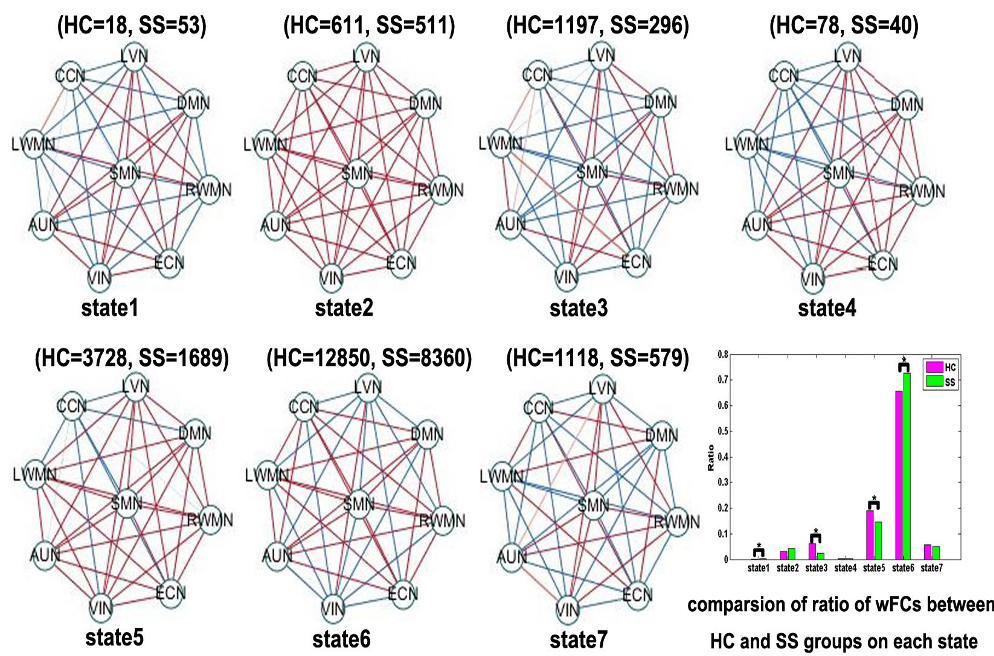 Figure 4: The 7 DFC states and the significant differences in "Ratio of Stay" between seafarers and non-seafarers.
Critical Insight: The Logic of Plasticity
The most profound takeaway is the concept of Functional Recombination. The brain doesn't necessarily "grow" new regions; instead, it optimizes the switching patterns between existing networks. For instance, the transition probability maps showed that seafarers have unique "survival states" (States 5 and 6) where their brains dwell longer to maintain the cognitive load required by their profession.
Conclusion and Future Outlook
This study provides a roadmap for assessing mental health in the shipping industry. By understanding the "normal" dynamic signature of a seafarer's brain, we could potentially identify early markers of mental sub-health or burnout when those dynamic patterns begin to break down.
Limitations: The study utilizes a 40s window, which is a standard but debated choice in DFC research. Future work using High-Order Functional Connectivity (HOFC) could reveal even deeper layers of the brain’s hierarchy in these professional populations.
Takeaway for the Field: If you want to see the impact of a career on the brain, stop looking at the map, and start watching the movie.