
Technical Communication vs. Training: Bridging the Cultural Divide in Professional Practice
Different Approaches to Similar Challenges: An Analysis of the Occupational Cultures of the Disciplines of Technical Communication and Training Tutorial -Feature by SAUL CARLINER, ASSOCIATE MEMBER, IEEE
This paper analyzes the distinct occupational cultures of Technical Communication and Training, highlighting that despite overlapping skill sets, they possess fundamental differences in goals, processes, and intellectual roots. It provides a comparative framework to help professionals navigate the transition between these two disciplines effectively.
TL;DR
While Technical Communication and Training seem like close cousins, they are separated by a "common language" and vastly different occupational cultures. This paper highlights that moving from writing manuals to designing training requires more than just a shift in format; it requires a fundamental shift from Usability (knowing where the information is) to Performance (verifiable skill mastery).
Background Positioning
Saul Carliner’s analysis is a seminal "occupational culture" study that places these two disciplines in a global academic and professional coordinate system. It serves as both a warning against professional presumption and a roadmap for successful interdisciplinary collaboration.
Problem & Motivation: The Assumption of Transferability
Engineers and technical writers often believe that because they can describe a task, they can teach it. Carliner argues this is a fallacy. The "Call for Papers" in professional journals often assumes that technical communication is the primary lens for examining training, ignoring that Training is its own established academic discipline with its own schisms, certifications, and massive body of empirical literature.
Methodology: Two Different Worlds
The paper breaks down the divergence into several core pillars:
1. The Goal: Information vs. Mastery
- Technical Communication: Produces content to explain how to perform tasks. The user might use the manual as a "crutch" repeatedly.
- Training: Produces programs to develop skills verified by third parties. The goal is for the learner to eventually work without the manual.
2. The Process: Linear but Weighted Differently
The author compares the Hackos (Documentation) process with the Dick and Carey (Instructional Design) model.
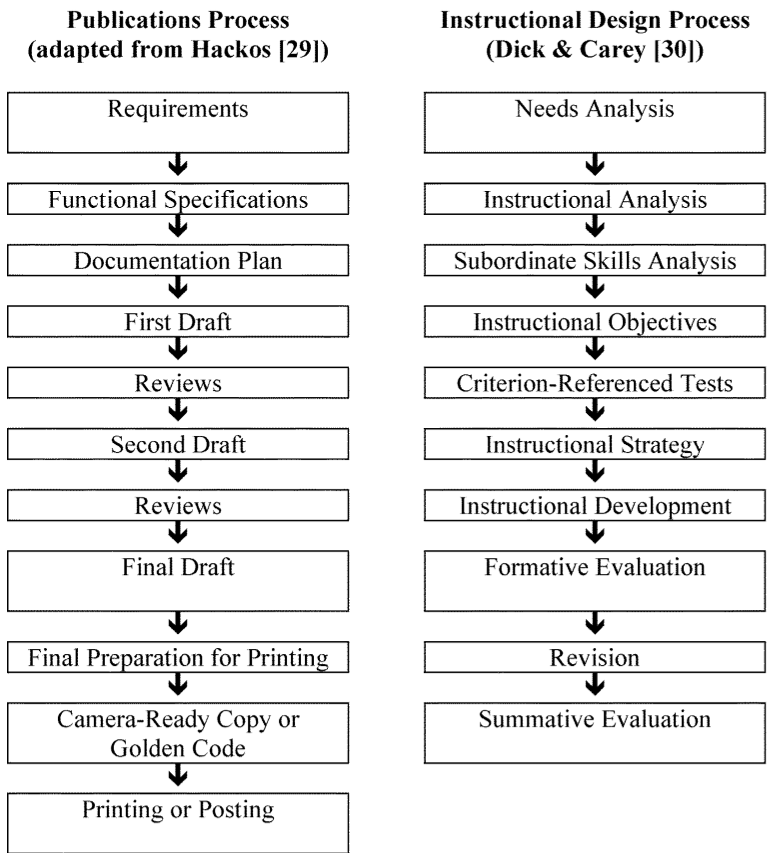
- Documentation Workflow: Heavy on writing, peer reviews, and technical editing.
- Training Workflow: Heavy on upfront performance analysis and backend summative evaluation. In Training, the "test" is often designed before the content.
3. Intellectual Roots
- Technical Communication: Primarily Humanities (Rhetoric, Composition, English).
- Training: Primarily Social Sciences (Andragogy, Human Resource Development, Educational Psychology).
Key Results: A Vocabulary and Value Conflict
The paper provides a crucial Rosetta Stone (Table I) for translating between the two cultures:
| Technical Communication | Training |
|---|---|
| User | Learner |
| Task | Objective |
| Writing | Message Design |
| Usability Test | Pilot |
| Usability | Performance |

The "Values" also differ: STC (Technical Communication) judges work on how well it is written and designed visually; ASTD/CSTD (Training) judges work on the ROI and actual performance improvement of the learners.
Critical Analysis & Conclusion
Takeaway
For a technical communicator to successfully "colonize" the training space, they must stop viewing training materials as just "longer manuals." They must adopt the language of Objectives and Evaluation.
Limitations
The study focuses heavily on North American/Western institutional frameworks. While it mentions international contexts (like laws in France or Quebec), the core philosophical divide (Humanities vs. Social Science) may manifest differently in non-Western educational traditions where these disciplines emerged simultaneously.
Future Outlook
As Documentation becomes "intelligent" (using AI-driven chatbots and Just-In-Time learning particles), the line between a "manual" and a "tutorial" is blurring. However, the need for performance verification remains the unique hurdle that training must clear, which documentation does not.