
The paper presents a novel off-shell recursion method for constructing all-loop planar integrands in Yang-Mills (YM) theory. By solving classical equations of motion via the perturbiner method and introducing a unique matrix formalism for the gluon sector, the author provides a systematic framework to generate higher-loop integrands including ghost contributions.
TL;DR
This research advances the frontier of scattering amplitudes by proposing an off-shell recursion framework for Yang-Mills planar loop integrands. By reimagining the recursive steps through a matrix formalism and integrating ghost field contributions, it transforms the daunting task of calculating higher-loop integrands into a structured process of "sewing" matrix chains.
Problem & Motivation: Beyond the Feynman Diagram Nightmare
In modern theoretical physics, calculating higher-loop integrands is notoriously difficult. The standard approach—brute-force summation of Feynman diagrams—quickly results in an algebraic explosion that hides the beautiful, underlying structures of gauge theories. While on-shell methods like BCFW have revolutionized tree-level amplitudes, extending them to all-loop integrands remains a challenge.
The author's intuition is rooted in the perturbiner method: if we can solve the classical equations of motion (EoM) recursively, we should be able to "sew" these off-shell solutions together to form loop integrands. This bypasses the need for individual diagrams and focuses on the collective evolution of multi-particle currents.
Methodology: The Power of Matrix Formalism
The core of this work lies in the Pure Gluon Sector and its transformation into a matrix-based recursion.
1. The Recursive "Comb"
The author identifies that the gluon current (comb component) follows a structure similar to the Fibonacci sequence. This allows the current $A_P^{comb}$ to be expressed as a product of matrices:
$$ \begin{pmatrix} A_{P(m)}^{comb} \cdot \epsilon \ A_{P(m-1)}^{comb} \cdot \epsilon \end{pmatrix} = \dots \cdot \begin{pmatrix} B(P(k)) & C(P(k)) \ 1 & 0 \end{pmatrix} \cdot \begin{pmatrix} \epsilon_{P_1} \ 0 \end{pmatrix} $$
Here, matrix B encodes 3-vertex interactions and C encodes 4-vertex interactions.
2. Sewing Loops
The 1-loop kernel is then constructed by closing these matrix chains. For higher loops, the process becomes a "local" operation: instead of recalculating the whole integrand, you simply "sew" a new matrix chain into the existing lower-loop kernel.
 Figure 1: The matrix representation of the comb component, showing the recursive structure transitions.
3. Incorporating Ghosts
To maintain the integrity of Yang-Mills theory, the author adds the ghost ($b, c$) contributions. The recursion is updated to include ghost multi-particle currents, ensuring that fermion loops (ghost loops) carry the necessary minus signs and correctly subtract unphysical degrees of freedom.
Experiments & Results: The 2-Loop Case Study
The author validates the theory by specializing in 2-point 2-loop planar integrands. By applying the recursion:
- Start with the 1-loop kernel (gluon + ghost).
- Apply the sewing operation to generate the $I_{2,2}^{kernel}$.
- Sum over divisions to produce the final 2-loop integrand.
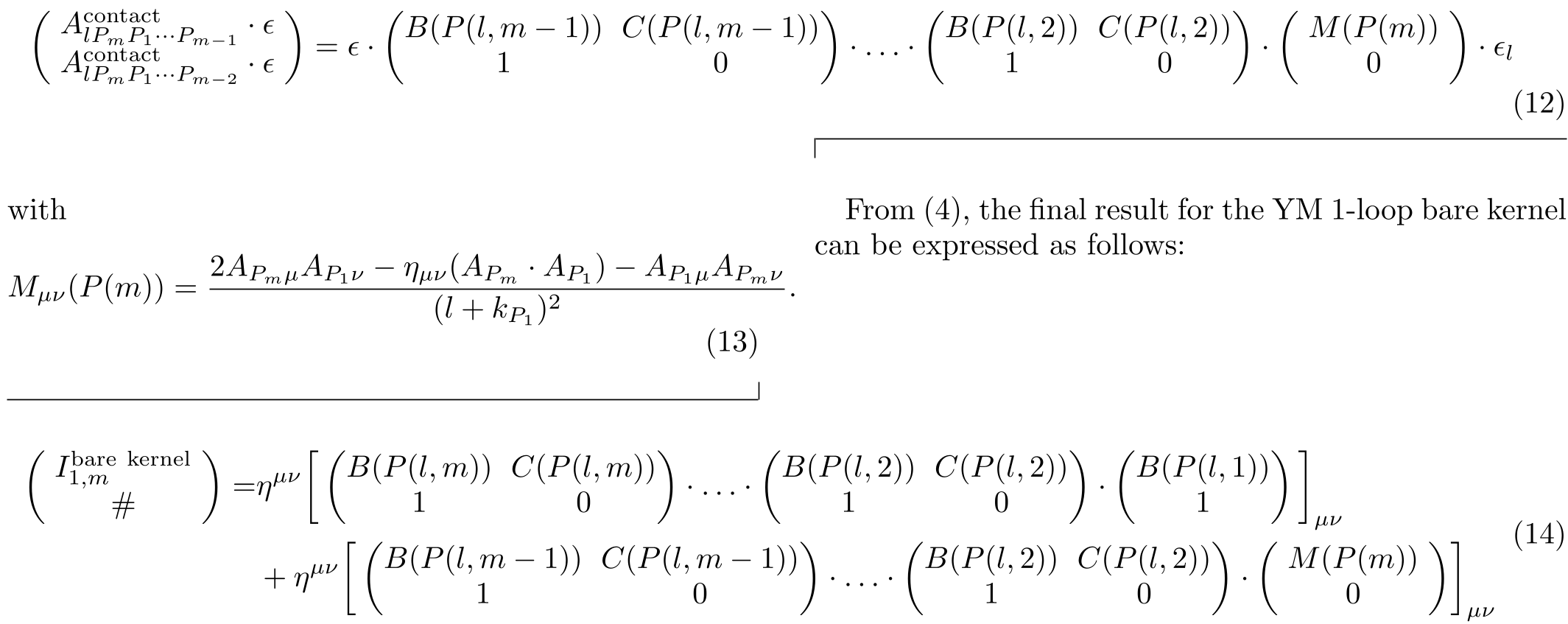 Figure 2: The analytical expression for the YM bare kernel, a key bridge to deriving the 2-loop SOTA results.
Key Outcome: The matrix formalism successfully separates legs and vertices, making the construction of 2-loop results significantly cleaner than traditional diagrammatic methods.
Critical Analysis & Conclusion
This work represents a significant step in Off-shell Engineering. By providing a "matrix chain" perspective, it simplifies the local interactions of the gauge field.
Limitations:
- Currently restricted to planar integrands. Non-planar extensions are teased for future work but remain a major theoretical hurdle.
- The complexity of graph factors ($g = S imes \frac{1}{\ell-r}$) still requires careful combinatorial accounting to avoid overcounting.
Future Outlook: The author suggests that this organized structure is the perfect playground for finding a differential operator that can transform complex YM loops into simpler scalar loops—a potential "Holy Grail" for amplitude relations. This work effectively builds the infrastructure for the next generation of scattering amplitude research.