
Find & Connect: Quantifying the Leap from Physical Handshakes to Digital Networks
Connecting People at a Conference: A Study of Influence between Offline and Online Using a Mobile Social Application
This paper presents Find & Connect, a mobile social platform designed to bridge the gap between offline physical encounters and online social networking at academic conferences. By leveraging RFID-based indoor positioning and homophily-based recommendations, the study quantifies the bidirectional "Offline to Online" (O2O) transition using metrics like overlap fraction and transfer amount.
TL;DR
Attending a conference is an exercise in "ephemeral networking"—you meet dozens of peers, but records of these encounters rarely survive the flight home. Find & Connect is a research-driven system that uses RFID tracking to map these physical encounters and transform them into lasting digital connections. The study finds that physical proximity is the primary driver of online professional social networking, with over half of digital connections born from "offline-first" encounters.
The Problem: The "Ephemeral" Networking Gap
In the academic world, the primary goal of conferences is networking. However, existing social applications fail in two ways:
- General-purpose apps (Foursquare/LinkedIn) lack the granular, real-time context of a specific session or physical room proximity.
- Academic prototypes usually focus on the "physics" of the crowd (mobility patterns) rather than the "social" utility for the attendee.
The authors identify a critical pain point: the difficulty of recalling why a conversation was enlightening or who exactly was presenting in a specific session.
Methodology: Bridging the O2O Gap
The architecture of Find & Connect (Figure 1) centers on three pillars: Physical Proximity (where you are), Homophily (who you are like), and Social Interaction (how you connect).
1. The Offline Engine (RFID Integration)
To track attendance without manual check-ins, the team deployed active RFID readers. They defined an "encounter" with professional rigor: two people must be within 4 meters for at least 5 minutes while moving at a walking speed of less than 1.5 m/s (to filter out random hallway passes).
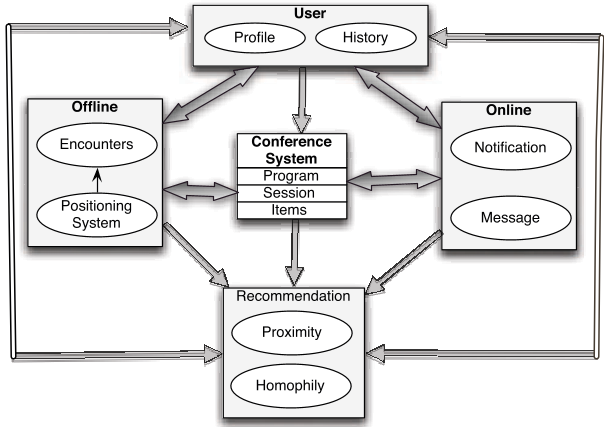
2. The Online Interface
The UI allowed users to browse attendees by "Nearby" status, research interests, or session attendance. This context-aware browsing meant that instead of searching a directory of 400 people, you could see the 10 people currently sitting in the same room as you.

Insights from the UbiComp 2011 Field Study
The researchers deployed the system at UbiComp 2011, capturing data from 241 attendees.
The Dominance of Offline-to-Online (O2O)
The most striking finding was the directionality of connection. The study proposed two metrics:
- TR(on -> off): Online interaction precedes offline encounter.
- TR(off -> on): Offline encounter precedes online interaction.
As shown in Figure 11 (implied by the data analysis), the Offline-to-Online flow was the dominant behavior. Users tended to use the app at the end of the day to "digitalize" the people they had physically met during the sessions.

Network Properties
The encounter network was remarkably dense (density = 0.5861), exhibiting a "small-world" property with an average shortest path of 1.41 hops. This suggests that at academic conferences, the physical environment creates a "close-knit community" where almost everyone is two handshakes away from anyone else.
Critical Analysis & Conclusion
Why this matters
This paper is a seminal look at Social Proximity. It proves that professional networking is highly dependent on physical "serendipity." The fact that 50%+ of digital connections overlapped with offline encounters suggests that digital tools should not try to replace physical interaction but should instead focus on augmenting the memory of it.
Limitations & Future Work
The authors noted two key hurdles:
- Positioning Accuracy: RFID can be noisy. Moving to peer-to-peer technologies like Bluetooth or NFC would improve encounter reliability.
- Recommendation Friction: Despite high-tech tracking, only 2% of automated recommendations were accepted. Users still prefer a manual "browse and verify" approach over algorithmic social matching.
In conclusion, Find & Connect demonstrates that the future of professional networking lies in the seamless synchronization of our physical presence and our digital identities.