
Deep-Sea Connectivity: Decoding LoRaWAN Performance in Harsh Offshore Environments
8467_Offshore LoRaWAN Networking Transmission Performances Analysis Under Different Environmental Conditions.
This paper presents a custom LoRaWAN infrastructure designed for offshore fish farming monitoring, achieving a reliable 8.33 km data link from a floating buoy to the coast. The study utilizes a multi-gateway architecture and specifically analyzes the impact of environmental variables (temperature, humidity, pressure) on Signal-to-Noise Ratio (SNR) and Received Signal Strength Indicator (RSSI) over a 70-day field trial.
TL;DR
This research demonstrates the deployment of a custom LoRaWAN infrastructure for offshore fish farming, successfully bridging an 8.33 km gap between a floating buoy and the Italian coast. Beyond proof-of-concept, the study provides a 70-day empirical analysis of how marine weather—humidity, rain, and temperature—affects signal integrity (RSSI/SNR), proving that while LoRa is robust, humidity and rainfall are the silent "signal killers" in maritime IoT.
The Motivation: Industry 4.0 Meets the High Seas
Aquaculture is booming, yet offshore fish farms remain "dark zones" for real-time data due to the harshness of the environment and the cost of satellite links. Traditional cellular signals struggle at sea, and the sea surface itself acts as a massive attenuator for radio waves. The researchers aimed to solve two problems: building a low-power monitoring system that survives the salt and waves, and scientifically measuring exactly how much performance we lose when the weather turns sour.
Methodology: Bespoke Hardware and Redundant Architecture
The authors didn't just buy off-the-shelf components; they engineered a specialized LoRaNode V1 interface.
1. The End Node (The Buoy)
- Core: STM32L073 microcontroller + RFM95 (SX1276) LoRa module.
- Antenna: A 9-dBi Yagi-Uda antenna mounted 2 meters above sea level.
- Strategy: Frequency hopping across 8 channels and repeating transmissions to combat the "fading" caused by waves and tide.
2. The Gateway (The Coast)
To ensure reliability, they didn't rely on one receiver. They deployed two identical gateways to create space diversity.
- Hardware: Raspberry Pi 3 + RAK831 Concentrator (SX1301 modem).
- Antenna: 14-dBi helical antennas mounted 5 meters high.
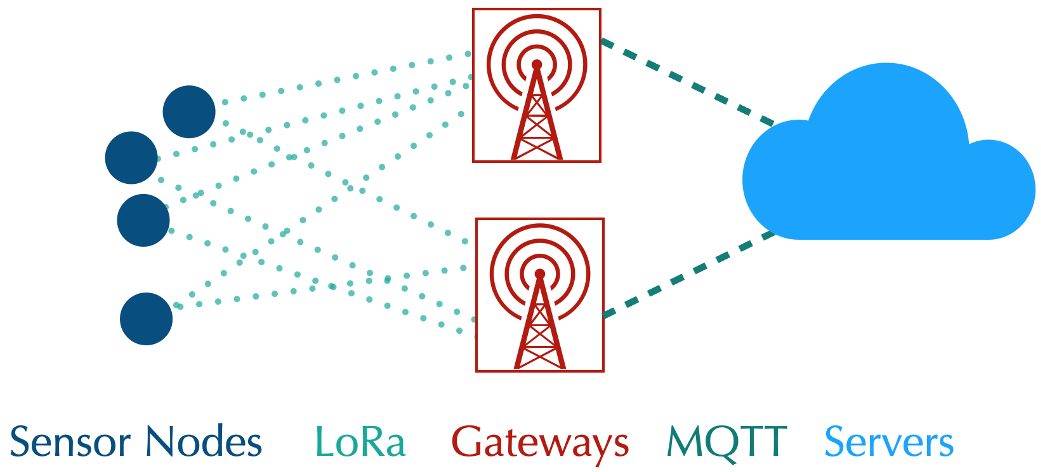 Fig 1: The architecture from sensor node to cloud dashboard via redundant gateways.
Crucial Insights: How Weather Fights the Signal
After 70 days and over 14,000 packets, the data revealed fascinating trends:
The Humidity Trap
Relative humidity (RH) proved to be the most consistent disruptor. As RH increased toward 100%, the Received Signal Strength (RSSI) dropped by roughly 2–3 dBm. This is because air saturated with water vapor is physically denser, leading to higher absorption of the 868 MHz signal.
The Rain Factor
Unsurprisingly, rain degrades performance. Heavy rain led to a significant dip in SNR (Signal-to-Noise Ratio). However, an odd phenomenon was noted: Cloudy skies actually performed slightly better than clear skies, potentially due to the cloud layer acting as a waveguide that reduces signal dispersion.
The Temperature Paradox
In land-based systems, higher temperatures usually mean more thermal noise (lower SNR). In this maritime study, RSSI and SNR actually increased with temperature. The authors explain this as a "superimposition effect": at their Italian site, low temperatures were almost always accompanied by high moisture and rain, which caused more damage than the heat ever could.
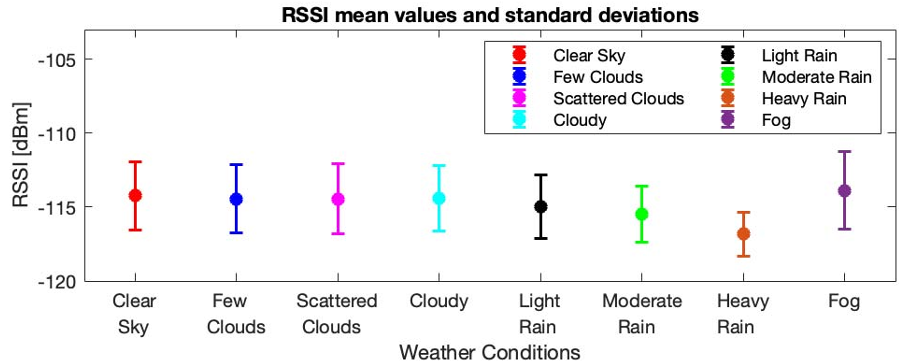 Fig 2: The fluctuation of RSSI and SNR over the 70-day trial period.
Experiments & Results: Is it SOTA?
The system maintained a 72.44% packet delivery rate using SF7 (Spreading Factor 7). While higher SF values (like SF12) would offer better range, the authors intentionally used SF7 to minimize "Time on Air" and power consumption, proving that a link can be stable at 8 km+ even with aggressive low-power settings.
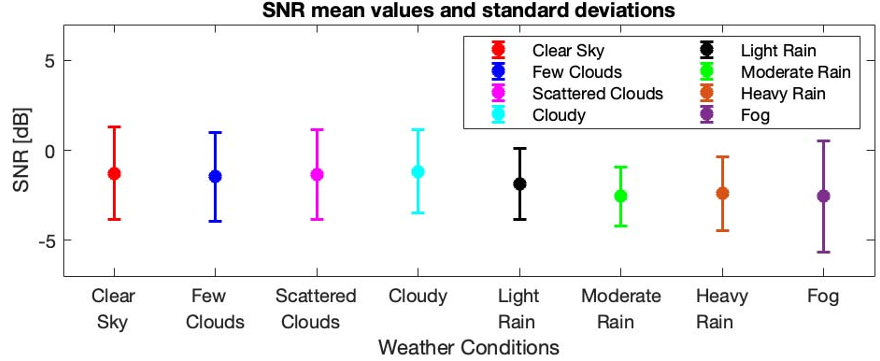 Fig 3: Mean RSSI/SNR values classified by weather condition, highlighting the impact of rain and fog.
Critical Analysis & Future Outlook
Strengths: This work moves beyond laboratory simulations to provide real-world, high-resolution data on the "marine atmospheric channel." It proves that the "space diversity" of using multiple gateways is non-negotiable for offshore IoT.
Limitations: The study was conducted primarily in summer. As the authors admit, winter storms and much lower temperatures could change the dynamics, particularly regarding battery longevity and signal diffraction.
Takeaway: For engineers building maritime IoT, the "2-3 dB humidity fade" is the new rule of thumb. When calculating your link budget for offshore platforms, don't just plan for distance; plan for the 100% humidity days that are guaranteed to happen at sea.