
Decoding Cognitive Decline: Using Nostalgic Imagery and EEG Entropy as a Digital Biomarker
Older Adult Mild Cognitive Impairment Prediction from Multiscale Entropy EEG Patterns in Reminiscent Interior Image Working Memory Paradigm
This study presents a machine learning framework for predicting Mild Cognitive Impairment (MCI) in older adults by analyzing EEG responses to reminiscent interior images. Using Multiscale Entropy (MSE) features from a 4-channel wearable dry-electrode EEG (MUSE), the researchers achieved over 80% accuracy in discriminating between normal cognition and MCI.
TL;DR
Researchers have developed a non-invasive, objective method to predict Mild Cognitive Impairment (MCI) by combining a 4-channel wearable EEG with a "nostalgia-driven" memory task. By measuring the complexity (entropy) of brain waves rather than just their amplitude, the system achieves over 80% diagnostic accuracy, paving the way for low-cost, home-based dementia screening.
Background: The Need for Objective Scalability
As the global population ages, dementia cases are expected to triple by 2050. Conventional screening tools like the Montreal Cognitive Assessment (MoCA) are prone to human error and subjective bias. While clinical EEG and fMRI provide objective data, they are not practical for daily monitoring. This paper positions itself as a bridge—leveraging consumer-grade wearable tech (MUSE headband) and advanced AI to create a reliable "digital biomarker."
Motivation: Why Nostalgia and Complexity?
The authors rely on two core insights:
- Reminiscent Logic: Older adults often retain more vivid emotional connections to childhood memories. The researchers hypothesized that images of "old Japanese/Western interiors" would trigger more distinct neural signatures than modern designs.
- Noise Robustness: Dry-electrode wearable EEGs are notoriously noisy. Traditional frequency analysis often fails here. Multiscale Entropy (MSE), however, looks at the unpredictability and complexity of the signal across multiple time scales, making it far more resilient to the environmental noise typical of home settings.
Methodology: The Reminiscent Paradigm
The study involved an oddball-style memory task where subjects viewed eight types of interior images—Japanese vs. Western, and Modern vs. Post-WWII (Reminiscent).
System Architecture and MSE
The EEG data was captured via four dry electrodes (AF7, AF8, TP9, TP10).
- Signal Processing: 1–30 Hz bandpass filter to eliminate muscle artifacts and power line noise.
- MSE Calculation: The signal is "coarse-grained" (downsampled) repeatedly. At each scale, Sample Entropy is calculated to measure the rate of new information generation.
- Classification: These complexity scores were fed into various ML models, comparing shallow learners (SVM, LDA) against deep learners (FNN).
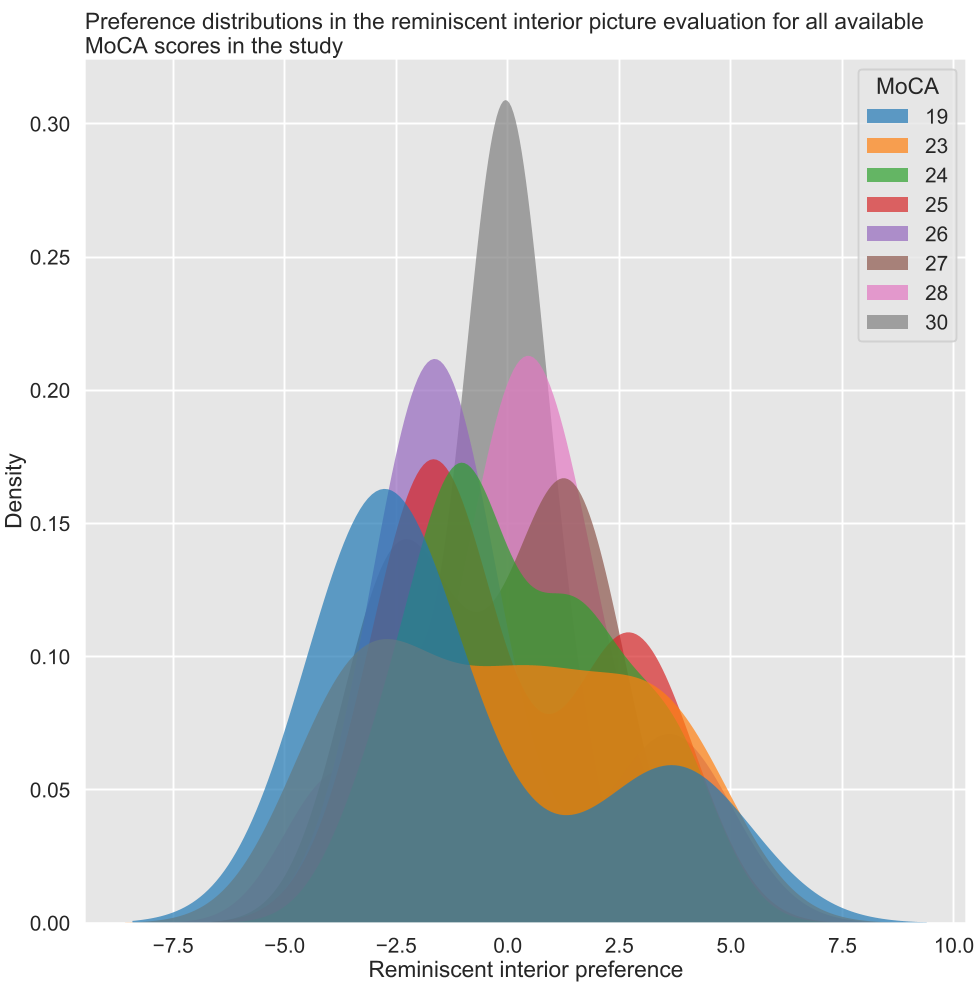 Fig 1. Behavioral results showing that subjects across the board preferred reminiscent Japanese interiors, though MCI subjects showed a more fragmented, bimodal distribution of preferences.
Experimental Results: High Accuracy with Minimal Data
The results validated the use of "complexity" as a diagnostic feature:
- Performance: The Fully Connected Neural Network (FNN) and Random Forest (RFC) both achieved median accuracies above 80%.
- Behavioral Split: Visually, the data showed that individuals with lower MoCA scores (MCI) exhibited a bimodal distribution in their image preferences (Figure 3), suggesting a disrupted emotional/cognitive processing of the reminiscent stimuli compared to the unimodal distribution of healthy controls.
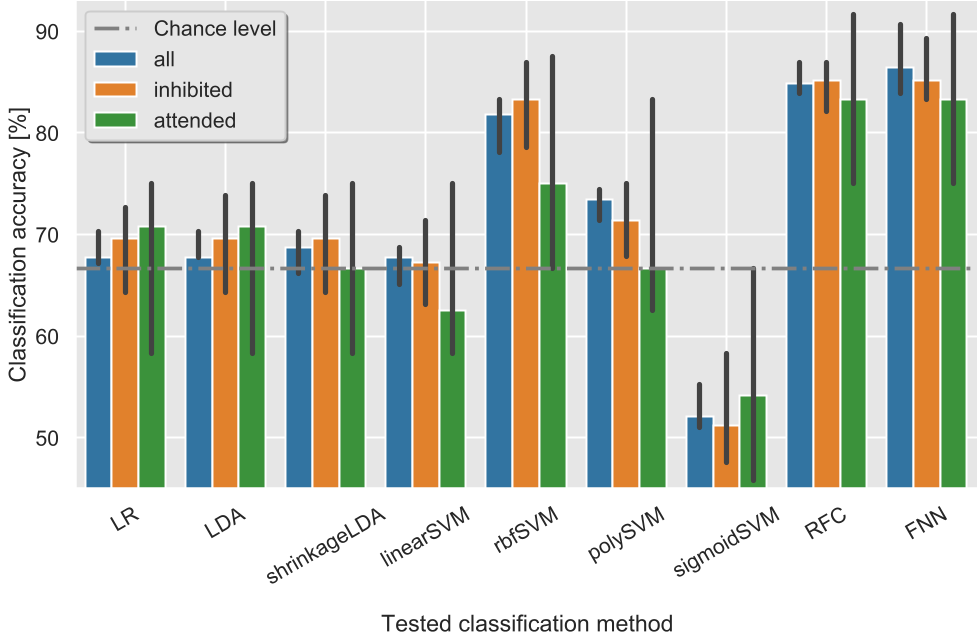 Fig 2. Comparison of classification accuracies. Note that the FNN consistently stays above the 80% mark across all task conditions (attended vs. ignored stimuli).
Critical Analysis: A Step Toward "Beyond a Pill" Therapy
The strength of this work lies in its social utility. It transforms a $200 wearable into a clinical-grade diagnostic tool by changing how we process the signal (Complexity vs. Power Spectrum).
Limitations & Future Outlook:
- Sample Size: With only 15 subjects, the results are "preliminary." A larger, more diverse cohort is needed to confirm the generalizability of the MSE patterns.
- Cultural Specificity: The study specifically used Japanese and Western interiors. How these biomarkers change in different cultural contexts (e.g., South Asia or Africa) remains an open research question.
In conclusion, this paper successfully demonstrates that AI does not need "perfect" data to produce high-value clinical insights—it simply needs the right mathematical lens, in this case, the lens of Multiscale Entropy.