
iNET: Breaking the Fixed-Window Myth in Personalized User Behavior Profiling
One Size Does Not Fit All: Profiling Personalized Time-Evolving User Behaviors
This paper introduces iNET, a streaming analytic and visualization framework designed to detect personalized behavioral changes in time-evolving social interaction networks. By challenging the convention of fixed observation intervals, it identifies unique user transition events without relying on invasive textual content analysis.
TL;DR
In the world of social network analysis, the industry standard is to slice time into neat, fixed chunks—days, weeks, or months. This paper proves that "one size does not fit all." By introducing iNET, the authors demonstrate that an adaptive, user-centric observation window can detect critical behavioral shifts (like a sudden interest in a product launch or a political event) with 95% precision, significantly outperforming traditional fixed-interval methods.
The Problem with "Fixed Time"
In academic and industrial analytics, we often aggregate interactions into snapshots—say, a user's activity per week. However, this creates a fundamental mismatch:
- User Diversity: Some users interact hourly; others, monthly. A weekly window is too noisy for one and too sparse for the other.
- Temporal Evolution: A single user's pulse changes. During a major life event, their interaction rate spikes, making a "standard week" irrelevant.
The authors call this the Temporal Asymmetry Hypothesis: interaction patterns are unique to the individual and vary over their lifetime.
Methodology: The iNET Framework
iNET operates as a streaming pipeline that learns a representation of a user's "baseline" without ever reading their private private messages.
1. Representation Learning
Instead of a fixed window, iNET uses the ADAGE algorithm to wait until a specific network metric (like weighted in-degree) reaches a "stable" state. This creates variable-length intervals (). For every interval, iNET records:
- : The intensity of incoming interactions.
- : The count of self-authored posts (broadcasts).
2. The Anomaly Signature
iNET's core intuition is that in "normal" behavior, self-posts () and incoming interactions () are correlated. An anomaly occurs when this balance is disrupted—for example, if a user posts once but receives thousands of replies (an external event), or posts excessively with zero engagement (potential behavioral distress).
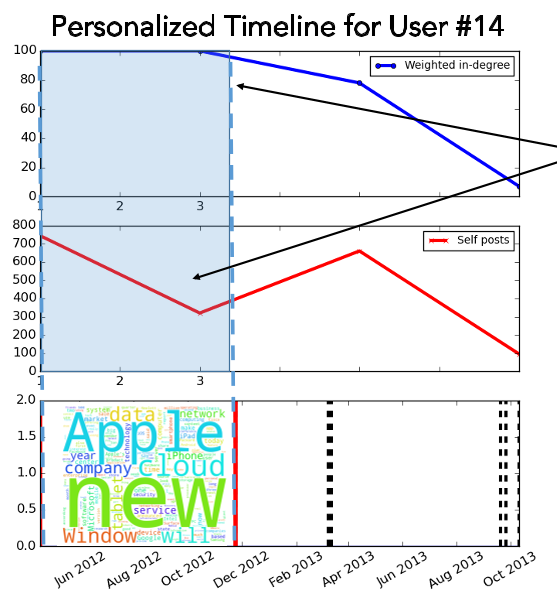 Fig 1: iNET detecting activity deviations across streaming features. The blue highlight shows an external event (Apple product release) driving behavior.
Experiments & Deep Insights
The authors tested iNET against eight datasets, primarily focusing on a 18.5-month Facebook stream (D2y).
Diversity of Detection
The most striking result is the Entropy of Discovery. iNET discovered a diverse range of event categories: Politics, Personal, News, Religion, and Technology.
- iNET Precision: 95%
- Baseline (Fixed Window): Captured mostly "Misc" categories or high-frequency organic events (like birthdays) but missed the nuanced "phases" of user interest.
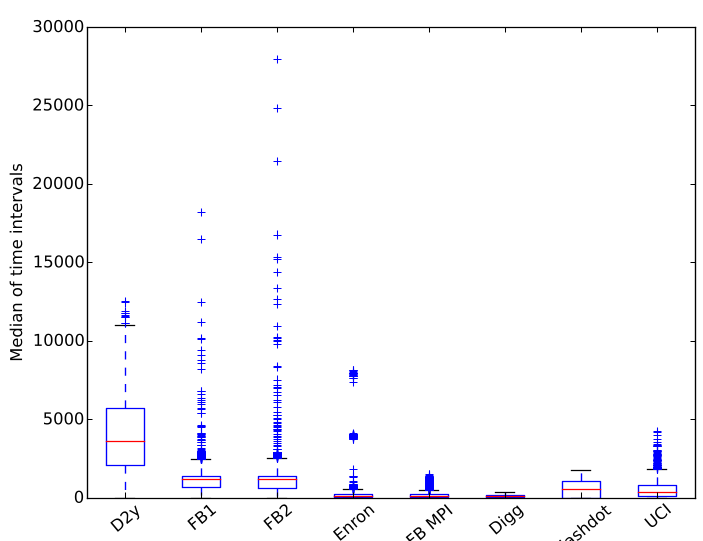 Fig 2: Validation of the Temporal Asymmetry Hypothesis across 8 datasets, showing massive variance in appropriate observation scales.
The "Phase" Phenomenon
iNET proved superior at identifying "User Phases." While fixed windows often flag a single point in time, iNET identifies the start and end of a behavioral change. For example, during the 2012 US elections, iNET adjusted its windows to match the political discourse cycle of the user, reverting back to "Personal" or "Sports" windows once the event passed.
Professional Perspective
This work sits at the intersection of Dynamic Graph Mining and Privacy-Preserving AI.
The "Why" it Works: By disassociating interaction from a physical clock and attaching it to a "structural clock" (the stability of the graph), iNET normalizes for lifestyle differences. It treats the interaction volume as the independent variable.
Future Impact:
- Clinical Utility: This can be a "smoke detector" for mental health, spotting changes in the ratio that precede depressive episodes.
- Privacy: It proves we don't need NLP (Natural Language Processing) to understand that a change occurred. We only need the metadata of "who talked to whom."
Conclusion
One size does not fit all. iNET provides a robust, streaming-ready roadmap for personalized monitoring. By letting the user's data dictate the observation pace, we achieve a higher resolution of human behavior than any fixed-schedule cron job could ever offer.