
OneWM-VLA: Why a Single Token per Frame is the Secret to Long-Horizon Robotic Control
OneWM-VLA is a world-model-augmented Vision-Language-Action (VLA) model that achieves state-of-the-art long-horizon robot control by compressing multi-view visual tokens into a single semantic token per frame. Built on the π0 backbone with 14.71M LoRA parameters, it reaches a 61.3% success rate on MetaWorld MT50 and 95.6% on LIBERO-Long, significantly outperforming base π0 models.
TL;DR
OneWM-VLA redefines how world models should be integrated into Vision-Language-Action (VLA) systems. By compressing each camera view into just one semantic token per frame and using a joint flow-matching objective for both latents and actions, it achieves massive gains in long-horizon tasks (e.g., +40% success rate in real-world cloth folding) while maintaining horizon-invariant computational efficiency.
Background: The Visual Bandwidth Paradox
In the quest to move robots from short-horizon imitation to long-term planning, "World Models" have become the go-to solution. Typically, researchers believe that more data is better—giving the world model 256 or more visual tokens per frame to "see" every detail.
However, the authors of OneWM-VLA identify a critical bottleneck: high visual bandwidth leads to massive memory consumption that scales poorly with time, and often forces the model to waste capacity on "photometric noise" (lighting, textures) rather than the "physics of the task."
The Core Innovation: Bottleneck-Rollout Coupling
OneWM-VLA introduces a hardware-efficient and logically elegant architecture designed to plug into pretrained backbones like π0 via LoRA adaptation.
1. Adaptive Attention Pooling (The Bottleneck)
Instead of passing raw visual features, the system uses an Adaptive Attention Pooling mechanism. It scores tokens using three strategies:
- MAX: Captures the peak channel response.
- SUM: Captures the total energy.
- LEARN: A task-aware MLP that learns what parts of the image matter for the specific robot goal.
These are fused into a single token. Remarkably, the authors found that increasing this to 12 tokens actually hurt performance, suggesting that the 1-token bottleneck acts as a vital regularizer.
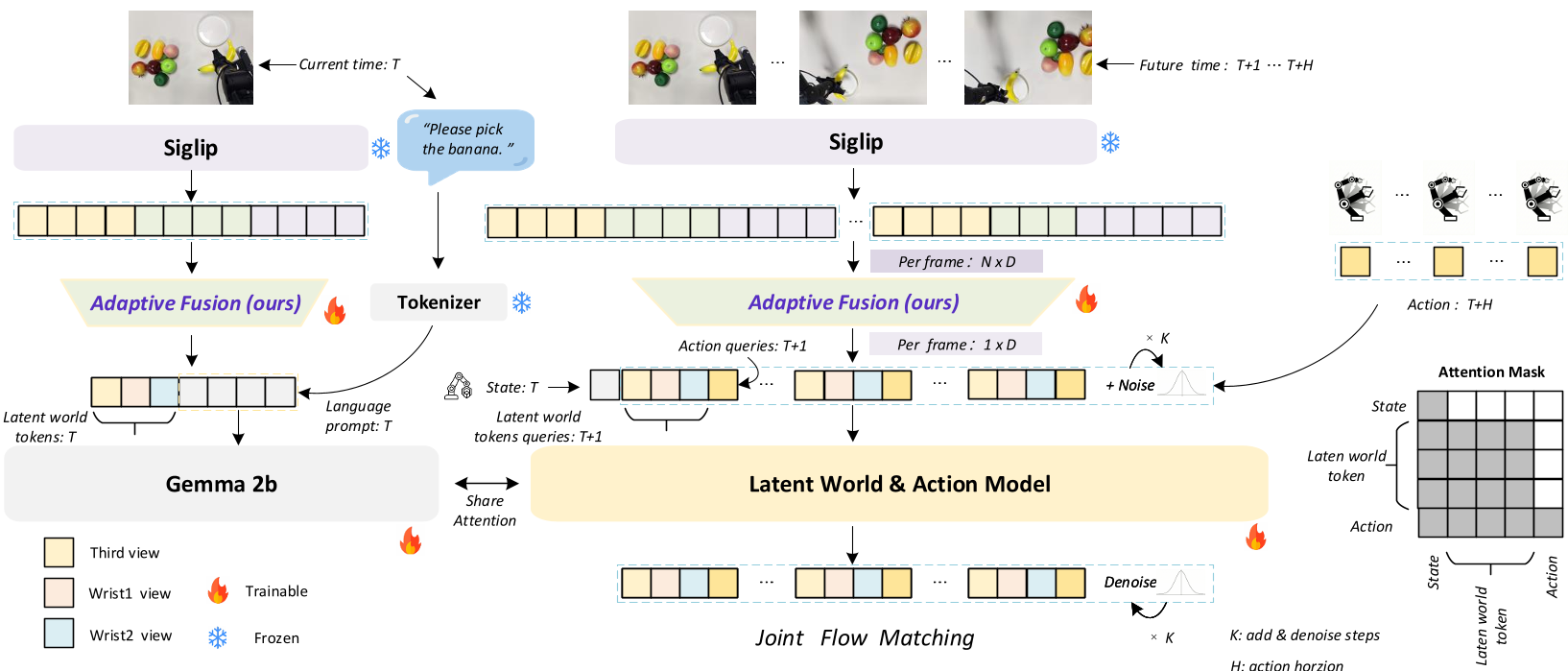
2. Joint Flow Matching (The Rollout)
Unlike models that predict video first and then compute actions, OneWM-VLA treats the future latent stream and the action trajectory as a single joint distribution. Using Flow Matching, the model "denoises" both sequences simultaneously. This ensures the predicted future environment states directly guide the predicted actions.
Experimental Proof: Dominating Long Horizons
The model was tested across MetaWorld, LIBERO-Long, and a real Piper robot arm.
- MetaWorld MT50: As the planning horizon () increased to 30 steps, the gap between OneWM-VLA and standard VLAs widened significantly. While others failed as tasks got harder, OneWM-VLA maintained high success rates on "Very Hard" tasks.
- Real-World Generalization: In the "Fold Cloth" task—a notorious challenge involving deformable objects—OneWM-VLA reached a 60% success rate, tripling the performance of the π0 baseline.
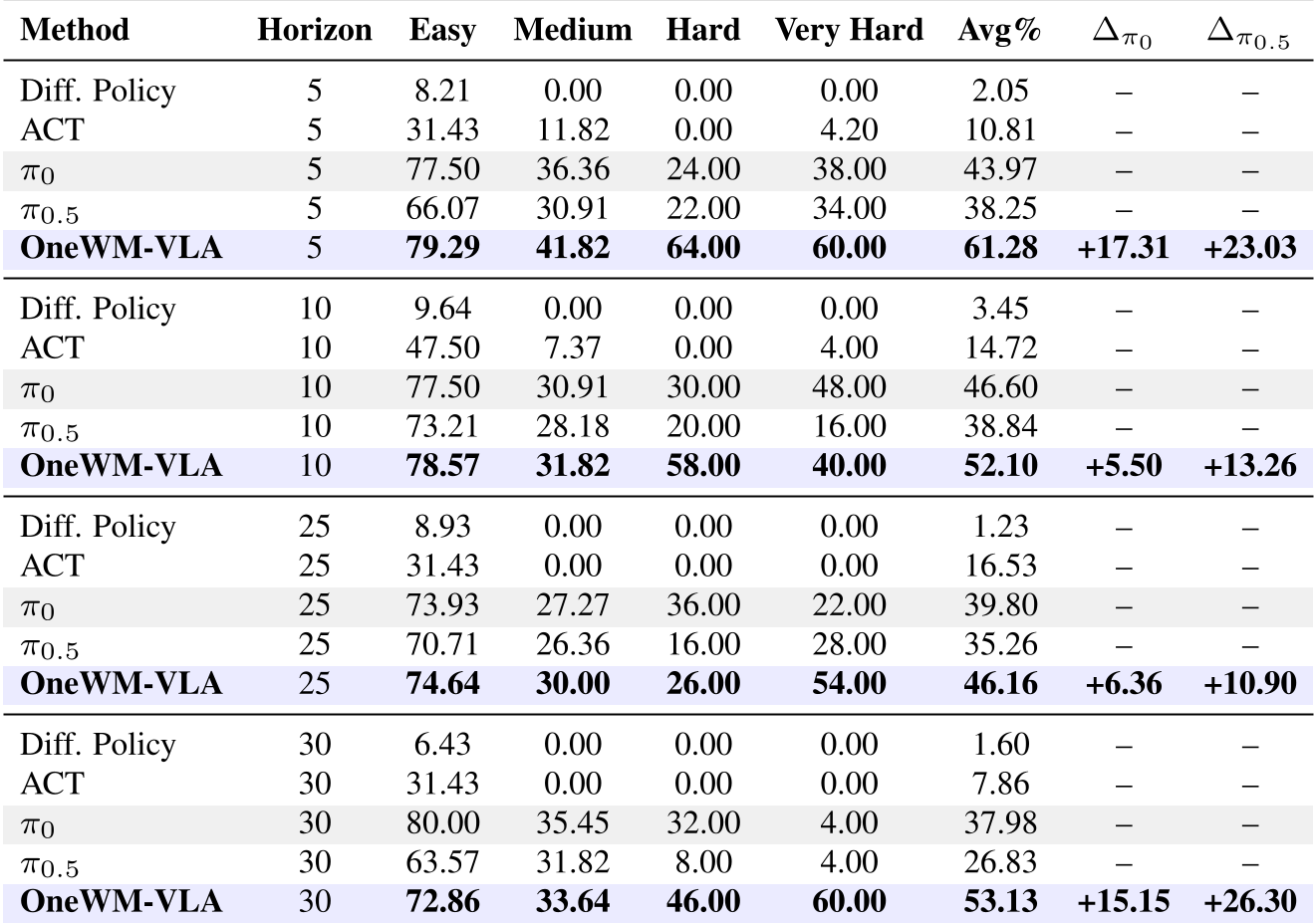
Critical Analysis: Why Does This Work?
The ablation studies provide three profound insights:
- Semantic vs. Pixel Space: Predicting in semantic latent space (features) is far more effective than pixel space (images). Pixel prediction forces the model to care about the color of the table; semantic prediction forces it to care about the position of the gripper.
- The Advantage of Adaptive Pooling: Static pooling (like simple averaging) fails. The "Adaptive" part allows the model to shift its attention dynamically as the robot moves.
- Regularization through Compression: By forcing the world model through a 1-token-per-frame bottleneck, the system is prevented from over-fitting to the training environment's visual specifics, leading to better generalization.
Conclusion & Future Outlook
OneWM-VLA shifts the paradigm for world-model-augmented robots. It suggests that the future of embodied AI isn't in building bigger, more complex visual pipelines, but in finding the cleanest semantic abstraction that allows a policy to "dream" its future actions and environment transitions in tandem.
As we scale to even longer horizons (hundreds of steps), this low-bandwidth approach will likely become the standard for maintaining real-time inference speeds on edge robotic hardware.
Takeaway: To plan effectively for the future, a robot doesn't need to see every pixel—it just needs to understand the "soul" of the frame in a single token.