
Efficient Task Allocation in Spatial Crowdsourcing: Balancing Location and Quality through Online Optimization
Online Algorithms of Task Allocation in Spatial Crowdsourcing
This paper introduces an online task allocation framework for spatial crowdsourcing that combines R-tree spatial indexing with a stochastic selection algorithm. By utilizing a threshold-based online optimization strategy (), it achieves efficient real-time worker matching while maintaining high worker quality in dynamic environments.
TL;DR
The rise of the "gig economy" (e.g., Meituan, Uber, DiDi) requires matching tasks to workers in real-time based on geographic proximity and uncertain worker quality. This paper proposes a dual-layer approach: using R-tree spatial indexing to filter workers by distance and an online stochastic optimization algorithm (based on the rule) to pick the best candidate without exhaustive searching.
Background & Motivation
Current crowdsourcing systems face two major hurdles:
- Spatial Dynamics: Tasks and workers are tied to physical locations; scanning every worker in a city for every single task is computationally suicidal.
- Uncertainty: In an online environment, you don't know the "quality" of a worker until they appear. If you pick the first one, they might be bad; if you wait for the "best" one, you might wait forever or incur massive "testing costs."
The authors' insight is to treat worker selection as an Online Stopping Problem, where the goal is to maximize the probability of selecting the best candidate while minimizing the search time.
Methodology: The Core Architecture
1. Spatial Pruning with R-Trees
Instead of a linear search, the system builds an R-tree for every task category. It uses the MINDIST metric (Minimum Distance from a point to a Minimum Bounding Rectangle) to prune entire groups of workers who are too far to be considered.
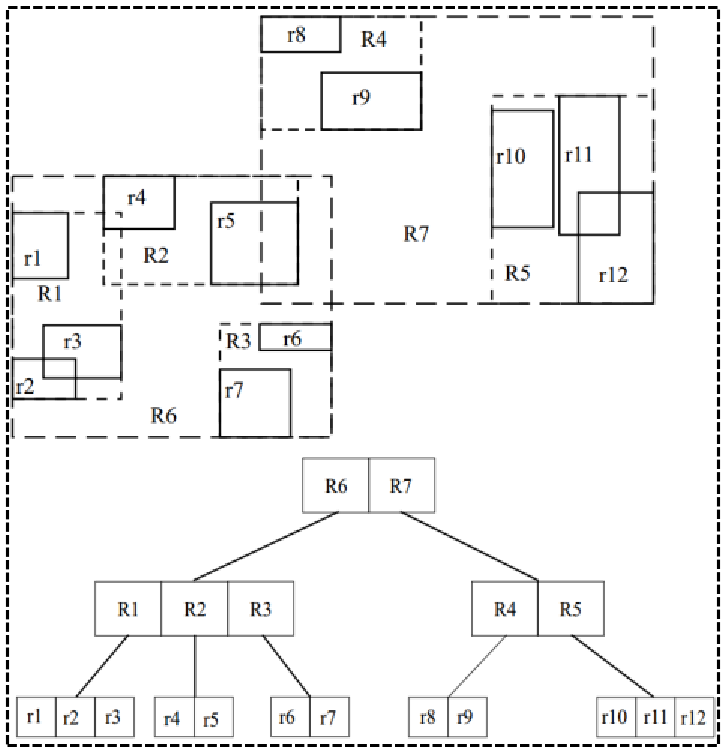
2. The Stochastic Selection
The paper compares three strategies:
- Random: Fast but low quality.
- Greedy: High quality but requires traversing workers (heavy cost).
- Online Optimal: The proposed algorithm.
The logic follows the "Secretary Problem" math:
- Observe the first workers to establish a quality benchmark (without hiring them).
- Hire the very next worker who exceeds that benchmark.
- Mathematically, the optimal is (roughly 37% of the candidate pool).
Experiments and Results
Performance Gain
By integrating the R-tree, the computation time remains significantly lower and more stable as the number of workers grows compared to standard crowdsourcing traversal (Crowdsourcing vs. RTree-Crowdsourcing).
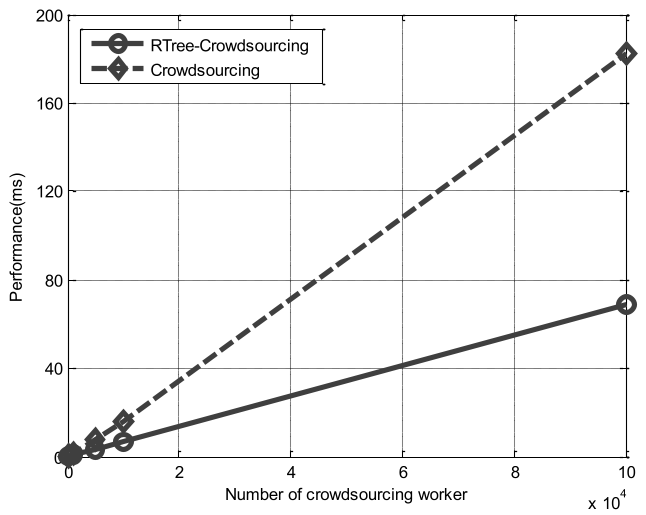
Quality Probability
The experimental data confirms that when , the system finds the "Most Qualified" worker with a probability of ~0.37 (37%). This is a massive improvement over (pure random) or (which is inefficient in an online context).
| threshold | Num=100 (Prob) | Num=1000 (Prob) |
|---|---|---|
| 0.052 | 0.005 | |
| 0.371 | 0.370 | |
| 0.015 | 0.001 |
Critical Analysis & Conclusion
Key Takeaways: This work successfully bridges geographic information systems (GIS) and online optimization. The use of R-trees handles the "Where" and the stochastic algorithm handles the "Who".
Limitations:
- The paper assumes the total number of workers () is known or estimable for the calculation, which might fluctuate in highly volatile markets.
- The "quality" metric is treated as a single scalar, whereas in reality, it may be multi-dimensional (rating, speed, reliability).
Future Outlook: In the era of AI 2.0, moving from fixed thresholds to Reinforcement Learning (RL) based thresholds could allow the system to adapt dynamically based on time-of-day or urban density traffic patterns.