
Beyond Batching: A Unified Framework for Online Stochastic Boosting
A family of online boosting algorithms
The paper introduces a unified framework for Online Stochastic Boosting (OSB) derived from the principles of stochastic gradient descent. It enables the creation of online boosting algorithms for various tasks, including Logistic Regression, Least Squares Regression, and Multiple Instance Learning (MIL), by updating weak learners sequentially as data arrives.
TL;DR
This paper presents a breakthrough in sequential learning by introducing Online Stochastic Boosting (OSB). By reframing boosting as a stochastic gradient descent problem within the parameter space of weak learners, the authors provide a recipe to turn complex batch boosting tasks—like Multiple Instance Learning and Regression—into efficient, one-pass online algorithms that rival the performance of their batch-mode predecessors.
Background: The Memory Bottleneck
Boosting has long been the "Swiss Army Knife" of machine learning, known for turning a collection of mediocre "weak" learners into a high-performance "strong" model. However, the classic Gradient Boosting Machine (GBM) is a memory hog. It requires the full dataset for every iteration to calculate gradients in function space. In an era of streaming data and edge computing (like visual tracking or real-time sensor monitoring), we cannot afford to wait for a batch or store millions of samples.
The Core Insight: Flipping the Loops
The authors observe that if we choose differentiable weak learners (e.g., small neural networks or sigmoid-based neurons) and a loss function that is additive over samples, we can optimize the strong model using Stochastic Gradient Descent (SGD).
In a traditional batch setting, the algorithm iterates through all weak learners , and for each learner, it sweeps through all data points. The authors' "Online Stochastic Boosting" (OSB) simply flips this: for every new data point that arrives, the algorithm sequentially updates all weak learners.
Algorithm Comparison: Batch vs. Online
 The fundamental shift: In OSB (Algorithm 2), the "for each data point" loop is moved to the outside, enabling real-time updates.
Methodology: One Framework, Many Flavors
The power of this framework lies in its 4th step: the Update Rule. By changing the loss function , the authors derive three distinct algorithms:
- Online Logistic Regression Boosting: For binary classification (e.g., Smile detection).
- Online Least Squares Regression Boosting: For predicting continuous values (e.g., Head pose yaw angle).
- Online Multiple Instance Learning (MIL) Boosting: For scenarios where labels are provided for "bags" of instances (e.g., Image retrieval).
The update rule for a weak learner with parameters generally follows:
Visualizing Performance and Convergence
The authors conducted extensive testing on datasets ranging from MNIST digit recognition to specialized tasks like Abalone age prediction and robotic arm kinematics.
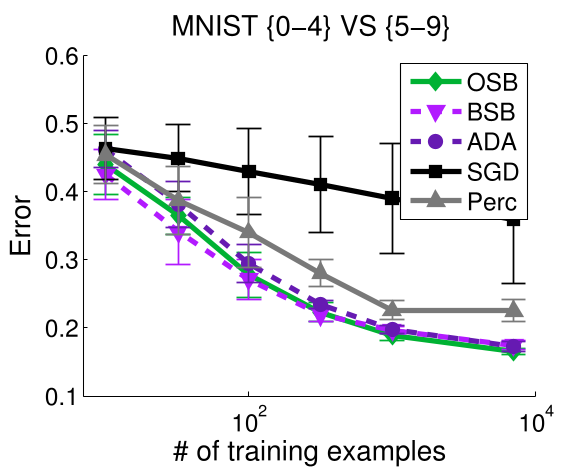 Comparison of Error Rates: The red dashed line (OSB) tracks closely with the blue solid line (Batch Boosting), eventually converging to nearly identical performance while using significantly fewer memory operations.
Key Findings:
- Convergence: OSB reaches "batch-level" accuracy surprisingly quickly.
- Efficiency: Because OSB processes each example only once, it avoids the heavy I/O costs associated with re-loading data from disk.
- Superiority over Linear Models: In every test, OSB outperformed standard online linear models like the Perceptron or Least Mean Squares (LMS).
Critical Analysis & Takeaways
The brilliance of this work is its generality. It moves away from "one-off" online algorithms for specific tasks and towards a template that any researcher can use.
Limitations:
- The requirement for differentiable weak learners means you can't easily use traditional Decision Stumps (which are discrete). The authors use a
tanh-based regression model as a workaround. - Hyperparameter Sensitivity: The learning rate becomes a critical factor in how fast the model adapts to new data.
Final Thought: This paper bridges the gap between the high performance of ensemble methods and the practical constraints of real-time engineering. It is a foundational read for anyone looking to implement robust, adaptive ML systems in the wild.