
The Power of the Boss: Quantifying Authority Effects in Email Marketing
Using Online Controlled Experiments to Examine Authority Effects on User Behavior in Email Campaigns
This paper examines the "Authority Effect" on user engagement within email marketing via a large-scale online controlled experiment (A/B testing). By tracking 730 users across three groups, the researchers demonstrate that emails sent from a "Superior" (Department Head) significantly outperform those from "Domain Experts" or "General Accounts" in metrics ranging from open rates to final event registration.
TL;DR
Who sends your marketing emails might be more important than what is inside them. This study uses a real-life academic event to prove that emails from a Superior (Department Head) achieve 11x higher registration rates than generic accounts. While Domain Experts help users click faster, they don't necessarily drive more final conversions, proving that organizational hierarchy is a dominant force in digital compliance.
Background: The Anatomy of a Churn
Every email campaign is a battle against "Exit Points." As users move from their inbox to a landing page and finally to a sign-up form, they drop off at every step. Current marketing research often looks at these platforms in isolation. This paper bridges that gap by asking a fundamental psychological question: Can the perceived authority of the sender stop the leak?
The authors categorize authority into two types:
- Superior Authority: Someone above you in the organizational hierarchy (e.g., your Boss/HOD).
- Domain Expert: Someone with high knowledge but no direct power over you (e.g., an Event Organizer).
Methodology: A Seamless Tracking System
To measure this, the researchers developed a multi-platform system that connects email data with web behavior. They used a "handshaking" process: when a user clicks a unique link in an email, the system identifies them on the website, allowing researchers to track mouse-overs, clicks, and registrations at an individual level.
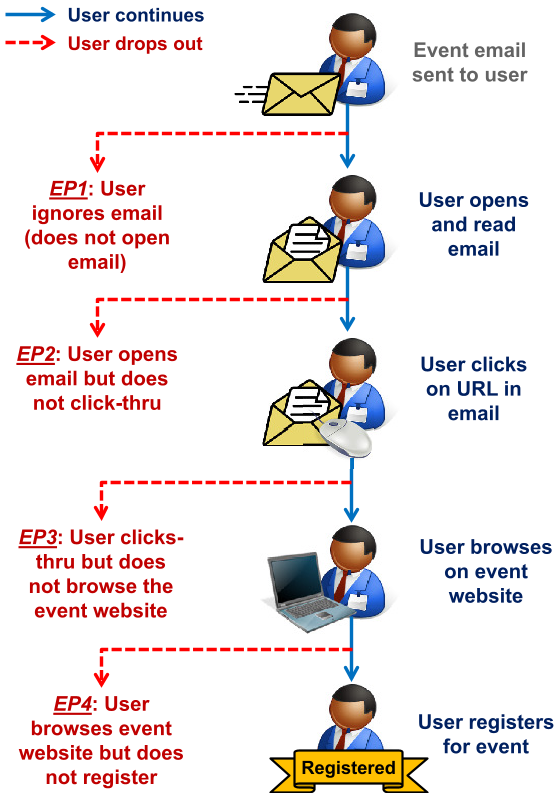 Figure 1: The four Exit Points (EP) where users typically drop off in a campaign.
Key Findings: Hierarchy Trumps Expertise
The experiment involved 730 users divided into three groups. The results were stark:
1. The Opening Gambit (EP1)
Emails from the Department Head (TGroup1) had a 39.9% open rate, significantly higher than the General Account's 26.3%. Interestingly, while people were more likely to open the boss's email, they didn't necessarily open it faster. The authors attribute this to fixed "mailbox checking routines"—people check their mail at set times, but prioritize what they open based on the sender.
2. The Speed of Action (EP2)
This is where the Authority Effect shines. Users receiving emails from both the Superior and the Domain Expert clicked through to the website significantly faster than those receiving generic mail.
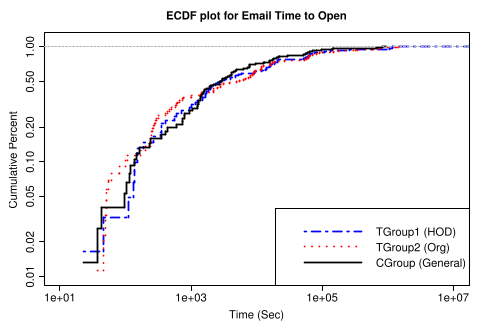 Figure 2: ECDF plots showing that authority figures (TGroup1 & 2) drive faster click-through times compared to the Control group.
3. The Final Conversion (EP4)
When it came to actually signing up for the event, the "Superior" authority was the clear winner.
- Superior Group: 3.9% Registration
- Expert Group: 2.1% Registration
- Control Group: 0.3% Registration
The Superior authority achieved an 11-fold increase in registration compared to the control. While the Domain Expert was better than nothing, the statistical evidence was strongest for the hierarchical superior.
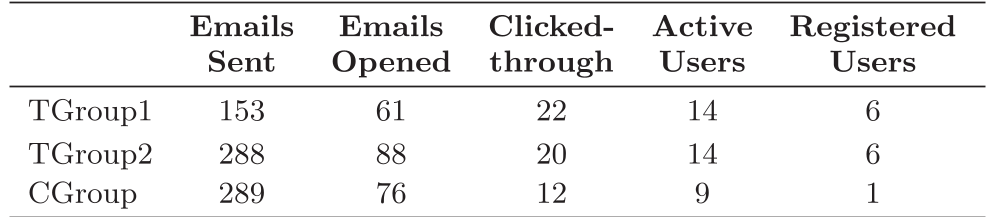 Table 1: Summary of the conversion funnel performance across the three groups.
Critical Insight: Why Does This Work?
The study demonstrates that Superior Authority exerts a form of social pressure or "implicit obligation." When a department head suggests an event might be "interesting," it is often perceived as a recommendation that carries weight for professional development or departmental alignment.
On the other hand, the Domain Expert provides "Informational Influence." People trust their judgment (hence the faster clicks), but they don't feel the same "normative" pressure to complete the registration.
Conclusion & Limitations
This work provides a blueprint for "Authority Marketing" within organizations. However, there is a risk of "Authority Fatigue"—if a superior sends too many marketing-style emails, their perceived authority and the associated "compliance" effect may diminish over time.
For future campaigns, the takeaway is clear: don't just send from info@company.com. If you want results, the recommendation should come from someone the audience respects—or someone they report to.