
Modeling the Commercial Effect: How Crowdsourcing Quantifies Consumption Behavior
An Online Crowdsourcing Experiment to Model the Effects of a Commercial on a User's Consumption Behavior
This paper presents a Multimedia Exposure Model (MMEM) designed to measure the impact of commercials on consumer behavior using an online crowdsourcing experiment. By integrating engagement, reactance, and marketing metrics, the study validates a 65-item instrument through a large-scale data collection effort (N=360) on the Clickworker platform.
TL;DR
How much does that 30-second YouTube ad actually change your mind? While the industry spends billions, quantitatively measuring "Multimedia Exposure" remains an elusive science. This paper introduces a robust, crowdsourced-validated instrument that measures the tug-of-war between Engagement and Psychological Reactance to predict buying intentions, proving that remote crowdsourcing can be as reliable as a controlled lab.
The "Black Box" of Media Exposure
The advertising world treats media exposure as its primary currency, yet we lack a standardized "meter" to measure it. Previous research has been fragmented—some focus on memory recall, others on social media "multiscreening." The authors argue that exposure isn't just about seeing an ad; it's about the psychological state it leaves you in.
The core challenge? Reactance. High-pressure ads often cause a "threat to personal freedom," leading consumers to subconsciously reject the product. To solve this, the researchers needed to observe users in a "natural" yet controlled digital environment.
Methodology: The 65-Question Instrument
The researchers built a comprehensive measurement tool by operationalizing four psychological dimensions:
- User Engagement: Derived from the UES scale to see if the user was "absorbed."
- Reactance: Measuring frustration or anger toward the commercial.
- Marketing & Memory: Tracking the customer decision-making process from problem recognition to decision.
- Psychometric Checks: Using "Gold Standard" data—a pink number flashing on the screen—to catch bots or distracted participants.
Experimental Setup
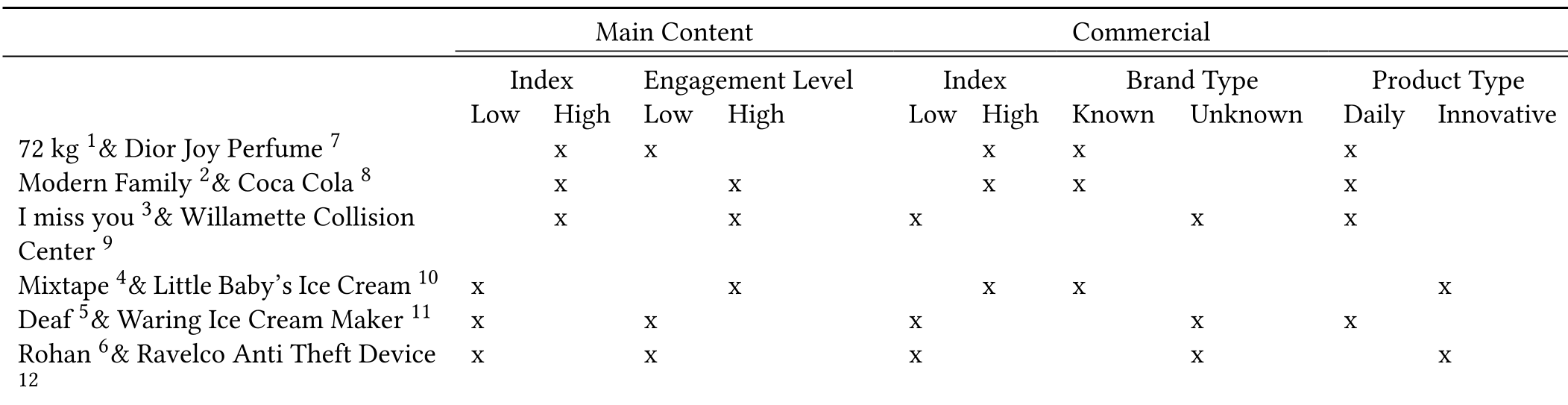
The study used a 4x8 factorial design, pairing different short films with diverse commercials (Known vs. Unknown brands, Daily vs. Innovative products).
Insights from the Crowd
By deploying the study on Clickworker, the authors gathered data from 360 young adults (ages 18-24). The data revealed fascinating behavioral patterns:
- Peak Attention: Participation spiked at 1:00 PM (lunch break) and dropped significantly at 9:00 PM.
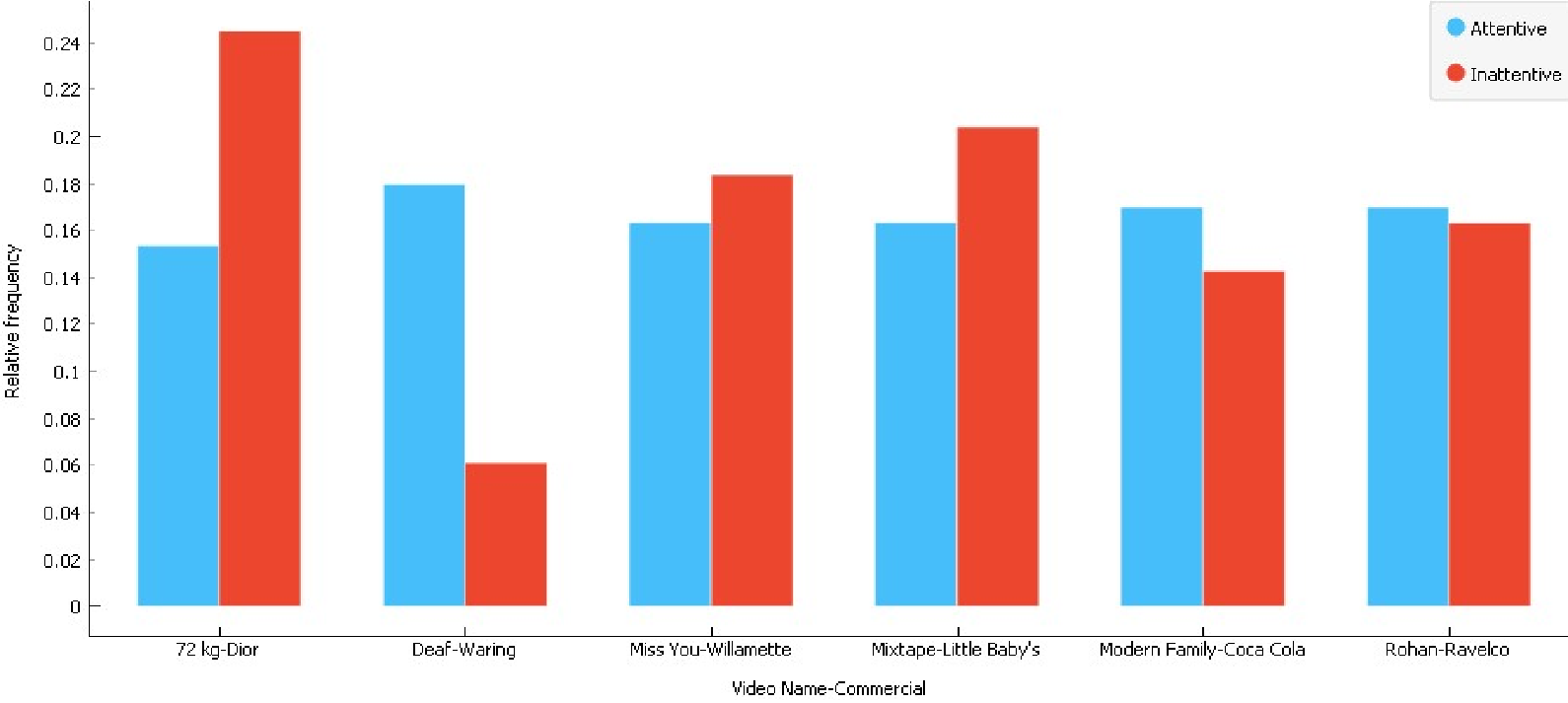
- The "Familiarity" Trap: Users were most inattentive during a Dior perfume ad (a hyper-known brand) but highly attentive to a "Waring Ice Cream Maker" ad (an unknown brand), suggesting that "creative fatigue" is a real metric in exposure.
- Gender & Age: Females showed a 3% higher attentiveness rate than males in recalling the control number.
Is Crowdsourcing "Scientific" Enough?
The results confirm a resounding Yes. Using Cronbach’s alpha () and McDonald’s omega (), the authors proved that the data collected remotely was stable and reliable. This validates the "instrument" as a legitimate way to build a Multimedia Exposure Model (MMEM) without the prohibitive costs of laboratory settings.
Critical Analysis & Takeaways
- Value: This paper provides a blueprint for how brands can test commercial effectiveness with high psychometric precision before launching massive campaigns.
- Limitations: The study focuses on a narrow demographic (18-24, USA). While this reduces "noise" in the data, it leaves room for future work to see if older demographics exhibit higher levels of reactance to digital ads.
- Future Work: The logical next step is to apply this MMEM to longitudinal studies—measuring how exposure builds up over weeks rather than a single five-minute session.
Conclusion: Measuring the "why" behind the "buy" is no longer a guessing game. By combining psychological theory with the scalability of crowdsourcing, we can finally begin to quantify the invisible impact of the advertisements that saturate our digital lives.