
Online Crowdsourced IQA: Scaling Subjective Ranking with Online HodgeRank
Online crowdsourcing subjective image quality assessment
The paper introduces an online rating framework for subjective Image Quality Assessment (IQA) leveraging HodgeRank on random graphs. By employing a Robbins-Monro stochastic approximation procedure, the method processes sequential paired comparison data from crowdsourcing to derive global quality scores while monitoring ranking inconsistencies in real-time.
TL;DR
Subjective Image Quality Assessment (IQA) is moving away from rigid, complete laboratory tests toward "in-the-wild" crowdsourcing. This paper introduces an Online HodgeRank framework that treats quality assessment as a streaming data problem. By using stochastic approximation (Robbins-Monro), the system updates quality scores in real-time as users submit paired comparisons, achieving speeds up to 370x faster than batch processing without sacrificing accuracy.
The Scalability Bottleneck in Subjective Testing
Subjective tests are the "Gold Standard" for image quality, yet they are notoriously hard to scale. Traditional Mean Opinion Scores (MOS) are prone to user bias (some users always rate higher than others), and Paired Comparisons—while more reliable—suffer from complexity.
The authors identify a critical gap: while previous work introduced HodgeRank on Random Graphs (HRRG) to handle incomplete and imbalanced data, these methods were designed for batch processing. In a modern crowdsourcing environment (like Amazon Mechanical Turk), data arrives as a stream. Waiting for a full batch to recalculate scores is computationally wasteful and prevents real-time monitoring of data quality.
Methodology: From Batches to Streams
The core innovation lies in converting the HodgeRank least-squares problem into a sequential decision process.
1. The HodgeRank Intuition
HodgeRank treats paired comparison data as a "flow" on a graph. Just as a physical fluid flow can be decomposed into a gradient (potential flow) and a curl (vortex), user preferences can be decomposed into:
- Global Rating (Gradient): The consistent, linear ranking of images.
- Inconsistency (Curl): Circular preferences (e.g., Image A > B, B > C, but C > A) which signal noise or multi-criteria decision-making.
2. Stochastic Approximation (Robbins-Monro)
Instead of solving the massive graph Laplacian at once, the authors use a stochastic gradient descent approach. When a new comparison between images and arrives, the scores are updated locally:
 Figure 1: Conceptual overview of online data collection and ranking.
Visualizing Consistency: Persistent Homology
To ensure the ranking is valid, the graph must be connected and preferably loop-free (in terms of homology). The authors utilize Persistent Homology—a topological tool—to track the "birth" and "death" of connected components () and loops () as samples arrive.
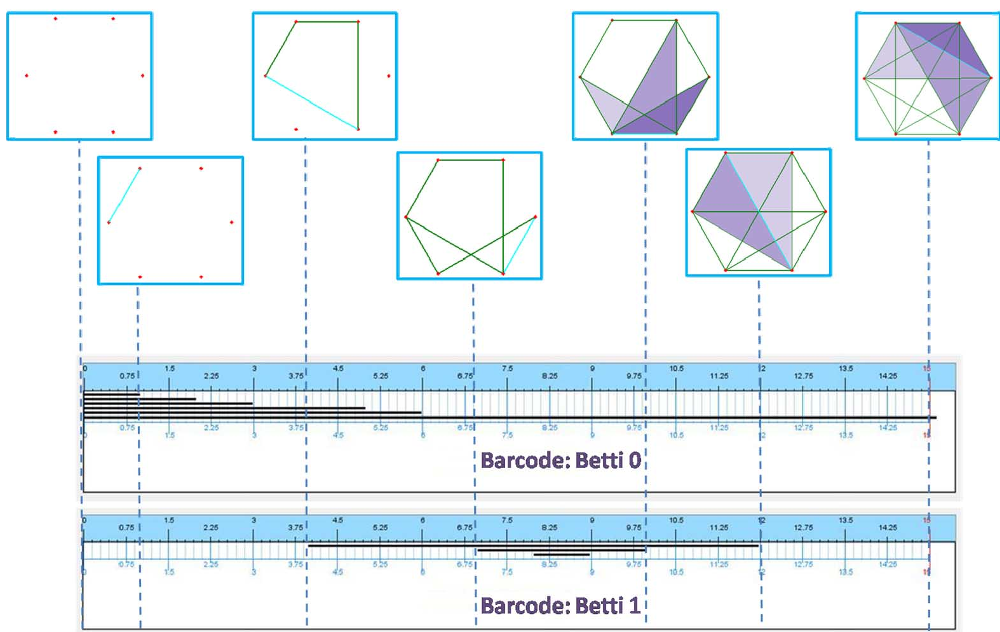 Figure 2: Persistence Barcodes showing the stabilization of graph topology as the number of samples increases.
Experimental Validation
Using the LIVE and IVC databases, the authors gathered 23,097 paired comparisons from 186 observers.
Key Findings:
- Convergence: The online algorithm converges to the batch solution at an optimal rate of .
- Robustness: An variation was tested to handle outliers, though performed sufficiently well for most IQA tasks.
- Efficiency: The online approach is significantly more efficient. As shown in the table below, the computation time is a fraction of the batch equivalent.
 Table 1: Computational complexity and accuracy comparison. Mean time for the online approach is near 0.14s compared to ~53s for batch.
Deep Insight: Local vs. Global Inconsistency
One of the most fascinating aspects of this work is the Online Tracking of Curls. The authors discovered "intransitive triangles" (A > B > C > A) that persist even with more data. For example, a JPEG2000 image might be preferred over a Fast Fading image, which is preferred over White Noise, yet the White Noise image is preferred back over the JPEG2000 one.
This suggests that human perception is not a single linear scale—observers may use different criteria (sharpness vs. color fidelity) depending on the specific pair. The online algorithm allows researchers to flag these "trouble spots" in the dataset instantly.
Conclusion & Future Work
The proposed Online HodgeRank framework effectively bridges the gap between statistical rigor and the practical needs of web-scale crowdsourcing. Its ability to monitor topological stability and preference consistency in real-time makes it a superior choice for modern multimedia evaluation. Future research may explore Active Sampling, where the system identifies which image pair would most reduce uncertainty, further accelerating the assessment process.