
OnlineDRR: High-Efficiency Route Recommendation for Spatial Crowdsourcing
Online delivery route recommendation in spatial crowdsourcing
The paper introduces the Online Delivery Route Recommendation (OnlineDRR) problem in spatial crowdsourcing, aiming to maximize an individual worker's income through delivery-type tasks. It proposes the Extended Prediction Based Route Recommendation (EPBR) algorithm, which outperforms baselines on both synthetic and real-world NYC taxi datasets.
TL;DR
Spatial crowdsourcing has evolved from simple "visit" tasks to complex delivery services like Uber or Meituan. This paper tackles the Online Delivery Route Recommendation (OnlineDRR) problem—how to maximize a single worker's income when tasks appear dynamically. The solution? An algorithm that balances current rewards with the "future potential" of a destination, ensuring workers don't just work hard, but work smart.
Problem & Motivation: The Greedy Trap
In spatial crowdsourcing, many workers follow a simple intuition: pick the closest task (Greedy) or pick the highest-paying task (Longest Order First). However, the authors argue that these strategies are fundamentally flawed in an online environment:
- Spatial Dead Ends: A high-paying task might drop a worker in a "desert" area with no subsequent tasks.
- Temporal Blindness: As a worker's shift nears its end, taking a far-flung task might prevent them from reaching their own destination on time.
- Online Uncertainty: Since future tasks are unknown, there is no deterministic algorithm with a constant competitive ratio (as proven in Section 2.2).
Methodology: Beyond the Immediate Reward
The core of the paper is the Extended Prediction Based Route Recommendation (EPBR). Unlike simple heuristics, EPBR uses a scoring function that fuses three critical dimensions:
- Distance to Task (): Minimizing "deadheading" (unpaid travel).
- Task Reward (): Directly proportional to the task's delivery distance.
- Future Demand (UOTD): Predicting the density of task origins at the current task's destination ().

The Extended version (EPBR) adds a vital temporal constraint: an exponential "pull" towards the worker’s own destination (). As the deadline () approaches, the algorithm prioritizes tasks that align with the worker's route home, preventing late-shift income loss.
Experimental Results: Proving the Advantage
The authors tested their algorithms against a massive dataset of NYC taxi trips.
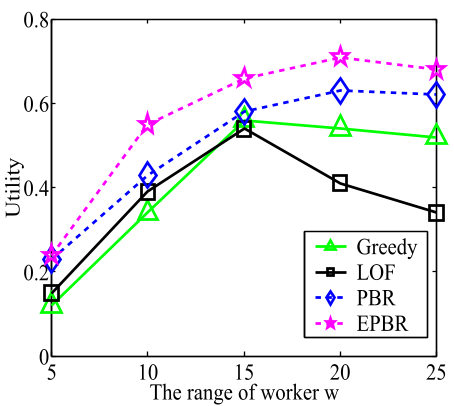
Key Findings:
- Utility Dominance: EPBR consistently outperformed Greedy and LOF baselines. While LOF often suffered from high no-load distances, EPBR successfully navigated the trade-off between reward and future availability.
- Scalability: Even with thousands of tasks (), the algorithm's running time remains efficient enough for real-time mobile platform deployment.
- Robustness: In real-world NYC data, EPBR’s ability to "predict" demand at destinations proved to be the decisive factor in high-density urban environments.
Critical Analysis & Conclusion
This work represents a significant step in worker-centric optimization. By treating the worker's route as a dynamic orienteering problem with a "future value" component, it bridges the gap between simple greedy algorithms and complex offline optimizations.
Limitations: The model assumes reward is strictly proportional to distance, which may not hold for surge pricing or complex commission structures. Furthermore, the "UOTD" prediction relies on historical demand patterns which might be disrupted by unexpected events (weather, accidents).
Future Outlook: Integrating Graph Neural Networks (GNNs) to better capture the spatial-temporal dependencies of UOTD could further refine the recommendation accuracy.