
OSS: Unveiling the Culprits of Viral Misinformation in Real-Time
Online diffusion source detection in social networks
This paper introduces the problem of Online Diffusion Source Detection in social networks, proposing a real-time framework to identify rumor or virus sources. The authors develop a non-convex -regularized regression model optimized via a novel Online Stochastic Sub-gradient (OSS) algorithm, achieving high accuracy in source localization on both synthetic and real-world datasets like Facebook and Twitter.
TL;DR
Information in social networks spreads like wildfire, but finding the "spark" usually happens after the forest is gone. This paper shifts the paradigm from offline snapshots to online tracking. By treating source detection as a real-time sparse regression problem and introducing the Online Stochastic Sub-gradient (OSS) algorithm, the authors enable the detection of diffusion sources (rumors, viruses) the moment information hits the first few monitors.
Background: Beyond the Static Snapshot
Most existing research assumes we can simply "pause" a network, look at who is infected, and work backward. In the real world, social networks are massive and dynamic. Waiting to collect a full dataset means missing the window for intervention. The challenge is threefold:
- The number of sources () is unknown.
- We don't know exactly when the diffusion started ().
- Most nodes (detectors) remain inactivated for a long time, providing "negative" but crucial evidence.
Methodology: The Logic of Relative Arrival
The core innovation lies in how the authors handle the unknown start time . By using Relative Time Difference of Arrivals (RTDA), they pick an "anchor" detector and measure the arrival times of others relative to it. This cancels out the unknown from the equations.
The Mathematical Intuition
The problem is framed as an -regularized regression:
- Term 1 (The Convex Part): Minimizes the error between observed arrival times at activated detectors and the estimated propagation time.
- Term 2 (The Concave Part): Ensures that the source choice doesn't imply that uninfected (inactivated) detectors should have been infected already.
- Term 3 ( Norm): Enforces sparsity, reflecting the reality that only a few nodes are the true sources among millions.
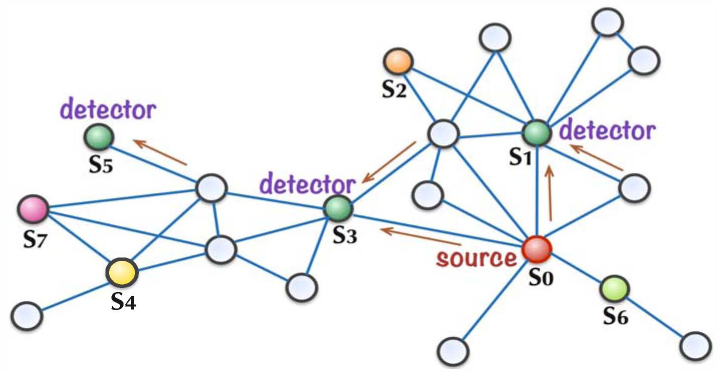 Fig 1. A typical network setup where a source starts a cascade, monitored by a subset of detectors.
The OSS Algorithm
Since the objective function is non-convex (due to the term involving inactivated detectors), the authors use a Non-convex to Convex Approximation. At each step , they linearly approximate the concave part based on the previous iteration's result. This allows the system to update the estimated source location continuously as new detectors get "hit" by the information wave.
Experiments and Real-World Validation
The authors didn't just stop at simulations. They crawled Sina Weibo to verify the physical intuition of their model.
Key Findings:
- Shortest Path Validity: 77.6% of tweets follow the shortest topological path, justifying the calculation of the and matrices using BFS.
- Gaussian Delay: Propagation time delay roughly follows a Gaussian distribution, supporting the use of mean-variance aggregation under the Central Limit Theorem.
- Accuracy: As shown in the parameter studies, the "error distance" (measured in hops from the true source) drops sharply as more detectors are added or as the monitoring window expands.
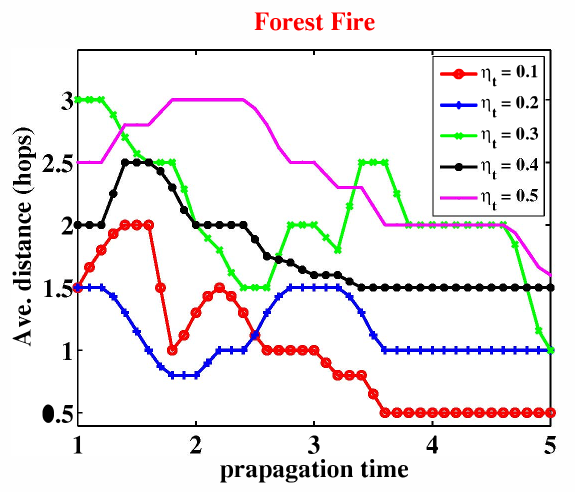 Fig 2. Impact of various parameters (sources , detectors , window ) on the detection error.
Critical Insight: Why This Works
The brilliance of this work is the treatment of inactivated detectors. Most models focus only on who is infected. By penalizing source candidates that should have infected inactivated detectors given the elapsed time, the search space is pruned far more effectively than looking at infected nodes alone.
Conclusion & Future Look
The OSS algorithm provides a robust framework for real-time social network security. While the shortest-path assumption holds for most viral content, future work could integrate more complex "independent cascade" or "linear threshold" models into the online regression framework to handle more nuanced human sharing behaviors.
Takeaway for Practitioners
If you're building a rumor-stopping system, don't just look at the rumor itself—look at the nodes that haven't heard it yet. Their "silence" is just as informative as the "noise" for pinpointing the source.