
Beyond the Like Button: Decoding Political Parties through Network Topology
18059_Online election campaigning Identifying political parties using likes and comments.
This paper presents a complex network approach to identify political party structures from social media interactions during the 2013 Australian and Malaysian elections. By applying "backbone extraction" to bipartite networks of Facebook likes and comments, the authors filter out statistically insignificant noise to reveal hidden partisan clusters without relying on text-based sentiment analysis.
TL;DR
Researchers have found that political affiliations are "well-hidden" within the noise of social media interactions. By treating Facebook likes and comments as a bipartite network and applying backbone extraction, this study shows we can perfectly reconstruct the political party landscape of two different nations without reading a single word of the users' posts. This topological approach proves that who you interact with matters more than how much you interact.
The "Like" Economy and the Noise Problem
In contemporary politics, social media is the primary battleground. However, academic analysis often stays at the surface level, counting "Likes" as a proxy for support. The authors of this paper argue that this is fundamentally flawed. A "Like" can be many things: support, irony, or even a form of protest.
When you map every interaction between users and politicians, the resulting network is a "hairball"—a dense, uninformative mess where candidates from opposing parties seem closely linked because of "drive-by" likers or trolls. The central challenge was: How do we separate meaningful political signals from statistical noise?
Methodology: Extracting the Backbone
The core innovation lies in moving away from Sentiment Analysis (which is computationally heavy and language-dependent) toward Topological Analysis.
1. Bipartite Projection
The researchers first modeled the data as a bipartite network (Users Candidates). They then projected this onto a "Candidate Mode," where two candidates are connected if they share common users who liked or commented on both their pages.
2. Statistical Filtering (Backbone Extraction)
Simply sharing a user isn't enough. The authors used a threshold—typically the Mean + 3 Standard Deviations—based on a Poisson binomial distribution. If the number of shared users between Candidate A and Candidate B is significantly higher than what you'd expect by chance, that edge is part of the "backbone."
 Figure 1: Illustration of a bipartite network and its projection onto the set of candidates.
Case Study: Australia vs. Malaysia
The study applied this to the 2013 Australian Federal Election and the 2013 Malaysian General Election.
- Australia (AFE13): The raw projection was a dense cloud. After extracting the backbone, distinct clusters emerged representing the Liberal-National Coalition, Labor, and the Greens. Interestingly, when the threshold was raised (to 15 SDs), the network even revealed intra-party hierarchies, isolating high-profile leaders like Tony Abbott from the rank-and-file.
- Malaysia (MGE13): The model correctly grouped the "National Front" and the opposition. It proved its predictive power by highlighting Saifuddin Abdullah, a candidate whose interactions spanned both sides of the aisle. Remarkably, he left his party for the opposition coalition two years after this data was collected.
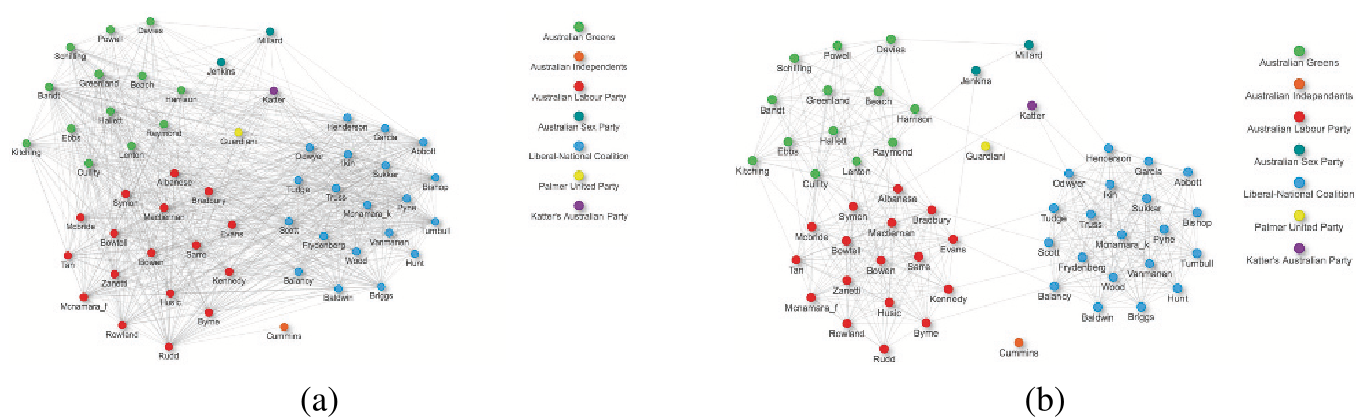 Figure 2: The transformation of the Australian candidate network from a noisy projection (left) to a clean party-based backbone (right).
Insights: Likes vs. Comments
One of the paper’s most intriguing findings is the difference between Likes and Comments.
- Likes are "cleaner" signals for party identification. Most people only "significantly" like candidates they support.
- Comments are "noisier." Because people comment to argue, the backbone of the comment network often connects bitter rivals (e.g., Bradbury and Scott in Australia) who contested the same seat. This creates a "bridge" of negativity between opposing party clusters.
Critical Insight & Conclusion
This work demonstrates the power of Structural Inductive Bias. By assuming that political affiliation drives recurring and statistically significant patterns of behavior, the authors bypassed the need for Natural Language Processing (NLP).
Takeaway: If you want to understand the true structure of a political system, don't look at the volume of the noise—look at the strength of the hidden connections. The "Backbone" method is a fast, efficient, and objective way to map the political landscape, and it holds significant potential for identifying "swing" actors or emerging schisms within parties before they manifest in official policy.