
Beyond Bullish vs. Bearish: How Multi-Dimensional Weibo Emotions Forecast the Chinese Stock Market
Can Online Emotions Predict the Stock Market in China?
The paper introduces a stock market prediction framework for China based on five distinct online emotions (anger, disgust, joy, sadness, and fear) extracted from over 10 million Weibo tweets. Using Granger causality tests and SVM-based classification (SVM-ES), the authors achieve significant predictive accuracy, reaching up to 64.15% for intra-day price fluctuations and over 60% for trading volume.
TL;DR
Researchers from Beihang University have demonstrated that the Chinese stock market (SSE Composite Index) can be predicted with surprising accuracy by monitoring five specific online emotions on Weibo. By analyzing 10 million tweets, they built a model called SVM-ES that achieves over 64% accuracy in predicting price fluctuations, proving that "Disgust" and "Joy" often precede market movements.
Background: Why China is Different
In Western markets, institutional investors dominate. In China, however, the landscape is heavily influenced by a massive number of individual (retail) investors. These investors are often more susceptible to emotional contagion and social media rumors. Furthermore, government policy interventions create "non-market factors" that are often discussed on platforms like Weibo long before they reflect in the trading data. This paper moves beyond the simple "positive/negative" sentiment analysis to see which specific human emotions act as triggers for financial decisions.
Methodology: Mapping the Emotional Landscape
The authors collected a massive dataset of 10.5 million stock-relevant tweets over a year. Using a specialized classifier called MoodLens, they broke sentiment down into five categories: Anger, Disgust, Joy, Sadness, and Fear.
The Prediction Workflow
- Filtering: Using keywords like "Shanghai Composite Index" to ensure the tweets were relevant.
- Causality Testing: Applying the Granger Causality Test to see which emotions actually "lead" the market. For instance, "Disgust" was found to be a causal factor for the Closing Index.
- Discretization: Instead of predicting exact prices (which is notoriously difficult), the authors used K-means clustering to categorize market movements into "Bearish," "Stable," and "Bullish" states.
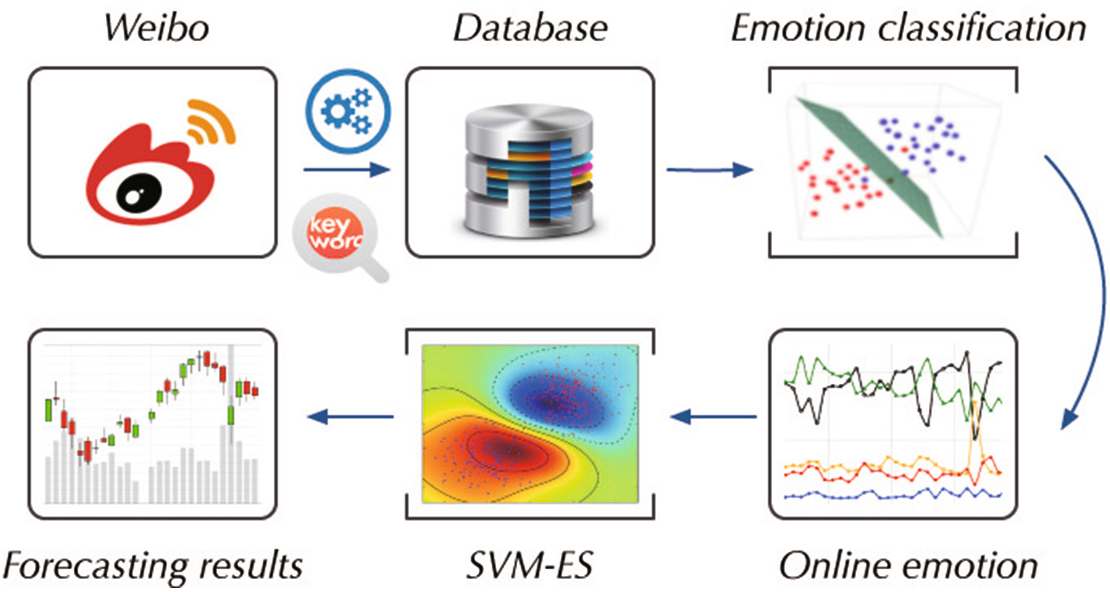 Fig 1: The framework for the realistic application of the SVM-ES model.
Key Findings: The Power of "Disgust" and the Silence of "Anger"
One of the most striking insights is the role of specific emotions:
- The Surprise of Anger: Despite being a high-arousal emotion, Anger had almost zero correlation with market attributes. Angry investors might vent online, but they don't necessarily change their trading patterns based on that specific feeling.
- The Predictive Power of Disgust: This emotion was a strong leading indicator for the Closing Index.
- Sadness and Volume: There was an unexpectedly high correlation (ρ > 0.5) between Sadness and trading volume, suggesting that market "apathy" or "despair" closely tracks how many shares change hands.
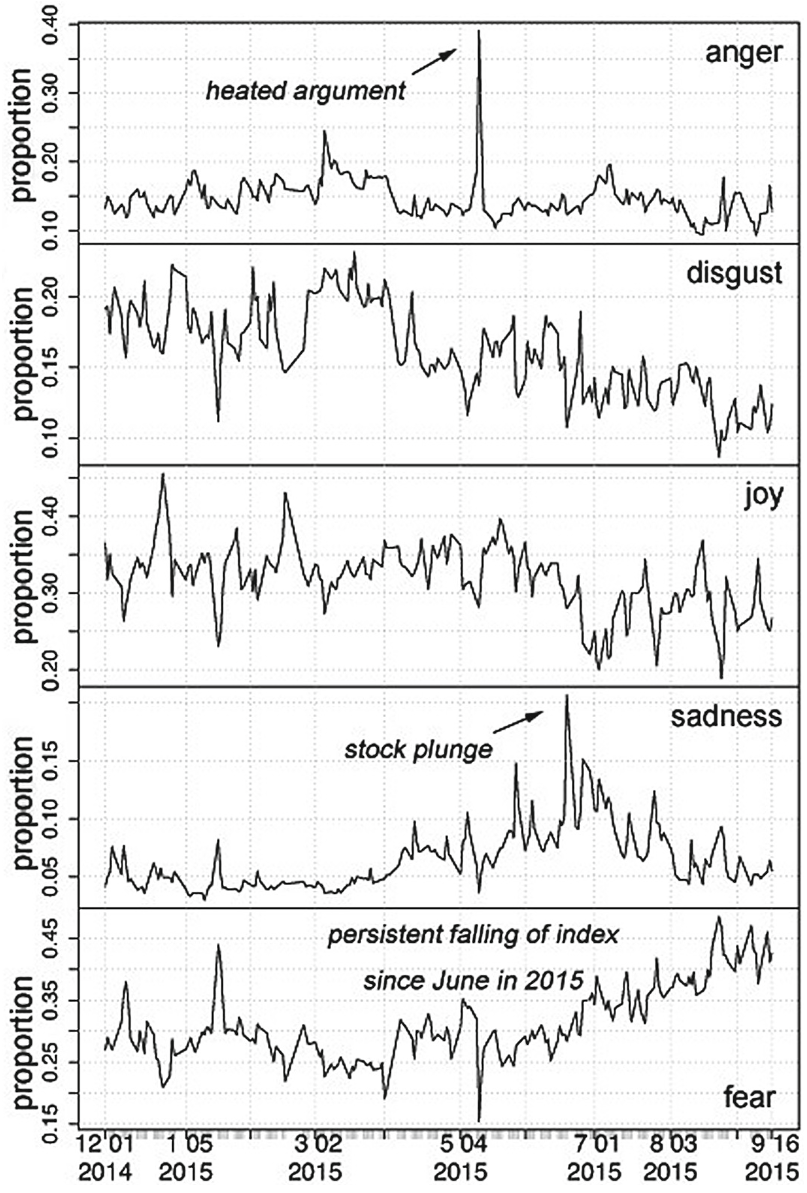 Fig 2: Time series of online emotions. Note the spike in Sadness during the June 2015 market plunge.
Experimental Performance
The authors compared Logistic Regression (LR) against Support Vector Machines (SVM). The non-linear SVM performed significantly better, suggesting that the relationship between how people feel on Weibo and how they trade is complex and non-linear.
| Target Attribute | SVM Accuracy (K-means) | SVM-ES (Feature Selected) |
|---|---|---|
| OPEN Index | 61.3% | 64.4% |
| LOW Index | 63.4% | 64.4% |
| VOLUME | 67.0% | 66.5% |
In a real-world evaluation (Table 3 in the paper), the model maintained a high accuracy of 64.15% for the Intra-day Highest index, proving that these emotional signals don't just exist in retrospect—they can be used for live forecasting.
Critical Insight & Conclusion
While previous studies (like Bollen et al. on Twitter) focused on broad "Calmness," this work proves that in the Chinese context, Disgust, Joy, Sadness, and Fear are the primary emotional drivers of the market. The success of the SVM-ES model highlights that Feature Selection (choosing the right emotion for the right market attribute) is more important than simply throwing all available data into a neural network.
Takeaway for the Future: As AI moves toward more sophisticated "Opinion Mining," the integration of these high-granularity emotional vectors into algorithmic trading could provide a significant edge in retail-heavy markets.