
OnBMF: Scaling Event Recommendations for the Streaming Era of Social Networks
Online Event Recommendation for Event-based Social Networks
This paper introduces OnBMF (Online Bayesian Matrix Factorization), an online learning framework for event recommendation in Event-Based Social Networks (EBSNs). It adapts the Bayesian Personalized Ranking (BPR) objective into a mini-batch online optimization process to handle sequentially arriving streaming data.
TL;DR
As Event-Based Social Networks (EBSNs) like Meetup grow, the challenge shifts from what to recommend to how to recommend it in real-time. This paper introduces OnBMF, an online learning framework that replaces slow batch processing with an efficient mini-batch update mechanism. By combining Bayesian Personalized Ranking (BPR) with Passive-Aggressive learning, the model handles implicit feedback while remaining scalable as new data streams in.
Motivation: The Problem with Batching
In the real world, social networks never sleep. New users join by the hour, and events are posted every minute. Traditional recommendation algorithms are "Batch-Learners"—they require the entire dataset to be re-processed to account for new interactions. This is not just slow; it’s a bottleneck for growth.
Existing online filters often fail in EBSN contexts because:
- Implicit Feedback: Users rarely "rate" events; they simply attend or don't. This binary 0/1 data is noisy.
- Noise in Streaming: Updating a model point-by-point can cause the parameters to fluctuate wildly (high variance).
Methodology: The OnBMF Framework
The authors propose OnBMF (Online Bayesian Matrix Factorization). The architecture is split into two distinct phases:
Phase 1: The Basis Model
The model starts with a standard Matrix Factorization (MF) pre-trained on historical data using the BPR objective. BPR focuses on ranking—ensuring that an event a user participated in is ranked higher than one they didn't.
Phase 2: The Online Update (Passive-Aggressive)
The core innovation lies in the online update rule. When a new batch of data arrives, the model solves an optimization problem that balances two needs:
- Stability: Stay close to the current parameters .
- Accuracy: Improve the posterior probability based on the new data.

This is implemented using Mini-Batches. Instead of updating after every single click, it processes small groups of interactions, which acts as a natural "denoiser" and stabilizes the learning curve.
Experimental Results
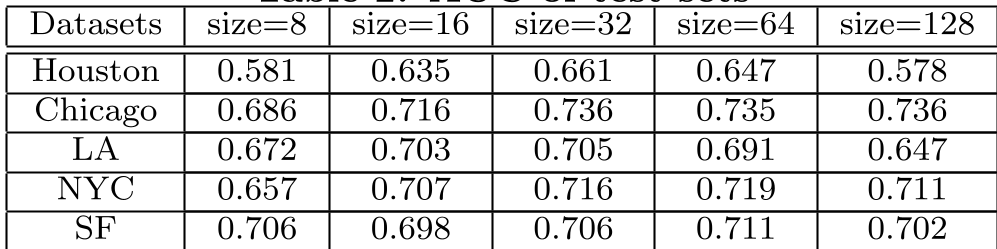
The researchers tested OnBMF against five datasets from Meetup (Houston, Chicago, NYC, LA, and SF).
The Mini-Batch Sweet Spot
The study found that the size of the mini-batch significantly impacts accuracy. A batch size of 16-32 consistently yielded the highest AUC (Area Under the Curve), proving that seeing "a little bit" of context is better than seeing "just one" or "too many" data points at once.
SOTA Comparison
When compared to Online Collaborative Filtering (OCF) and Online Max-Margin Matrix Factorization (OM3F), OnBMF was the clear winner. In some cases, like the Houston dataset, it outperformed the OCF baseline by over 11% in AUC.

Critical Analysis & Conclusion
OnBMF successfully bridges the gap between the high-accuracy ranking of BPR and the operational necessity of online updates.
Strengths:
- High efficiency and scalability for real-time systems.
- Robustness against the noise typically found in implicit feedback.
Limitations:
- The model treats all events as equally weighted, ignoring temporal decay (older events should arguably have less influence on current preferences).
- It relies on a "Basis Model" initialization; if the initial training data is biased, the online updates might struggle to correct that bias quickly.
Future Outlook: The transition from batch to online learning is inevitable for production-grade AI. OnBMF provides a solid mathematical foundation for this transition in social recommendation, suggesting that the future of EBSNs lies in reactive, streaming architectures.