
The Geography of Fear: Why Wealthier Regions in Italy Expressed More Pessimism During COVID-19
Online feelings and sentiments across Italy during pandemic: investigating the influence of socio-economic and epidemiological variables
2020-12-07
Summary
Problem
Method
Results
Takeaways
Abstract
The paper investigates the socio-economic and epidemiological determinants of online sentiment in Italy during the COVID-19 pandemic using over 1.7 million geo-localized tweets. By employing panel and cross-section regression models at both municipality and province levels, the study identifies a significant correlation between local virus severity and pessimistic online discourse.
## TL;DR
By analyzing nearly 2 million tweets, researchers at Politecnico di Milano discovered that online sentiment during Italy's pandemic was highly polarized. While high mortality predictably fueled negativity, a surprising trend emerged: the wealthiest provinces, despite having better healthcare, were significantly more pessimistic than their less affluent counterparts, revealing a complex interplay between health anxiety and the fear of economic collapse.
## Background: More Than Just a Health Crisis
The COVID-19 pandemic was not just a biological event; it was a socio-economic earthquake. While early research focused on *what* people were saying, this study shifts the focus to *why* they were saying it. Is online sentiment a pure reflection of the infection rate, or is it filtered through the lens of local wealth, inequality, and social deprivation?
## Methodology: Tracking Emotions at the Local Level
The researchers combined two major data streams:
1. **High-Frequency Social Data**: 1.7 million tweets captured during the first wave (Feb-May 2020), processed via **SentITA**, an Attentional Bidirectional LSTM model specialized for Italian sentiment.
2. **Structural Socio-Economic Data**: Municipality and province-level metrics including average income, fiscal capacity, deprivation indices, and actual epidemiological data (extra mortality, ICU beds).
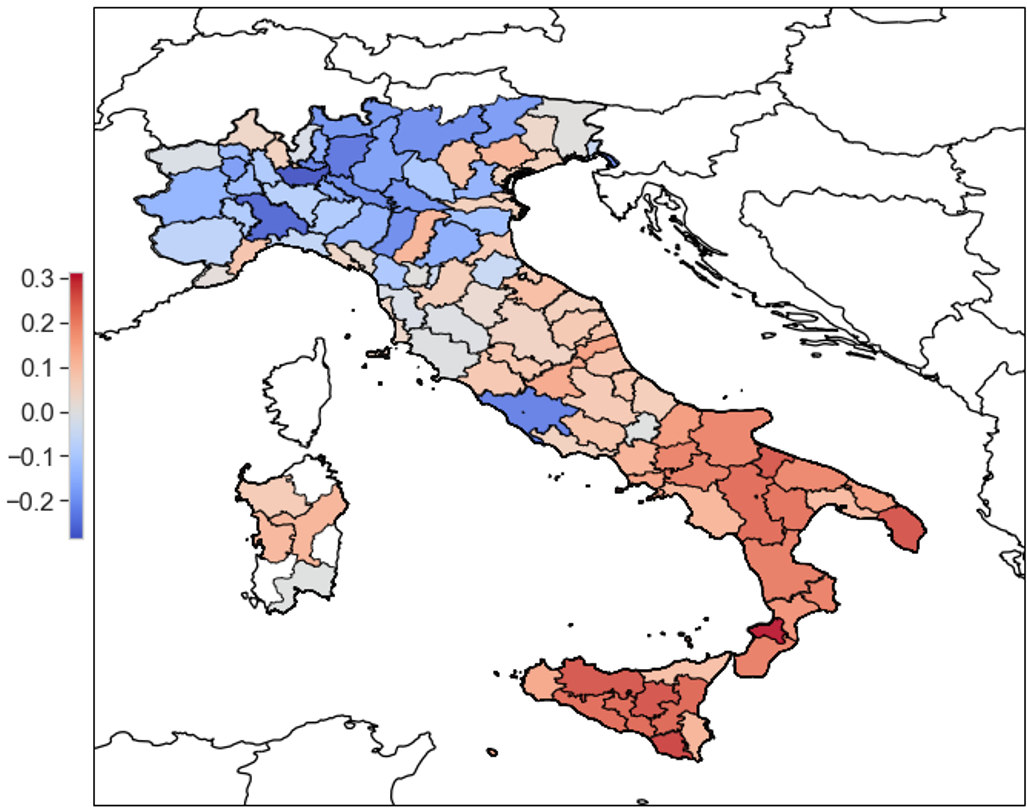
*Figure: The geographical distribution of sentiment exhibits a strong North-South polarization during the pandemic peaks.*
## Core Insights: The "Wealth Vulnerability" Paradox
The regression analysis (using GMM and Fixed Effects to ensure statistical robustness) yielded several striking findings:
### 1. The Virus as the Primary Driver
Unsurprisingly, the "Extra Mortality Rate" and "% of Infected Individuals" were the strongest predictors of negative sentiment. The data confirms a delayed reaction: mortality rates affected sentiment with a lag, reflecting the time-course of the disease.
### 2. The Pessimism of the Affluent
Perhaps the most significant finding is that **Income per capita was negatively correlated with sentiment**. Residents in wealthier, northern regions (like Lombardia and Piemonte) expressed more negative emotions. This wasn't just because the virus hit there first—the models controlled for infection rates.
* **Hypothesis**: High-income individuals may perceive a greater "relative loss" in quality of life or fear the massive economic backlashes that lockdowns impose on industrial hubs.
### 3. Healthcare Capacity and Perception
Areas with *more* intensive care units (ICUs) actually displayed more pessimistic feelings. This suggests that the mere presence and visible "overburdening" of large hospital systems served as a constant stressor for the local population, heightening the perceived severity of the crisis.
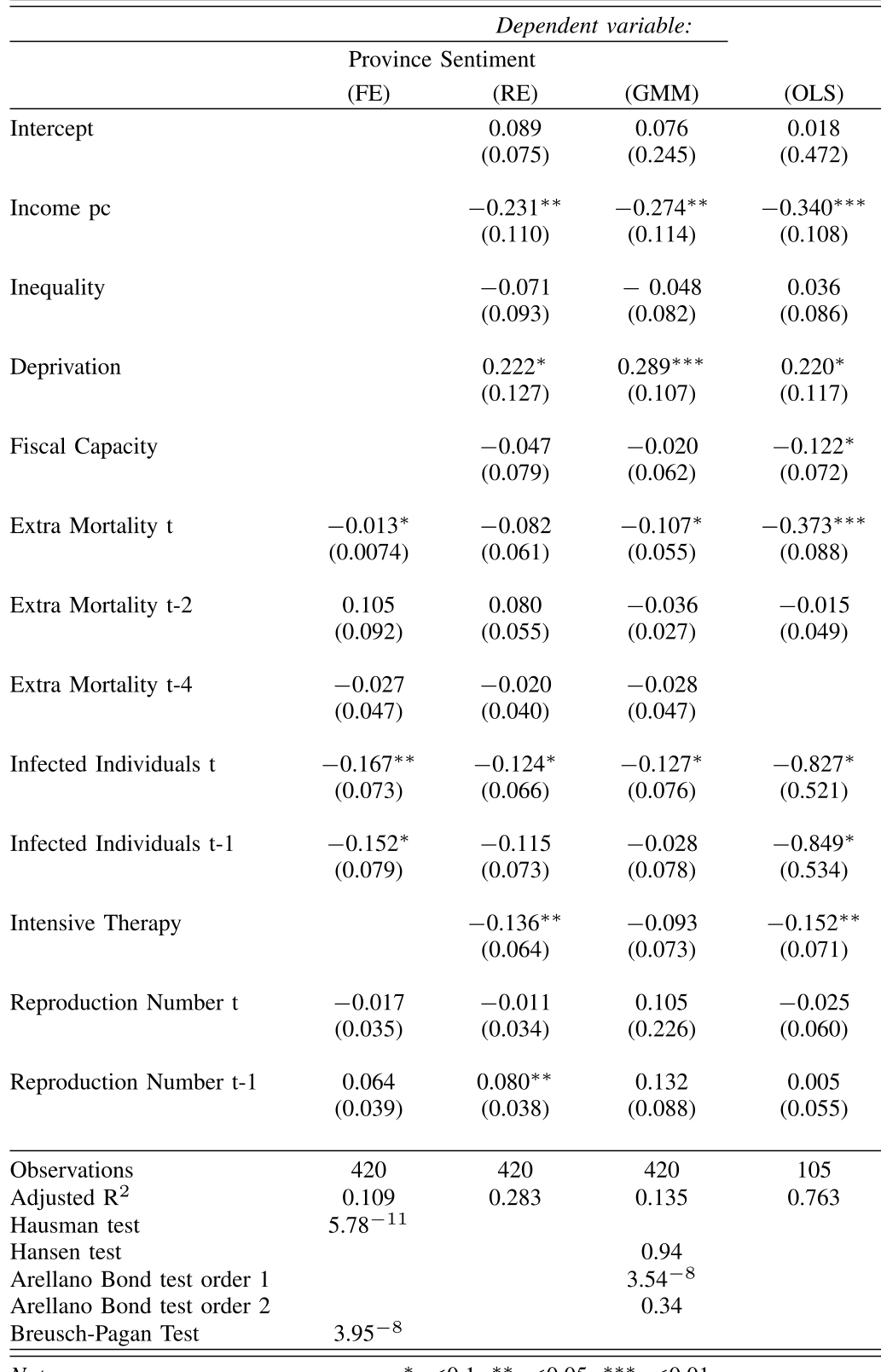
*Table: Regression results show the persistent negative coefficient for Income per capita across different model specifications (RE, GMM, OLS).*
## Why This Matters for the Future
This research highlights that during a crisis, "the public" is not a monolith. Online sentiment is a localized phenomenon.
* **For Policy Makers**: Communication strategies must represent a "tailored" approach. Sentiment in southern Italy was driven by different factors (potentially social resilience or different economic concerns) compared to the north.
* **For Researchers**: This work bridges the gap between digital humanities and traditional econometrics, showing that social media can serve as a "real-time census" of a nation's psychological health.
## Conclusion & Limitations
The study successfully demonstrates that socio-economic variables are just as influential as viral spread in shaping public discourse. However, the study's reliance on Twitter—a platform with specific user demographics—means we must be cautious in generalizing these findings to the entire population. Future work will expand this to multi-country comparisons to see if the "wealth-pessimism" link is a cultural Italian trait or a global pandemic reality.